INTRODUCTION
Imagine trying to hear a whisper from someone standing in Tokyo while you are sitting in New York. Now, imagine that person is moving at 35,000 miles per hour. Now, imagine that whisper has to travel not across a planet, but across the absolute, freezing void of the solar system, passing through screaming solar radiation, atmospheric interference, and millions of miles of empty blackness.
This is the daily, mind-bending reality for space agencies around the world.
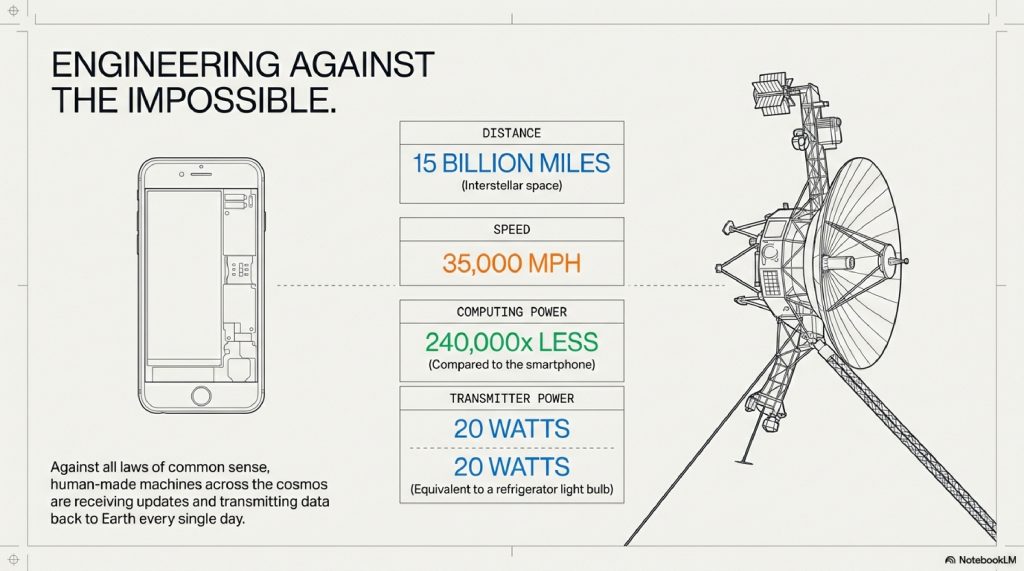
Right now, human-made machines are scattered across the cosmos. We have orbiters circling Jupiter, rovers drilling into the red dust of Mars, and ancient probes like Voyager 1 and 2 that have literally pierced the bubble of our solar system and entered interstellar space over 15 billion miles away.
Yet, against all laws of common sense, we are still talking to them. We send them software updates, tell them where to drive, and receive stunning, high-definition photographs of alien landscapes in return.
How is this possible? There are no fiber-optic cables running from Earth to Mars. There are no cell towers floating in the asteroid belt.
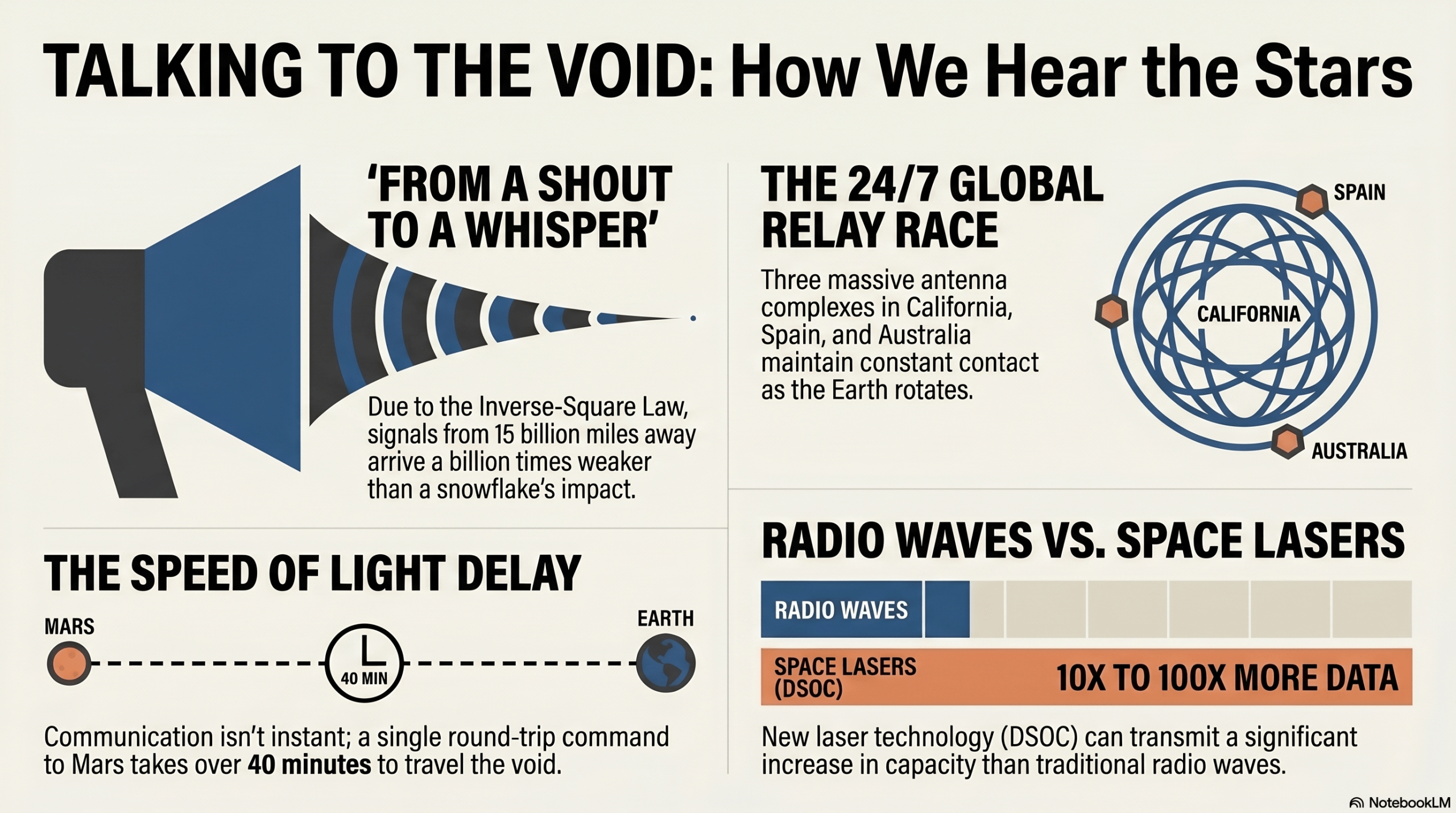
The answer lies in a masterclass of physics, planetary geometry, and some of the largest, most sensitive mechanical ears ever constructed by human hands. It involves catching radio waves so incredibly weak that a single snowflake falling on a receiver could drown them out, and it requires a global relay race that never stops, 24 hours a day, 365 days a year.
In this deep dive, we are going to strip away the mystery of interplanetary communication. We will explore how data survives the abyss, why a simple command to Mars takes longer than a pizza delivery, and how lasers are about to revolutionize the way we talk to the stars.
Strap in. We are broadcasting to the void.
TABLE OF CONTENTS
- The Simple Explanation: The Flashlight in the Dark
- The Core Problem: The Inverse-Square Law
- The Earthly Solution: The Deep Space Network (DSN)
- Step-by-Step Breakdown: Sending a Command to Mars
- Real-World Example: Updating a Rover’s Brain
- Advanced Technical Layer: Coding the Void and Doppler Shifts
- Common Myths About Space Communication
- The Future: Lasers and Deep Space Optical Communications
- Fascinating Facts You Didn’t Know
- FAQs
- Other Blog Suggestions
- Conclusion
A. THE SIMPLE EXPLANATION: The Flashlight in the Dark
To understand how a spacecraft communicates, think of a simple flashlight.
Imagine you are standing on a dark beach, and a friend is on a boat a mile offshore. You want to send them a message using Morse code. You turn your flashlight on and off.
In space communication, the “flashlight” is a radio transmitter, and the “light” is a highly focused beam of radio waves.
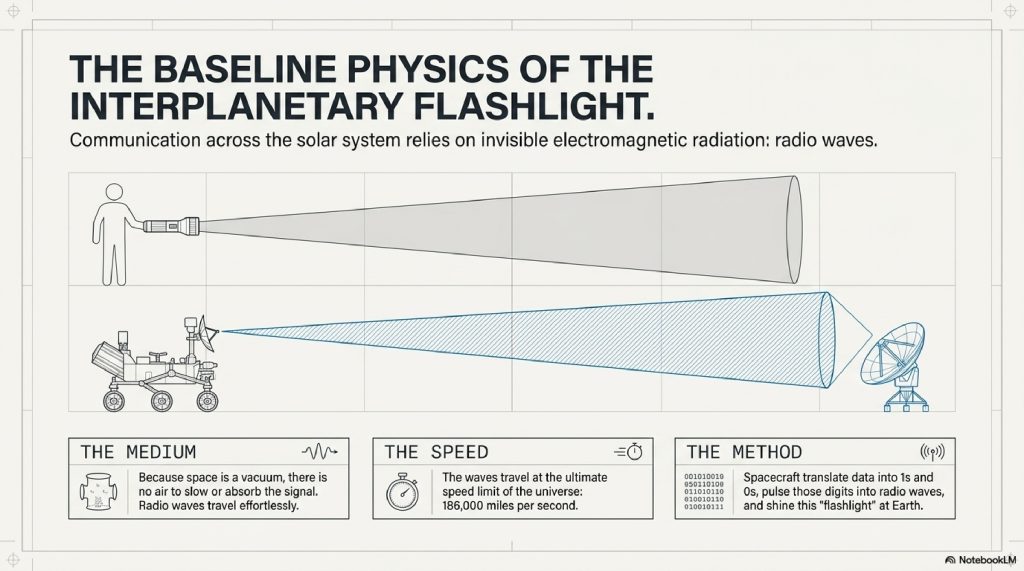
Radio waves are part of the electromagnetic spectrum, just like visible light, but they are invisible to our eyes. Because there is no air in space to slow them down or absorb them, radio waves travel effortlessly at the ultimate speed limit of the universe: the speed of light (roughly 186,000 miles per second).
To send a picture of Mars back to Earth, a rover translates the digital image into a series of 1s and 0s, pulses those digits into radio waves, and shines its “radio flashlight” directly at Earth. Earth looks up, catches those invisible flashes with giant metal dishes, and translates them back into a picture.
B. THE CORE PROBLEM: The Inverse-Square Law
If radio waves travel perfectly through the vacuum of space, why is this so difficult?
Because of a brutal rule of physics known as the Inverse-Square Law.
When a flashlight shines, the beam spreads out as it travels. By the time the light reaches your friend on the boat, the beam is much wider, but also much dimmer.
In physics, this is expressed mathematically as:
(Where is the intensity of the signal, is the source power, and is the distance).
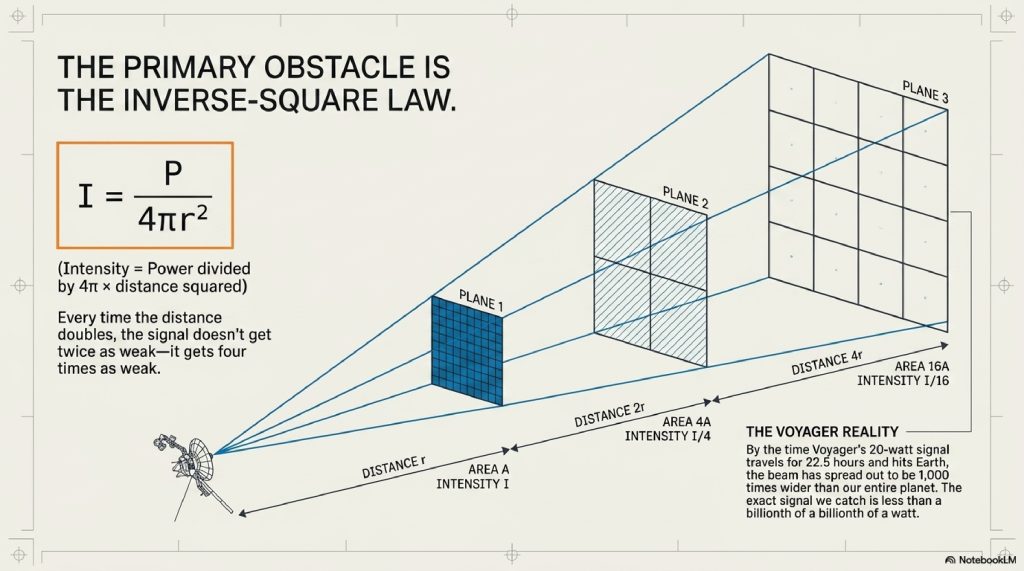
Simply put: Every time the distance doubles, the signal doesn’t get twice as weak, it gets four times as weak.
When Voyager 1 transmits data from 15 billion miles away, its radio transmitter operates on about 20 watts of power (roughly the same as a refrigerator light bulb). By the time that signal travels for 22.5 hours and finally hits Earth, the beam has spread out to be a thousand times wider than our entire planet.
The signal we actually catch is less than a billionth of a billionth of a watt. It is a whisper so faint that it requires monumental engineering to hear it.
C. THE EARTHLY SOLUTION: The Deep Space Network (DSN)
To catch a whisper that faint, you need the world’s biggest hearing aids. Enter NASA’s Deep Space Network (DSN).
Because the Earth is constantly rotating, a single antenna pointing at Mars will eventually turn away from it as the sun sets. To maintain 24/7 contact with spacecraft, NASA strategically placed three massive antenna complexes around the globe, spaced about 120 degrees apart:
- Goldstone, California (USA)
- Madrid (Spain)
- Canberra (Australia)
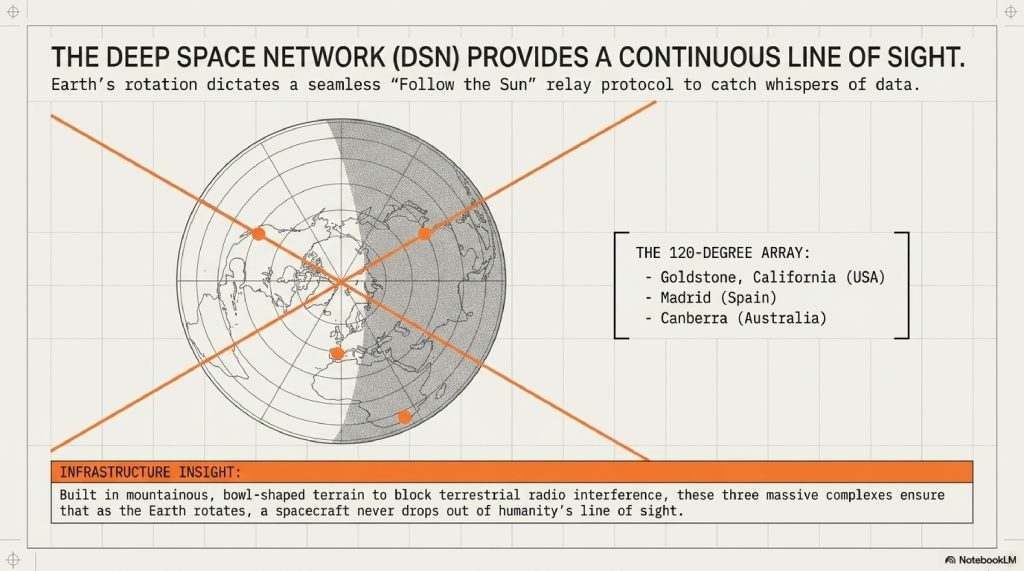
As a spacecraft sets below the horizon in California, it is rising above the horizon in Australia. The network operates like a seamless, global relay race.
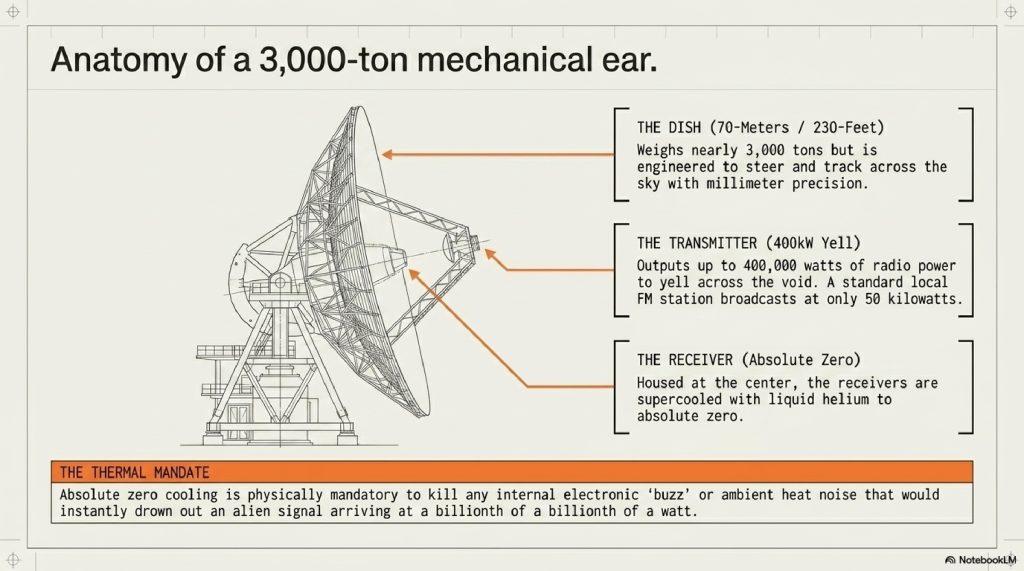
These aren’t your standard rooftop satellite dishes. The crown jewels of the DSN are the massive 70-meter (230-foot) antennas. They weigh nearly 3,000 tons, yet they can be steered with millimeter precision. To ensure they catch the faintest radio waves, the receivers located at the center of the dish are supercooled with liquid helium to absolute zero, killing any internal electronic “buzz” or heat noise that might drown out the alien signal.
D. STEP-BY-STEP BREAKDOWN: Sending a Command to Mars
Let’s trace exactly what happens when NASA tells a rover to move.
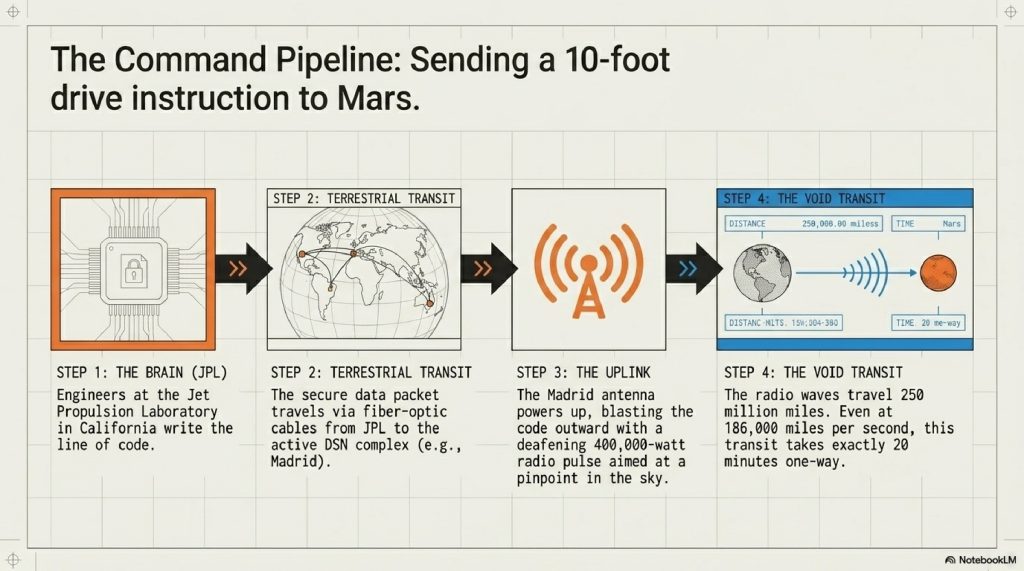
Step 1: The Command Center (The Brain)
Engineers at the Jet Propulsion Laboratory (JPL) in California write a line of code instructing the Perseverance rover to drive 10 feet forward.
Step 2: The Terrestrial Journey
This data packet is sent securely over fiber-optic cables from JPL to the DSN complex that currently has Mars in its line of sight (let’s say, Madrid).
Step 3: The Big Yell (The Uplink)
The Madrid antenna powers up its transmitter. Unlike the weak 20-watt transmitters on the spacecraft, the DSN antennas blast the signal outward with up to 400,000 watts of power. It is a deafening radio shout aimed at a pinpoint in the sky.
Step 4: The Transit (Light Time)
The radio waves leave the dish at the speed of light. However, depending on planetary orbits, Mars can be up to 250 million miles away. Even at the speed of light, it takes the signal roughly 20 minutes just to cross the gap.
Step 5: The Reception (The Downlink)
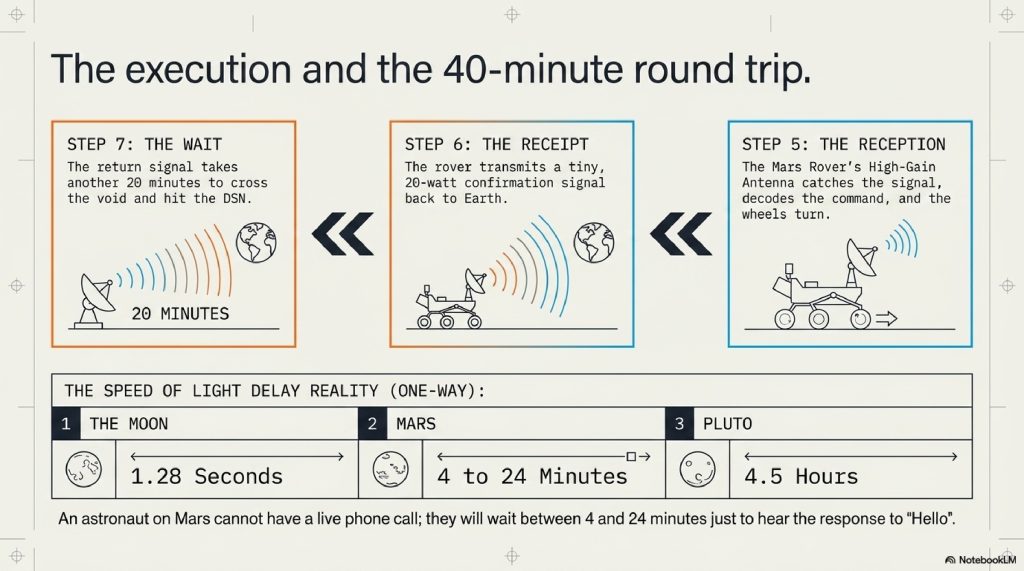
The rover’s High-Gain Antenna catches the signal, decodes the command, and the wheels begin to turn. The rover then sends a tiny, 20-watt “receipt” back to Earth, which takes another 20 minutes.
Total round-trip time for a single command? Over 40 minutes.
E. REAL-WORLD EXAMPLES: Navigating the Obstacles
What happens when a planet gets in the way?
Every two years, Earth and Mars experience a Solar Conjunction. This means the Sun is positioned directly between the two planets. The Sun is essentially a massive, screaming ball of electromagnetic radiation. If NASA tries to shoot a radio signal through or near the Sun, the solar plasma will scramble the 1s and 0s, potentially causing a rover to receive a corrupted command and drive off a cliff.
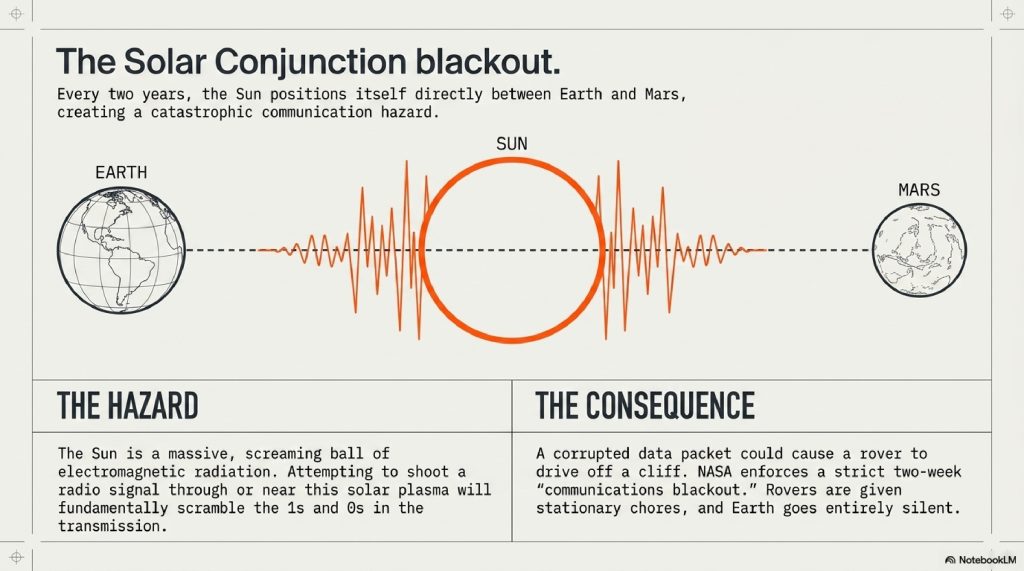
During this two-week period, NASA enforces a “communications blackout.” The rovers are given a list of safe, stationary chores to do, and Earth simply stops talking to them until the planets drift out of the Sun’s shadow.
F. THE ADVANCED TECHNICAL LAYER: Coding the Void
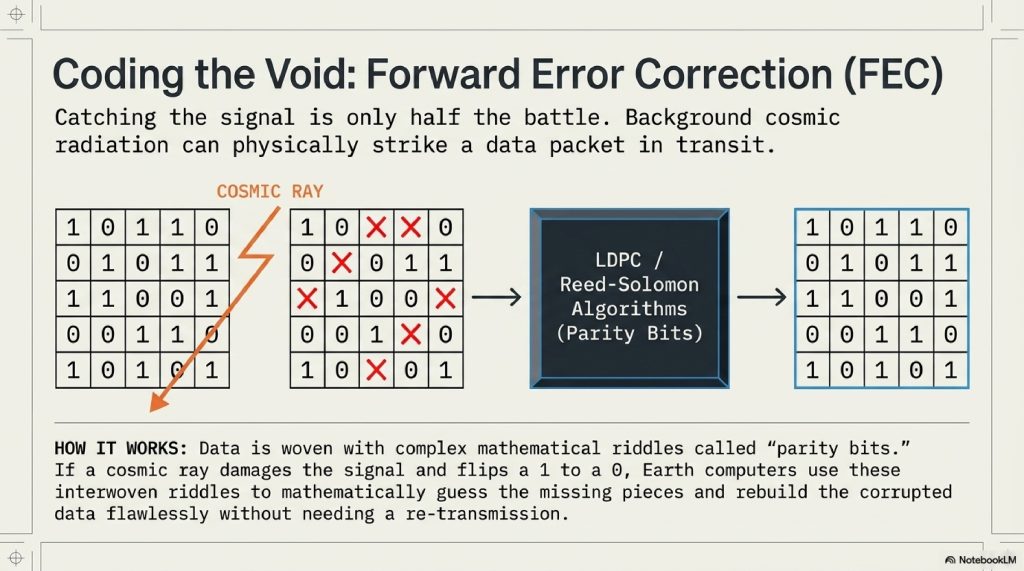
For the highly technical reader, catching the signal is only half the battle. How do you prevent data corruption when background cosmic radiation flips a 1 to a 0?
Forward Error Correction (FEC)
Spacecraft use advanced mathematical algorithms, such as Reed-Solomon codes or Low-Density Parity-Check (LDPC) codes. When the spacecraft sends an image, it doesn’t just send the raw data. It weaves complex mathematical riddles (parity bits) into the transmission. If a cosmic ray damages the signal in transit, the computers on Earth can use these mathematical riddles to actually guess the missing pieces and rebuild the corrupted data flawlessly.
The Doppler Shift
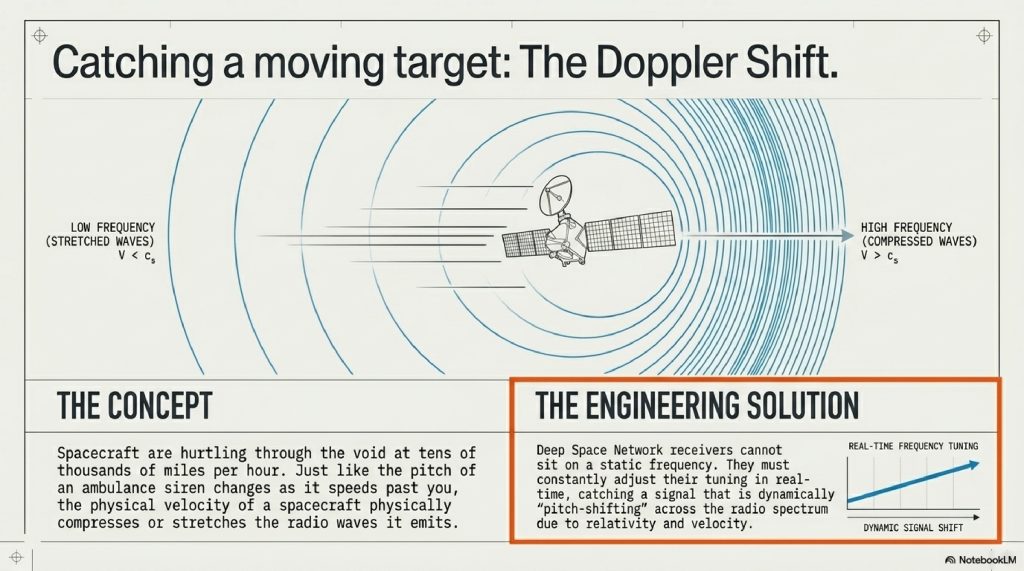
Because spacecraft are hurtling through space at tens of thousands of miles per hour, the radio waves they emit get compressed or stretched exactly like the pitch of an ambulance siren changing as it drives past you. DSN receivers must constantly adjust their tuning frequencies in real-time to catch a signal that is “pitch-shifting” across the radio spectrum due to relativity and velocity.
Technical Note: Modern deep space missions use specific radio frequency bands. X-band (8-12 GHz) is the standard workhorse for planetary missions, offering reliable weather penetration. Ka-band (26-40 GHz) is increasingly used for high-bandwidth downlinks, allowing for massive data returns, though it is more susceptible to rain and clouds on Earth.
G. COMMON MYTHS ABOUT SPACE COMMUNICATION
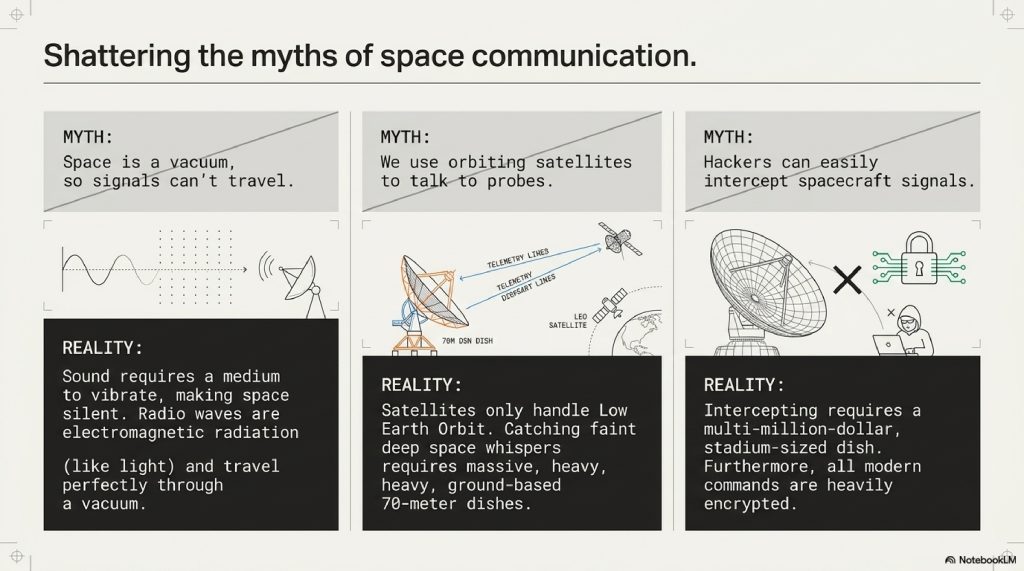
Myth 1: Space is a vacuum, so sound and signals can’t travel.
Reality: Sound waves require a medium (like air or water) to vibrate, which is why space is silent. Radio waves, however, are electromagnetic radiation (like light) and travel perfectly through a vacuum.
Myth 2: We use satellites to talk to deep space probes.
Reality: While we use satellites (like the TDRS network) to talk to the International Space Station in Low Earth Orbit, communicating with deep space requires massive, ground-based dishes. A satellite dish in orbit simply isn’t large enough to catch the faint whispers from Mars or Jupiter.
Myth 3: Communication is instantaneous.
Reality: No force in the universe can exceed the speed of light. The absolute minimum delay to talk to the Moon is 1.28 seconds. To talk to Pluto, it can take over 4.5 hours one-way.
H. THE FUTURE: Lasers and Deep Space Optical Communications
Radio waves have served us well since the Apollo era, but we are hitting a physical bandwidth limit. Sending a high-resolution map of Mars via radio takes days.
The future is Lasers.
Instead of broadcasting wide radio waves, NASA is transitioning to Deep Space Optical Communications (DSOC). This involves shooting a highly concentrated, near-infrared laser beam across the solar system. Because the wavelength of laser light is significantly tighter than radio, you can pack 10 to 100 times more data into a single transmission.
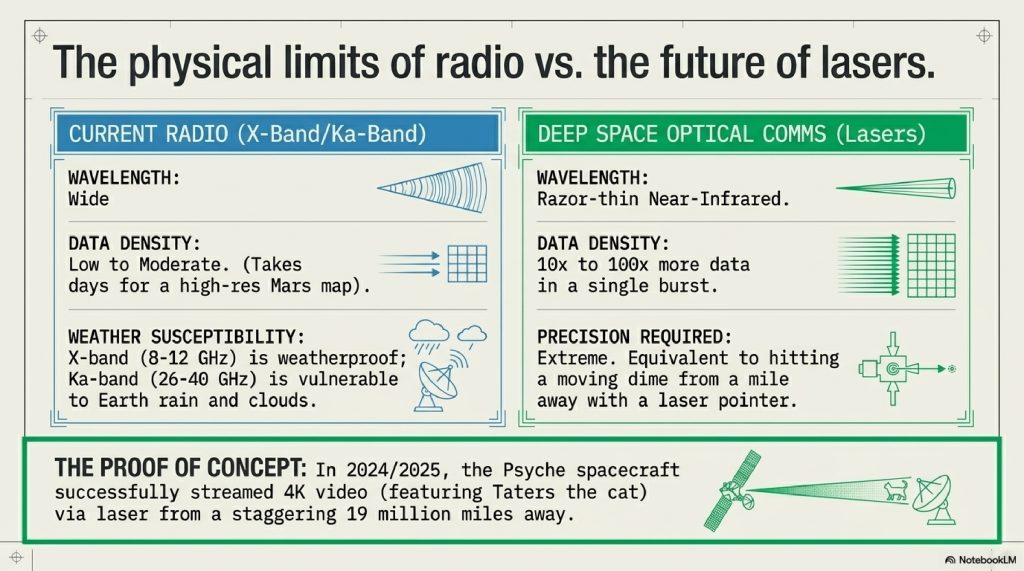
In late 2023, NASA launched the Psyche spacecraft toward a metal asteroid. Attached to it was a revolutionary DSOC transceiver. By 2024 and 2025, from a staggering 19 million miles away, Psyche successfully streamed ultra-high-definition video (featuring a cat named Taters) back to a telescope in California.
Laser communication requires terrifying precision, it is the equivalent of hitting a moving dime from a mile away with a laser pointer but it is the key to eventually streaming live video of astronauts walking on Mars.
I. FASCINATING FACTS YOU DIDN’T KNOW
- The Global Relay Race: The Deep Space Network is operated via a “Follow the Sun” protocol. During the day, the Australian team runs the entire global network. When their shift ends, they hand control to Spain, who then hands it to California.
- The Oldest Connection: Voyager 1’s computers have roughly 240,000 times less memory than a modern smartphone, yet they still routinely ping the massive 70-meter dishes on Earth from interstellar space.
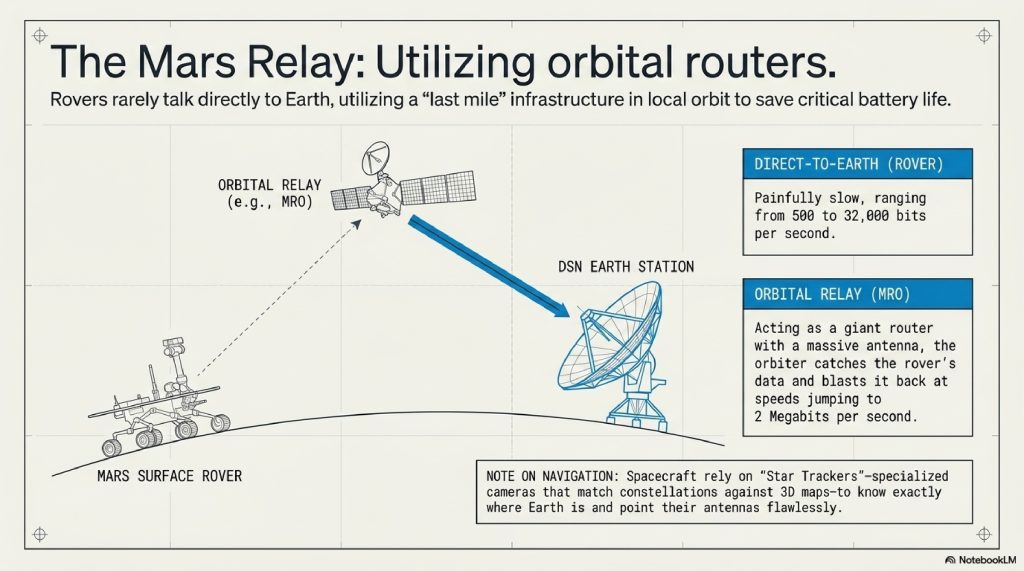
- The Mars Relay: Rovers on Mars rarely talk directly to Earth. Because their antennas are small to save battery, they beam their data up to orbiters circling Mars (like the Mars Reconnaissance Orbiter). The orbiter acts as a giant router, catching the data and blasting it back to Earth using its much larger antenna.
FAQs
1. Can bad weather on Earth block a signal from space?
Yes. High-frequency signals (like Ka-band) can be heavily attenuated by rain, heavy clouds, or snow over the receiving DSN station.
2. How do spacecraft know where Earth is to point their antennas?
Spacecraft use “Star Trackers.” These are specialized cameras that take pictures of the constellations, compare them to an internal map, and calculate their exact orientation in 3D space, allowing them to point their antenna flawlessly back at Earth.
3. What happens if a spacecraft’s antenna breaks?
Most spacecraft have “Low-Gain Antennas” as backups. These broadcast in all directions (omnidirectional). The signal is incredibly weak and slow, but it allows engineers to send basic rescue commands if the main dish fails.
4. How fast is the internet speed on Mars?
Direct-to-Earth connections from a rover are painfully slow (roughly 500 to 32,000 bits per second). However, when relaying through a Mars orbiter, speeds can jump to 2 Megabits per second.
5. Do other countries use NASA’s Deep Space Network?
Yes. Space exploration is highly collaborative. The European Space Agency (ESA), Japan (JAXA), and India (ISRO) frequently lease time on the DSN to communicate with their own interplanetary probes.
6. How much power does a Deep Space Network antenna use?
When transmitting, a DSN 70-meter antenna can output up to 400 kilowatts of radio power. To put that in perspective, a standard local FM radio station usually broadcasts at around 50 kilowatts.
7. Can an astronaut on Mars just pick up a phone and call Earth?
They can speak into a microphone, but it won’t be a live conversation. Due to the speed of light delay, they will have to wait between 4 and 24 minutes just to hear the response to “Hello.”
8. Why are the DSN stations located exactly where they are?
Goldstone, Madrid, and Canberra were chosen because they are roughly 120 degrees apart on the globe, ensuring at least one station always has a line of sight to deep space as the Earth rotates. They are also built in bowl-shaped, mountainous terrain to block out terrestrial radio interference.
9. Can hackers intercept spacecraft signals?
Intercepting a signal requires a multi-million-dollar, stadium-sized radio dish. Even if intercepted, all modern commands sent to spacecraft are heavily encrypted.
10. How long will we be able to hear the Voyager probes?
The limiting factor is not distance, but power. The nuclear batteries (RTGs) on the Voyager probes are slowly decaying. Sometime around 2030, they will no longer have enough electricity to power their transmitters, and they will drift into the dark in total silence.
OTHER BLOG SUGGESTIONS
To keep readers engaged and improve your site’s SEO architecture, consider linking to these related topics:
- How Global Shipping Systems Work: The World’s Physical Internet
- How Data Centers Power the Entire Internet
- How Air Traffic Control Prevents Plane Collisions
- How Undersea Internet Cables Carry the World’s Data
- How GPS Works: The Science of Satellites and Location
CONCLUSION
When we look up at the night sky, we see an infinite, quiet void. But to the giant robotic ears in California, Spain, and Australia, the sky is alive with conversation.
The ability to command a machine millions of miles away is arguably one of humanity’s greatest achievements. It is a triumph that defies the crushing vastness of the universe. Every time an image of a distant crater or a swirling gas giant arrives on our screens, it is the result of a perfectly choreographed dance involving the speed of light, planetary rotation, supercooled electronics, and a global team of engineers who refuse to let our explorers face the dark alone.
As we stand on the precipice of sending human beings to Mars, and as lasers prepare to replace radio waves, the invisible threads that tie us to our spacecraft will only grow stronger. We have bottled our curiosity into mathematical codes, beamed it into the abyss, and miraculously, the abyss is talking back.
Comment