INTRODUCTION
Look around the room you are sitting in right now.
The screen you are reading this on, the chair you are sitting in, the fabric of your clothes, the coffee mug on your desk, almost every single physical object within your line of sight shares a secret history. Before it belonged to you, it embarked on an epic, invisible journey across thousands of miles of violent oceans, traversing robotic ports, moving along humming highways, and passing through sprawling warehouses the size of small cities.
We live in an era of intoxicating convenience. You open an app, tap your thumb against a piece of glass, and two days later, a cardboard box appears on your porch. We treat this process like magic. We assume it just “happens.” But there is no magic. There is only a brutal, beautiful, and hyper-optimized mechanical ballet that operates 24 hours a day, 365 days a year, entirely out of sight.
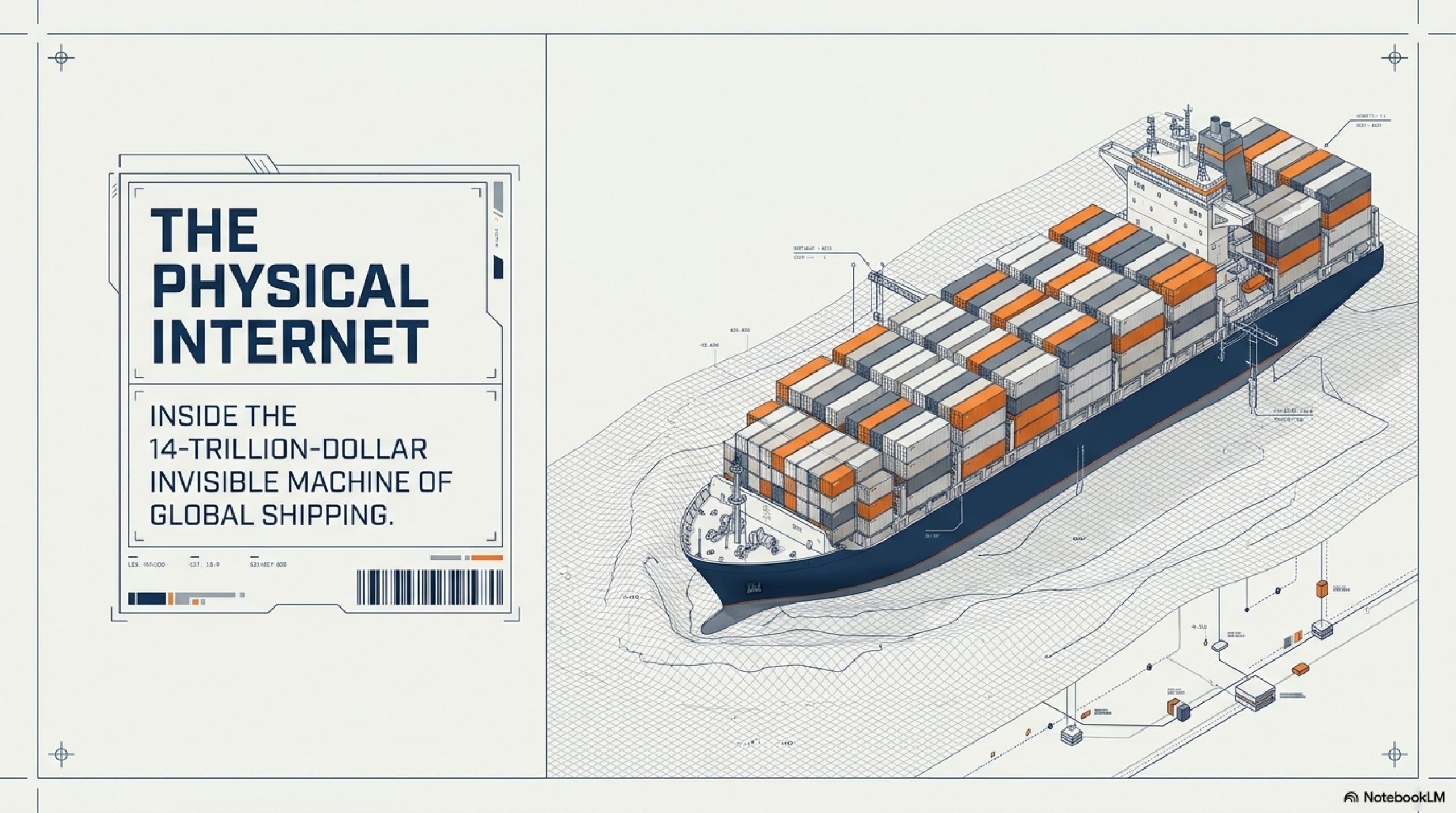
This is the global shipping system. It is the physical internet.
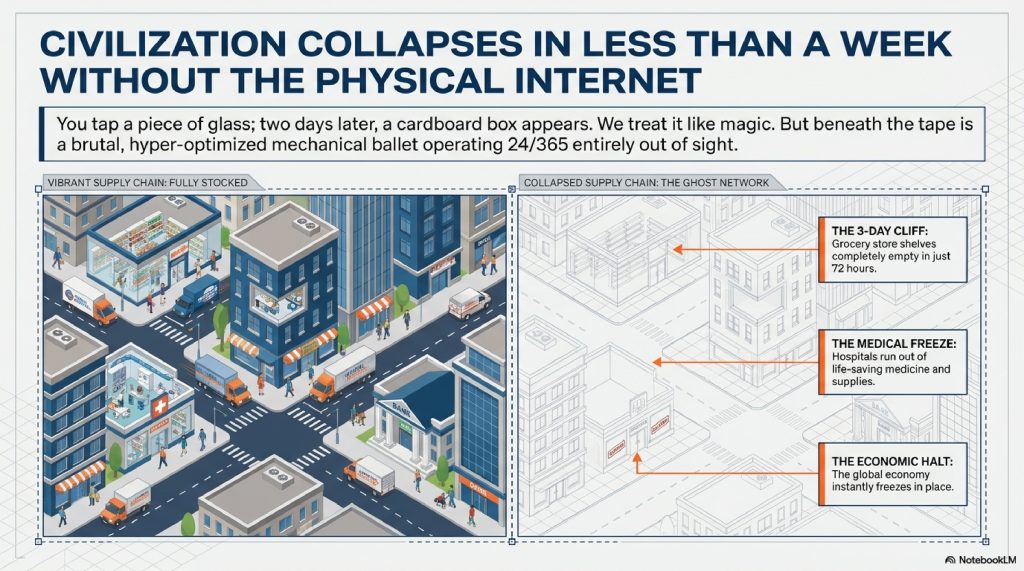
Without it, modern civilization collapses in less than a week. Grocery store shelves would empty in three days. Hospitals would run out of medicine. The global economy would instantly freeze. Yet, the vast majority of us have absolutely no idea how this 14-trillion-dollar machine actually functions. How exactly does a pair of sneakers manufactured in Vietnam coordinate with a ship the size of the Empire State Building, bypass a storm in the Pacific, navigate customs in Los Angeles, and end up on a delivery truck in Ohio at the exact moment you get home from work?
If you strip away the cardboard and the tape, global shipping reveals itself to be a marvel of human engineering, algorithms, and sheer scale. Today, we are going to trace the lifecycle of the things you buy. We will explore the steel boxes that changed the world, the megaships that carry them, the robotic sorting hats that categorize them, and the invisible data streams that keep it all from falling apart.
Prepare to never look at a delivery truck the same way again.
TABLE OF CONTENTS
- The Simple Explanation: The Physical Internet
- Step-by-Step Breakdown: The Ultimate Relay Race
- Real-World Example: The Journey of a Smartphone
- The Advanced Technical Layer: Algorithms and AIS
- The Hero of the Story: The Standardized Container
- Common Myths About Global Shipping
- The Future: Ghost Ships and Green Oceans
- Surprising Facts You Didn’t Know
- FAQs
- Other Blog Suggestions
- Conclusion
A. THE SIMPLE EXPLANATION: The Physical Internet
To understand the global shipping network, it helps to think of it exactly like the Internet but instead of moving data, it moves atoms.
When you send an email, your message isn’t sent as one giant chunk. It gets chopped up into tiny, identically sized “packets.” These packets travel across different fiber-optic cables, hit routers that read their addresses, and eventually reassemble in your friend’s inbox.
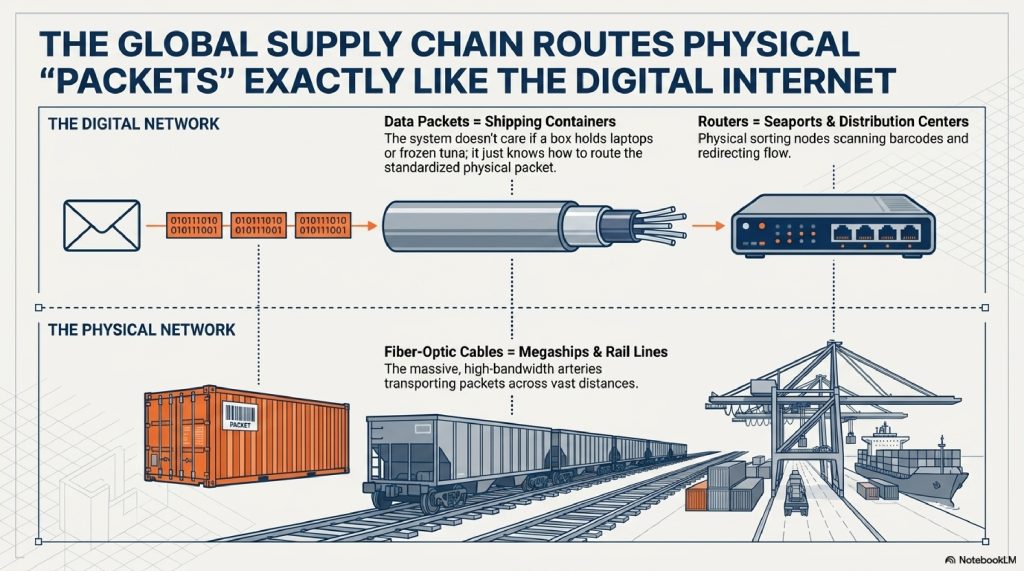
The global shipping system works the exact same way.
- The Data Packets: These are Shipping Containers, identical corrugated steel boxes. Because they are all the exact same size, the system doesn’t care if a box is full of laptops, frozen tuna, or toilet paper. It just knows how to move a box.
- The Fiber-Optic Cables: These are the Megaships, Trains, and Trucks that move the boxes.
- The Routers: These are the Ports and Distribution Centers. They receive thousands of boxes, read their barcodes, and route them in different directions.
By standardizing everything into identical “packets” (containers), the world built a universal physical network. A truck in Germany can lock onto the exact same container as a crane in Singapore.
B. STEP-BY-STEP BREAKDOWN: The Ultimate Relay Race
What actually happens when a product leaves a factory? It undergoes a multi-stage relay race known as “Intermodal Freight Transport.” Intermodal simply means using multiple modes of transportation (truck, train, ship) without ever taking the cargo out of the container.
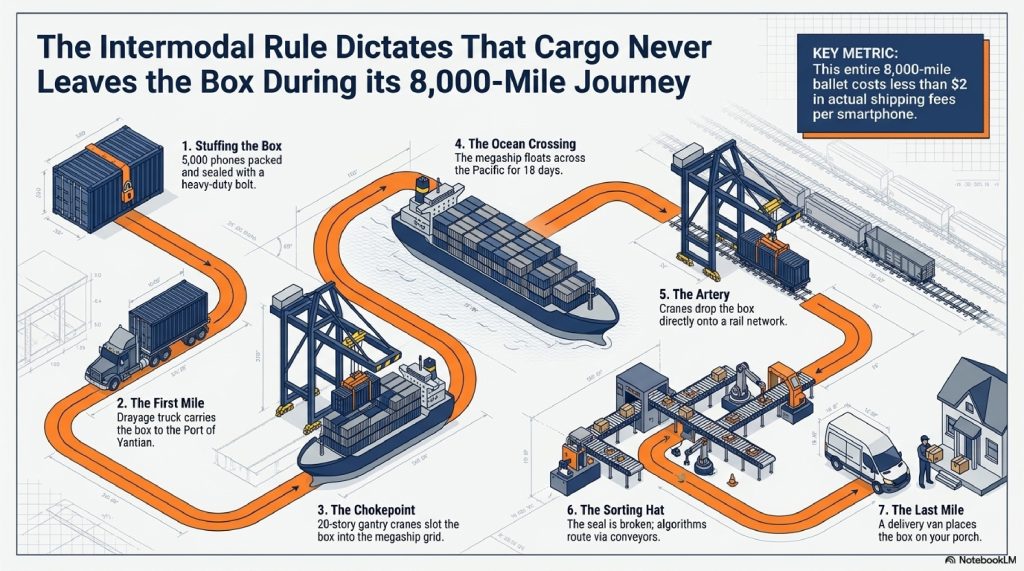
Here is exactly what happens behind the scenes:
Step 1: The Origin (Stuffing the Box) Goods are manufactured at a factory. They are packed into cardboard boxes, placed on wooden pallets, and loaded into a shipping container. Once the container doors are closed, a heavy-duty bolt seal is attached. Unless customs orders a search, those doors will not open again until they reach the final destination.
Step 2: The First Mile (The Drayage Truck) A specialized truck, known as a drayage truck, picks up the heavy container from the factory and drives it to the nearest major seaport or rail yard.
Step 3: The Chokepoint (The Port & The Crane) The truck enters a massive, humming seaport. Towering gantry cranes standing 20 stories tall, reach down, grab the container, and hoist it into the air. With terrifying precision, the crane slots the container into a puzzle-like grid on the deck of a massive cargo ship.
Step 4: The Ocean Crossing (The Megaship) The ship, carrying upwards of 20,000 containers, departs. It navigates international waters, dodging typhoons and navigating narrow chokepoints like the Suez or Panama Canals. This journey can take anywhere from 12 to 40 days.
Step 5: The Unloading and the Rail Network The ship arrives at the destination port (e.g., Los Angeles or Rotterdam). Cranes pull the container off the ship and place it directly onto a waiting freight train. The train acts as an artery, pumping the goods deep into the interior of the country.
Step 6: The Sorting Hat (The Distribution Center) The container arrives at a massive warehouse. Finally, the seal is broken. The individual boxes are unloaded and put on conveyor belts. Algorithms read the barcodes and sort the boxes based on zip codes.
Step 7: The Last Mile A local delivery driver loads your specific box into a familiar brown or white van, navigates your neighborhood, and places the item on your porch.
C. REAL-WORLD EXAMPLE: The Journey of a Smartphone
Let’s trace the journey of a brand-new smartphone you just ordered.
It starts in a factory in Shenzhen, China. Your phone, packed in its sleek retail box, is placed onto a pallet with 5,000 other phones. This pallet is loaded into a 40-foot container.
A truck takes this container to the Port of Yantian. There, it is hoisted onto the Ever Given, a megaship roughly the length of the Empire State Building. For 18 days, your phone floats across the vast, dark Pacific Ocean.
The ship docks at the Port of Long Beach, California. A crane drops the container onto a railcar. A train pulls it across the American Southwest, through the Rockies, to a sprawling logistics hub in Memphis, Tennessee.
In Memphis, the container is opened. Your specific phone is scanned, placed on a high-speed conveyor belt, and dropped into a bin marked for your local city. That night, it is loaded onto an 18-wheeler truck, arriving at your local delivery hub at 4:00 AM. By 10:00 AM, the delivery driver is walking up your driveway.
From a sterile room in Shenzhen to your hands, the phone traveled 8,000 miles, was handled by robots, trains, and ships, and cost less than $2 in actual shipping fees to cross the ocean.
D. THE HERO OF THE STORY: The Standardized Container
Before 1956, shipping was a nightmare. It was called “break-bulk” shipping. Sacks of coffee, barrels of oil, and crates of machinery were all loaded individually by thousands of dockworkers. It took weeks to load a single ship, and theft was rampant.
Then, an American trucking entrepreneur named Malcolm McLean had a brilliant idea. Why load the contents of a truck? Why not just take the back of the truck off and put the whole thing on the ship?
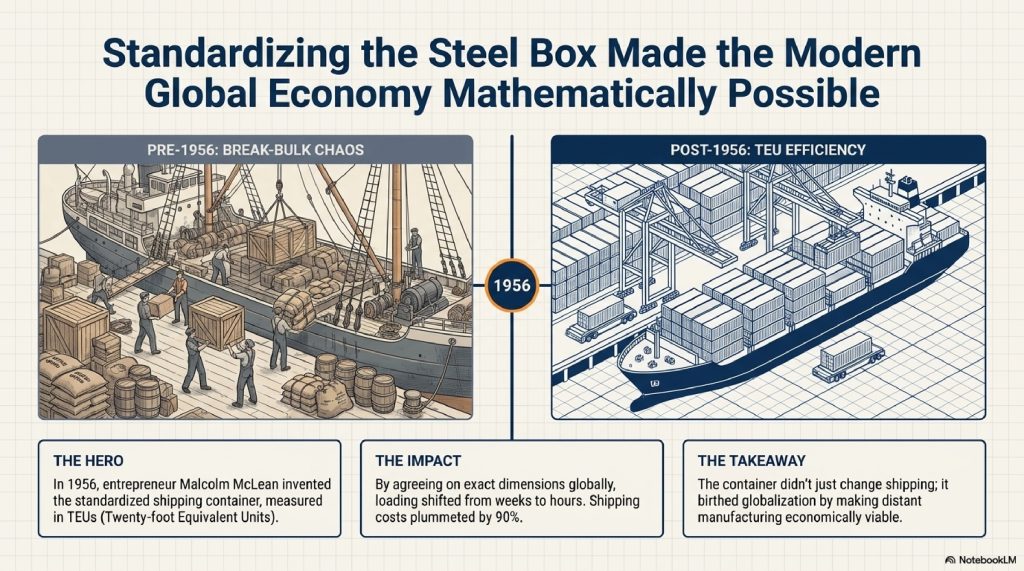
He invented the standardized shipping container. Today, we measure shipping capacity in TEUs (Twenty-foot Equivalent Units). By forcing the entire world to agree on exact dimensions for these boxes, McLean accidentally birthed globalization. Suddenly, ships could be loaded in hours instead of weeks. The cost of shipping plummeted by 90%.
Without the container, it would be too expensive to manufacture a phone in China and sell it in the US. The box didn’t just change shipping; it built the modern global economy.
E. ADVANCED TECHNICAL LAYER: Algorithms and AIS
For the system to work smoothly, immense technical complexity is hidden beneath the surface.
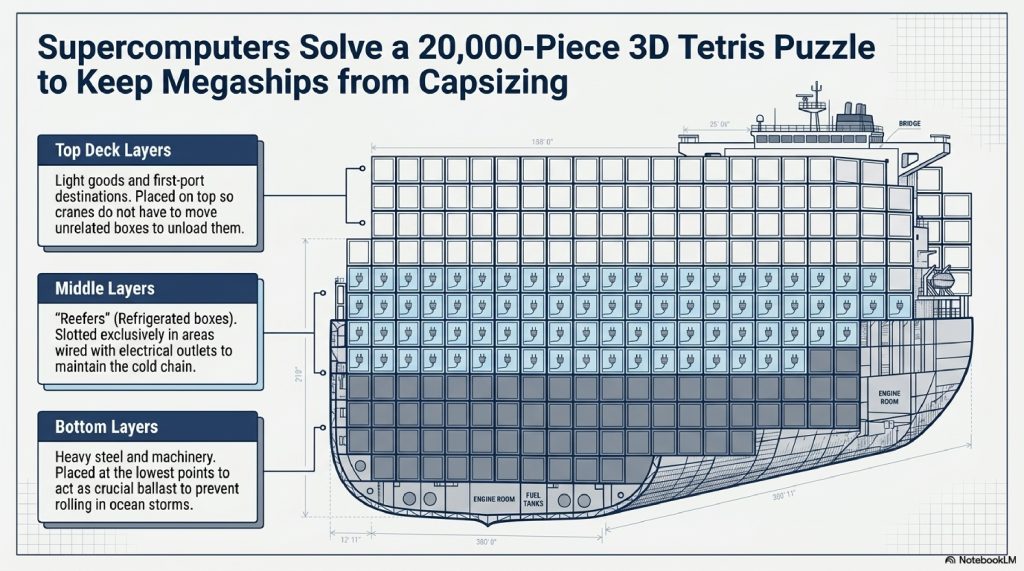
How Do Ships Not Tip Over? (Stowage Planning) You can’t just pile 20,000 containers onto a ship randomly. If you put all the heavy steel parts on the left, the ship capsizes. If you put them all on top, the ship becomes top-heavy and rolls in a storm. Ports use supercomputers to generate a Stowage Plan. Algorithms calculate the weight and destination of every container.
- Heavy items go at the bottom.
- Refrigerated containers (Reefers) must be placed in specific slots that have electrical outlets.
- Containers bound for the first port of call must be placed on top so they don’t have to move other boxes to get to them.
How Do We Track Them? (AIS) If you open an app like MarineTraffic, you can see almost every commercial ship on Earth moving in real-time. This is thanks to AIS (Automatic Identification System). Every ship constantly broadcasts a VHF radio signal to satellites and coastal receivers, sharing its GPS location, speed, heading, and cargo type. This prevents collisions in the middle of the ocean and allows ports to know exactly when a ship will arrive, down to the minute.
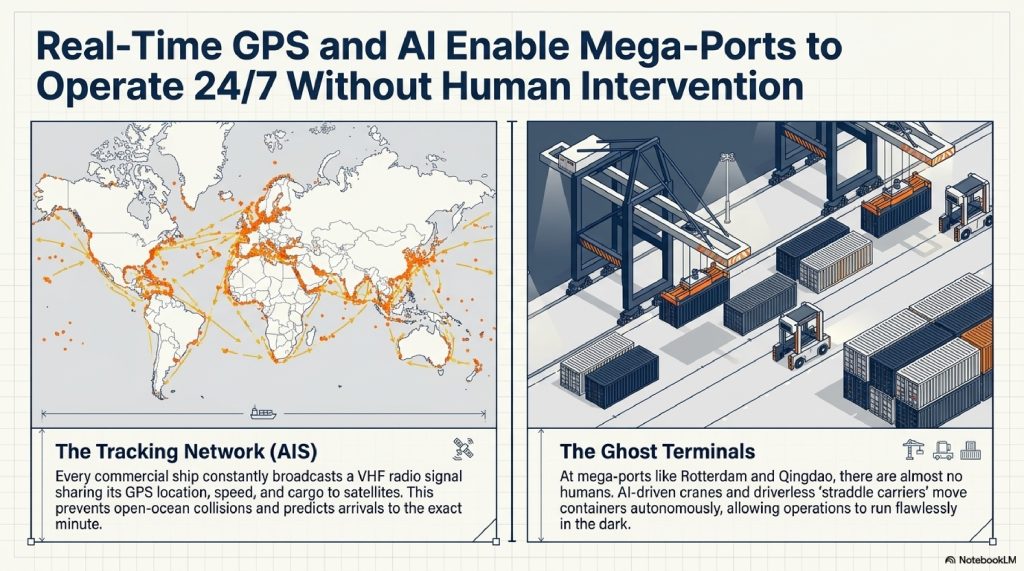
The Ghost Terminals (Automation) If you visit the Port of Rotterdam or the Port of Qingdao today, you will notice something eerie: there are almost no humans. The cranes are driven by AI. The containers are moved around the yard by automated straddle carriers massive, driverless robotic vehicles that glide around like giant metal spiders. This automation allows ports to operate 24/7 in total darkness.
F. COMMON MYTHS OR MISCONCEPTIONS
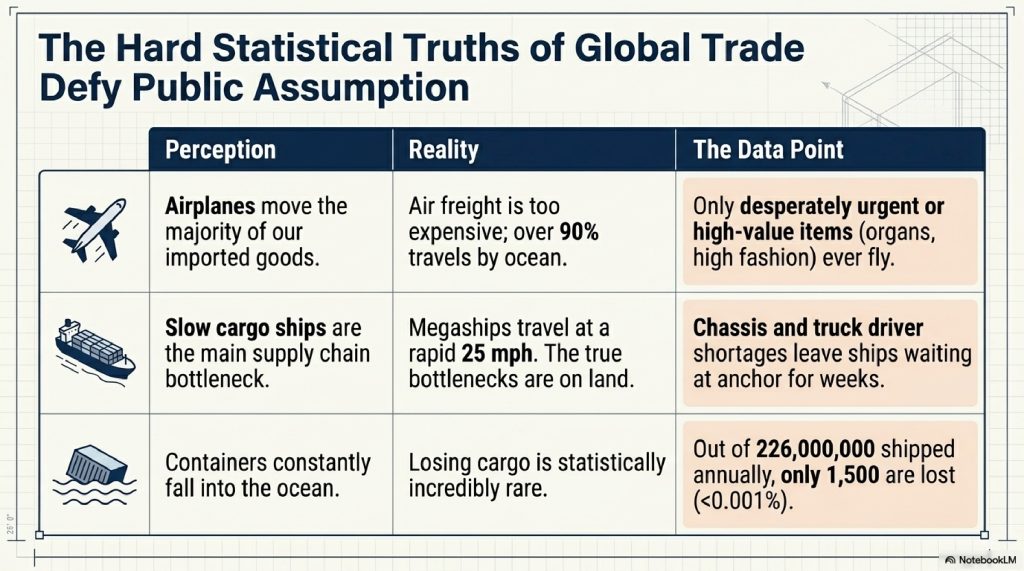
Myth 1: Most of the things we buy are flown on airplanes. Reality: Air freight is incredibly expensive. Over 90% of all globally traded goods travel by ocean. If it is heavy, bulky, or not desperately urgent, it goes on a ship. Only high-value, time-sensitive items (like certain electronics, high-end fashion, or vital organs) fly.
Myth 2: Shipping ships are slow, so they are the bottleneck. Reality: Megaships actually travel at a decent clip (about 20-24 knots, or 25 mph). The true bottlenecks in the supply chain are the ports. If a port lacks enough truck drivers or chassis (the wheels the containers sit on), a massive ship might have to drop anchor off the coast and wait for two weeks just to get a parking spot.
Myth 3: Containers frequently fall off ships and pollute the ocean. Reality: While it makes the news when it happens (like thousands of rubber ducks washing ashore), it is statistically incredibly rare. Out of the 226 million containers shipped every year, an average of only 1,500 are lost at sea less than 0.001%.
G. THE FUTURE OF THE TECHNOLOGY: Ghost Ships and Green Oceans
The shipping industry is facing two massive pressures: the need to be faster, and the need to stop polluting. Cargo ships burn “bunker fuel,” a thick, tar-like substance that is heavily polluting.
1. Decarbonization (Green Fuels) The industry is racing to replace bunker fuel. Giant shipping companies like Maersk are currently building ships that run on Green Methanol and Ammonia. Some cutting-edge experimental ships are even bringing back a technology from the 1800s: giant, automated, computer-controlled sails to harness wind power and reduce fuel consumption.
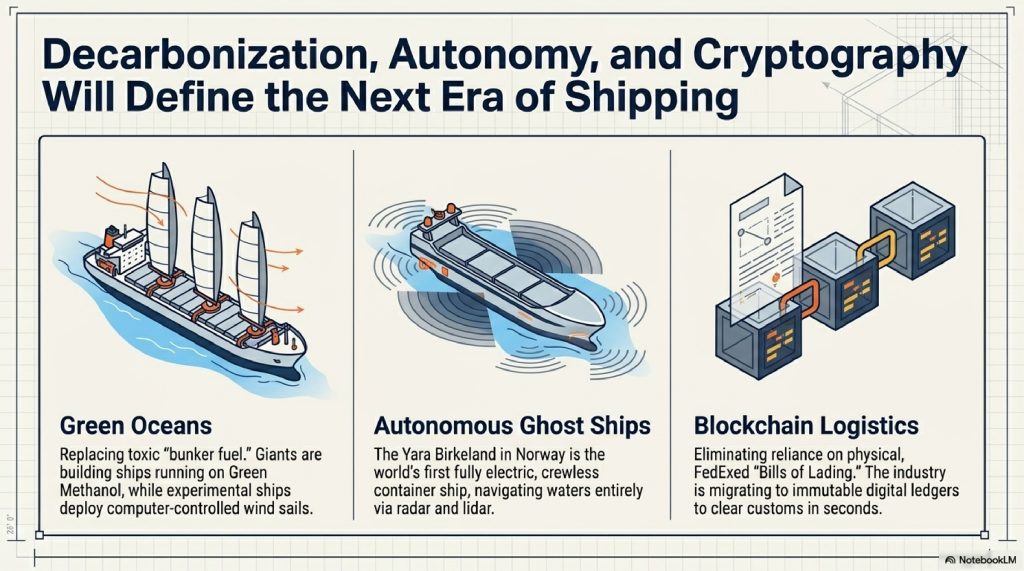
2. Autonomous Ghost Ships Just as self-driving cars are hitting the streets, autonomous ships are hitting the water. In Norway, the Yara Birkeland is the world’s first fully electric, autonomous container ship. It navigates coastal waters entirely without a human crew, utilizing radar, lidar, and infrared cameras to avoid obstacles.
3. Blockchain and Paperwork Believe it or not, a massive part of global shipping still relies on physical, stamped pieces of paper (called Bills of Lading) being mailed via FedEx ahead of the ship. The industry is currently migrating to Blockchain technology to create immutable, instantaneous digital ledgers, ensuring customs agents can clear cargo in seconds rather than days.
H. INTERESTING FACTS SECTION
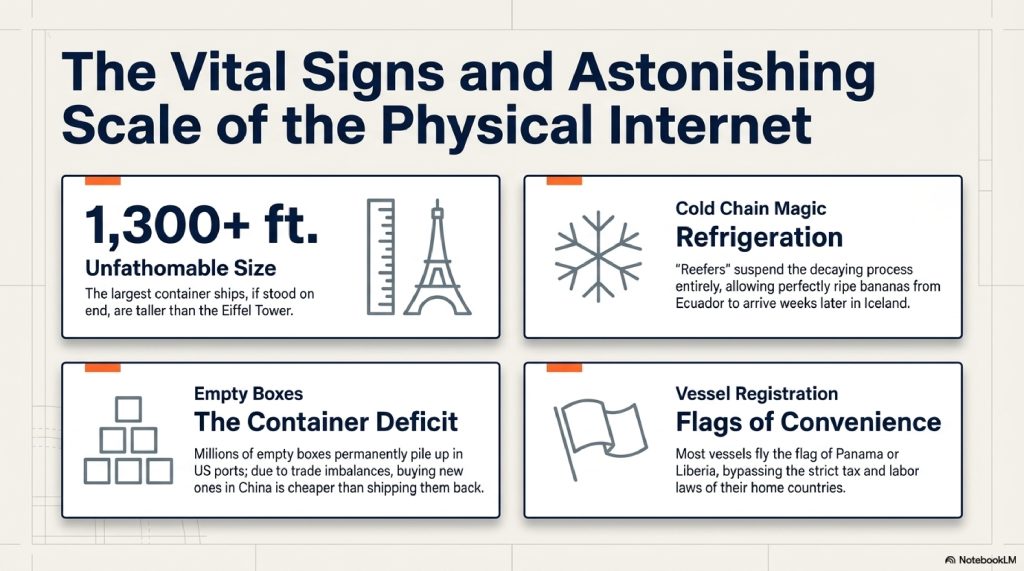
- The Size is Unfathomable: The largest container ships today are over 1,300 feet long. If you stood one on its end, it would be taller than the Eiffel Tower.
- The Container Deficit: Because the US imports far more than it exports, millions of empty shipping containers pile up in American ports. It is often cheaper for companies to buy new containers in China than to ship empty ones back across the Pacific.
- Cold Chain Logistics: Without refrigerated containers, the modern diet wouldn’t exist. “Reefers” allow bananas from Ecuador to arrive in Iceland perfectly ripe, suspending the decaying process for weeks.
- Flags of Convenience: You rarely see a ship flying a US or UK flag. Most ships fly the flag of Panama, Liberia, or the Marshall Islands. This is called a “Flag of Convenience,” allowing shipping companies to bypass strict labor and tax laws in their home countries.
FAQ SECTION
1. What does TEU stand for? TEU stands for Twenty-foot Equivalent Unit. It is the standard unit of measurement in shipping. A standard 20-foot container is 1 TEU. A 40-foot container is 2 TEUs.
2. How long does it take a ship to cross the ocean? It typically takes about 14 to 20 days to cross the Pacific Ocean (China to US West Coast), and about 10 to 14 days to cross the Atlantic (Europe to US East Coast), depending on weather and vessel speed.
3. Why do shipping costs fluctuate so much? Shipping costs are driven by supply and demand. During the pandemic, everyone bought physical goods while stuck at home, causing a massive container shortage, which drove the price to ship a single container from $1,500 to over $20,000.
4. What happens if a container falls into the ocean? Most sink immediately. However, some containing buoyant materials can float for months, becoming major hazards for small sailboats. Shipping companies are legally required to report lost containers.
5. How are shipping containers powered if they need refrigeration? Refrigerated containers (reefers) have an internal cooling unit. On a truck, they plug into a diesel generator. On a ship or at a port, they plug directly into the ship’s or port’s electrical grid.
6. Do pirates still exist? Yes. Modern piracy is a significant threat in areas like the Gulf of Aden, the Strait of Malacca, and the Gulf of Guinea. Ships use barbed wire, water cannons, and sometimes armed guards to repel boarders.
7. How do customs agents check millions of containers? They use risk-assessment algorithms. AI flags suspicious shipments based on origin, destination, and the company’s history. These flagged containers are passed through massive X-ray machines without needing to be physically opened.
8. What is the “Last Mile” in shipping? The last mile refers to the final leg of a product’s journey from the local distribution center to the customer’s front door. It is famously the most expensive and inefficient part of the entire shipping process.
9. How many containers can the largest ship carry? As of recent launches, the absolute largest “Megamax” container ships can carry just over 24,000 TEUs.
10. Can you track a specific shipping container? Yes. Just like a FedEx package, containers have unique ID numbers. Shipping companies provide tracking portals where you can see exactly which port or ship your container is currently at.
OTHER BLOG SUGGESTIONS
To keep readers engaged and improve your site’s SEO architecture, consider linking this article to:
- How Data Centers Power the Entire Internet
- How Air Traffic Control Prevents Plane Collisions
- How Undersea Internet Cables Carry the World’s Data
- How GPS Works: The Science of Satellites and Location
CONCLUSION
The next time a delivery driver drops a cardboard box at your door, take a moment to pause.
You aren’t just holding a new pair of shoes or a replacement laptop charger. You are holding the final result of the most complex, perfectly synchronized mechanical ballet in human history. That box represents the labor of distant factories, the roar of diesel trains, the silent efficiency of robotic cranes, and the relentless churning of megaship propellers in the middle of a dark, freezing ocean.
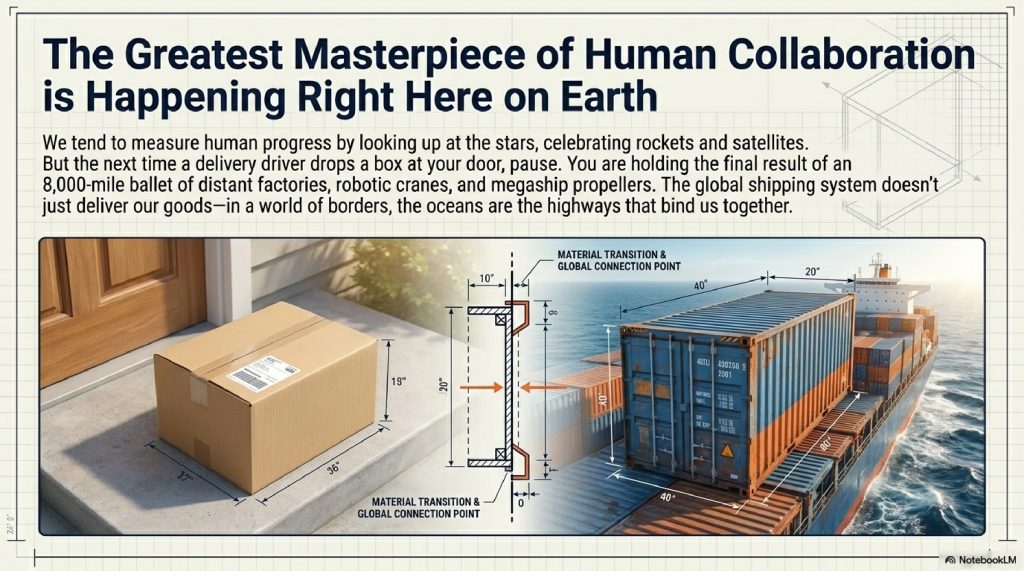
We tend to measure human progress by looking up at the stars, celebrating rocket launches and satellites. But the true masterpiece of human collaboration is happening right here on Earth, moving across the water in identical steel boxes. The global shipping system is the invisible bloodline of modern civilization. It doesn’t just deliver our goods; it connects us all, proving that in a world of borders, the oceans are the highways that bind us together.