INTRODUCTION
You open a new tab, type in a URL, and hit enter. Within a fraction of a second, a high-definition video hosted on a server in Tokyo begins playing on your screen in New York.
How did that data cross the world so fast? If you ask the average person on the street, they will likely point upward. They’ll talk about satellites, the cloud, and invisible radio waves bouncing through the stratosphere. It’s a beautiful, futuristic image. It is also completely wrong.
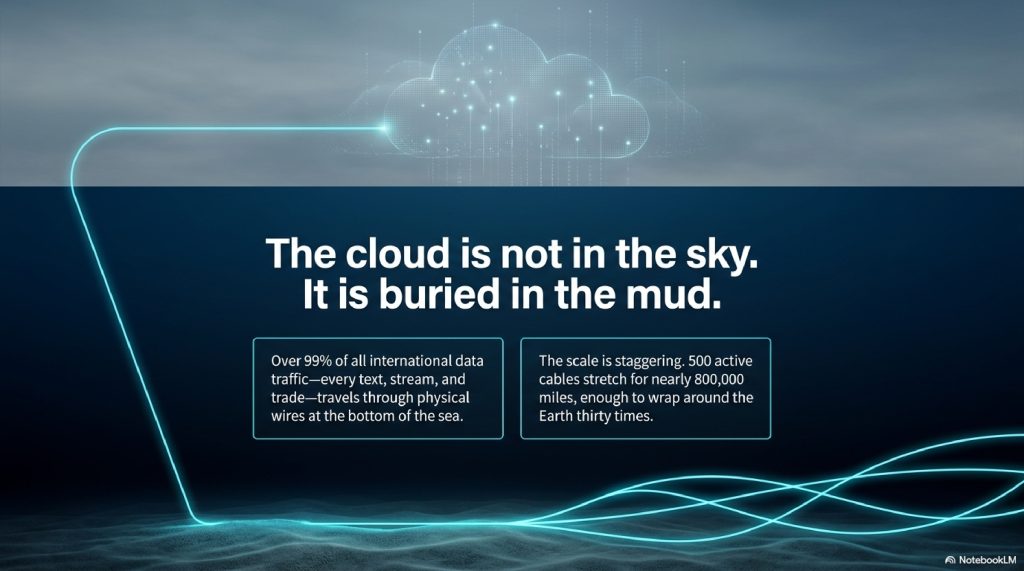
The “cloud” isn’t in the sky. It is buried beneath the crushing, freezing, lightless depths of the world’s oceans. Right now, as you read this sentence, over 99% of all international data traffic, every text message, every stock trade, every Netflix stream, and every Zoom call is traveling through a physical wire resting at the bottom of the sea.
There are over 500 active submarine cables crisscrossing the globe, stretching for nearly 800,000 miles. That is enough cable to wrap around the Earth thirty times. Yet, the actual conduit carrying all of human knowledge is a fragile strand of glass no thicker than a single human hair, wrapped in armor and dropped into the abyss.
This infrastructure is a modern engineering miracle, but it is also terrifyingly vulnerable. If a ship drops its anchor in the wrong spot, or an underwater earthquake triggers a mudslide, entire nations can be plunged into digital darkness.
In this deep dive, we are going to strip away the mystery of the physical internet. We will travel from the humming server farms of dry land down to the abyssal plains 20,000 feet below the surface. We will explore how lasers encode our lives into pulses of light, how specialized ships lay these digital lifelines across oceanic trenches, and what happens when the most important cables on Earth snap.
Grab a deep breath. We’re going underwater.
TABLE OF CONTENTS
- The Great Satellite Illusion
- The Simple Explanation: The Flashlight and the Mirror
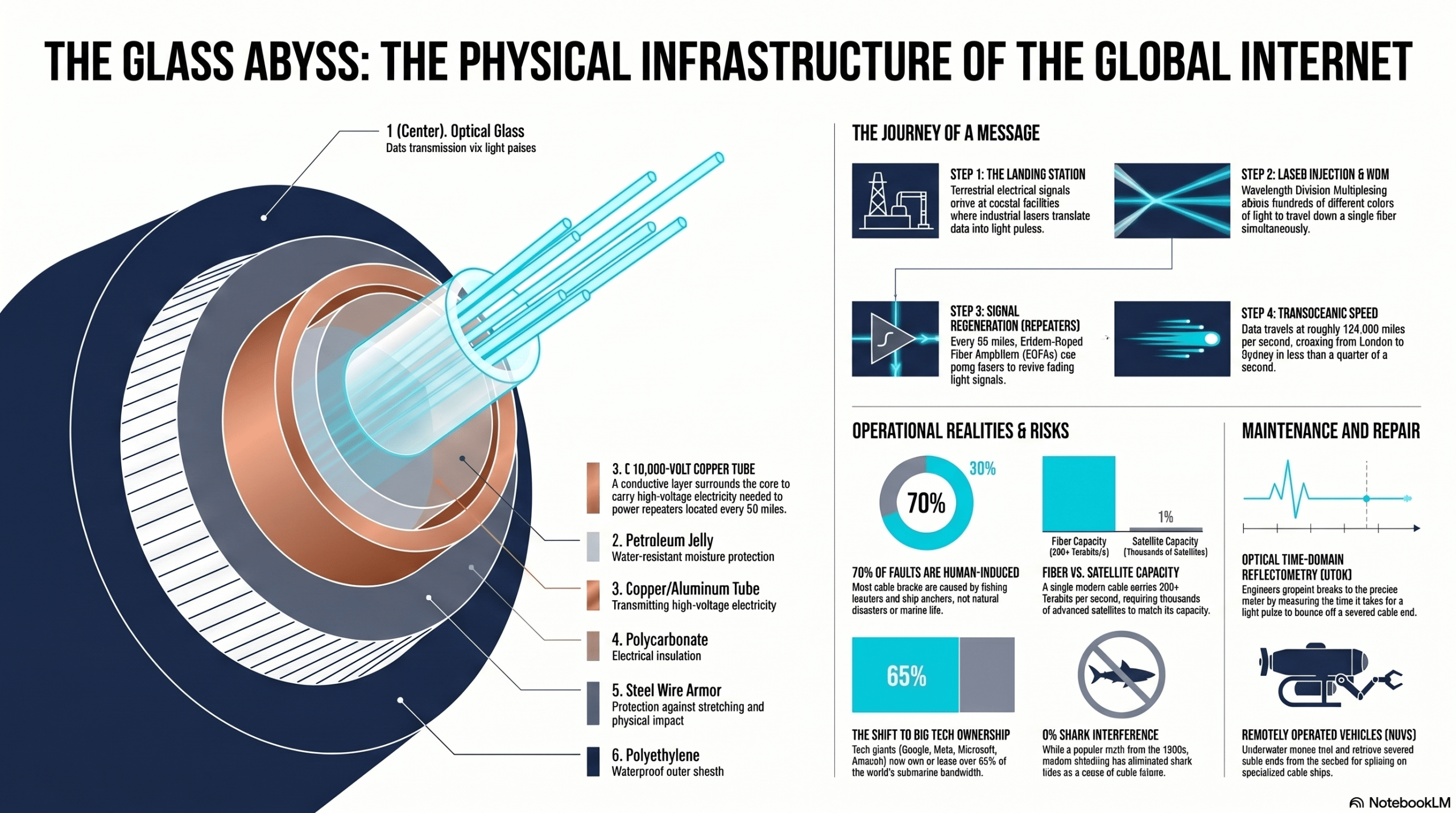
- The Anatomy of a Submarine Cable: Armor for Glass
- Step-by-Step Breakdown: The Journey of a Message
- Real-World Example: An Email from London to Sydney
- Advanced Technical Layer: Lasers, Repeaters, and WDM
- Laying the Veins of the Earth: Cable Ships and ROVs
- Common Myths About Undersea Cables
- The Future: Reaching the Physical Limits of Light
- Surprising Facts You Didn’t Know
- FAQs
- Conclusion
1. The Great Satellite Illusion
Why don’t we just use satellites? With SpaceX’s Starlink and other constellations making headlines, it seems logical that the internet should be entirely wireless.
The problem is physics.
Satellites have massive constraints when it comes to bandwidth and latency. Sending a signal up into space and back down takes time, creating a noticeable delay (latency) that makes real-time communication frustrating. More importantly, the total data capacity of a satellite is a tiny fraction of what a physical cable can handle.
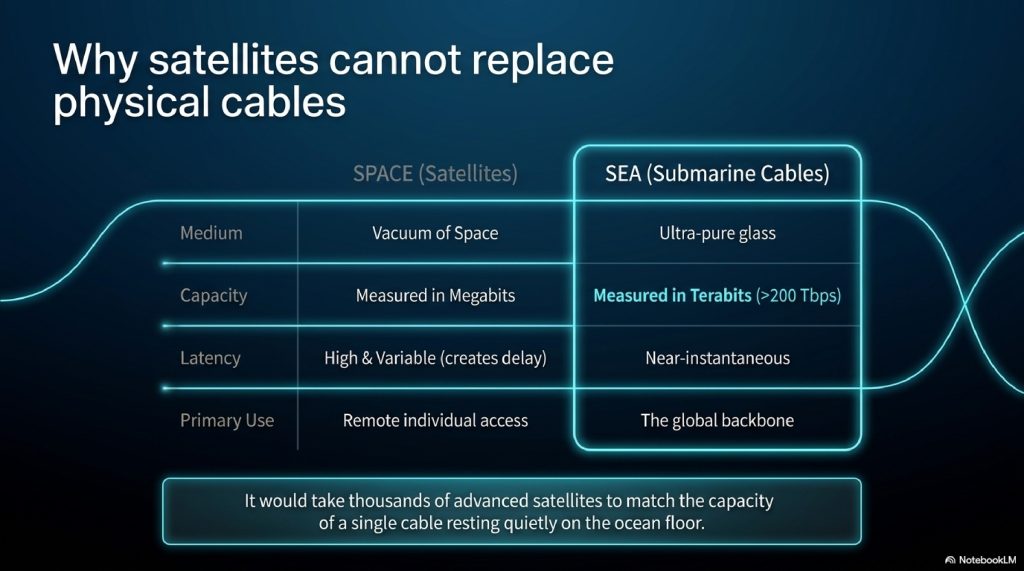
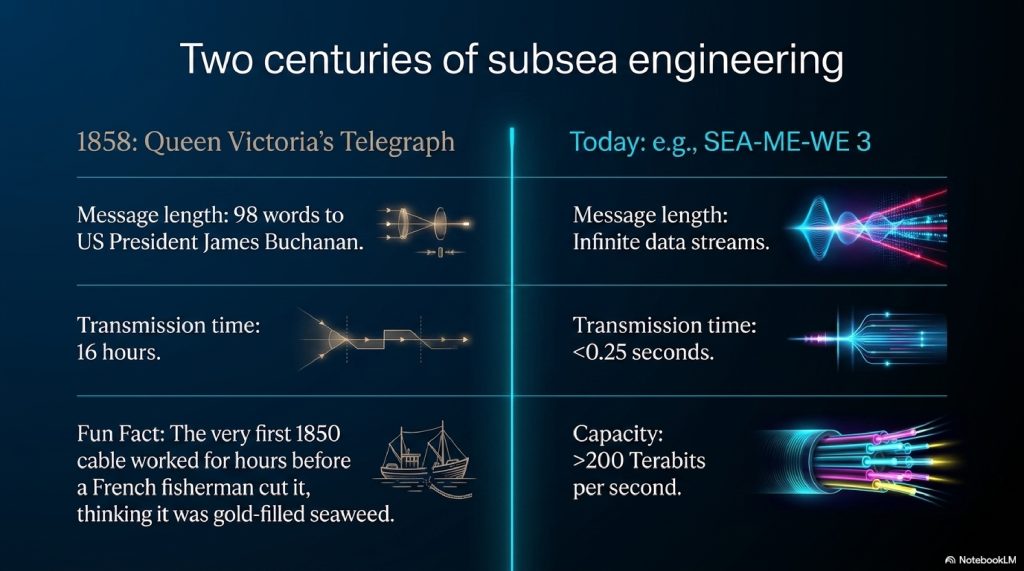
To put it in perspective: A single modern undersea cable can transmit over 200 Terabits of data per second. You would need thousands of advanced satellites to match the capacity of just one cable resting quietly in the mud. Light traveling through glass is simply the fastest, most efficient way to move massive amounts of information.
2. The Simple Explanation: The Flashlight and the Mirror
At its core, submarine internet relies on fiber optics.
Imagine you are standing at one end of a long, dark, perfectly straight pipe that has mirrors coating the inside. You want to send a Morse code message to a friend at the other end. You take a powerful flashlight and click it on and off. The light bounces off the mirrored walls and shoots down the pipe, allowing your friend to see the flashes and decode the message.
This is exactly how fiber optics work, just on a microscopic, hyper-fast scale.
Instead of a pipe, we use incredibly pure, ultra-clear glass threads. Instead of a flashlight, we use high-powered lasers. And instead of you clicking a button, computers turn the laser on and off billions of times per second to represent the 1s and 0s of digital data.
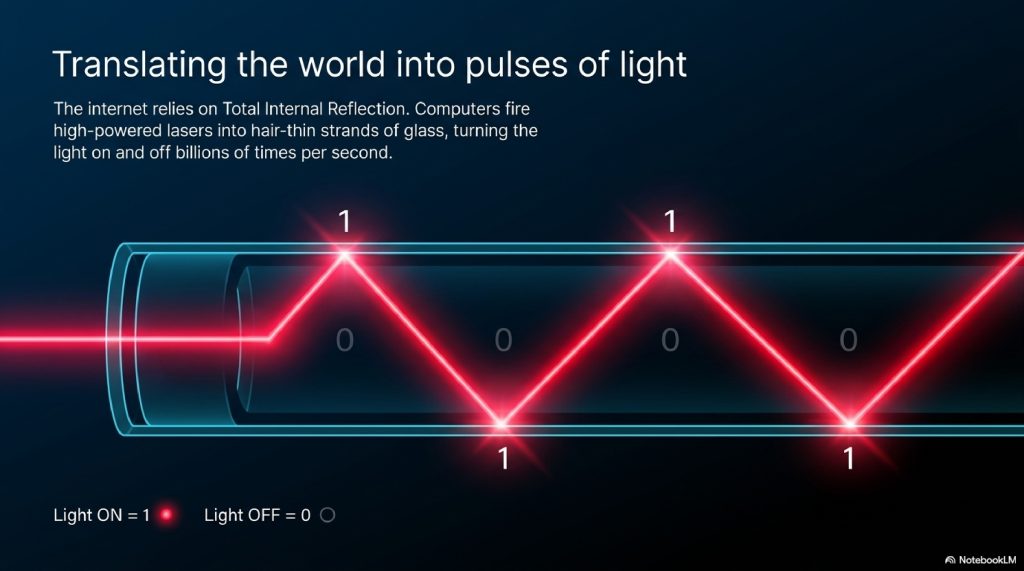
- Light ON = 1
- Light OFF = 0
These light pulses travel through the glass, bouncing off the edges in a process called Total Internal Reflection, until they reach the other side of the ocean.
3. The Anatomy of a Submarine Cable: Armor for Glass
The glass fibers inside the cable are so pure that if the ocean were filled with this glass instead of water, you could see the bottom perfectly clearly from the surface. But glass is fragile. If you’re going to drop it to the bottom of the ocean, where water pressure is heavy enough to crush a submarine, it needs protection.
An undersea cable in the deep ocean is surprisingly thin about the diameter of a garden hose. As it gets closer to the shore, where ship anchors and fishing nets pose a threat, the cable becomes as thick as a soda can.
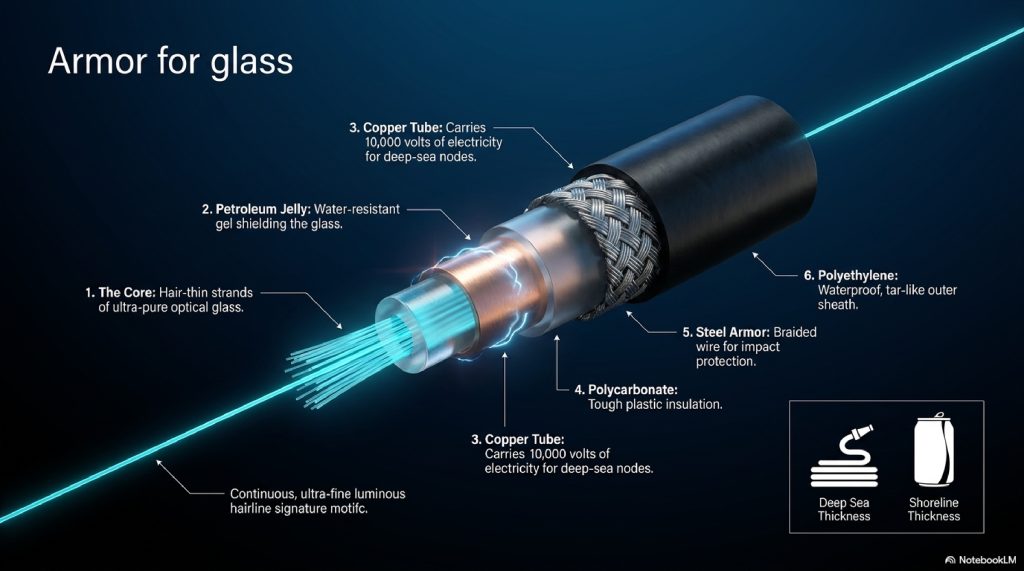
From the inside out, the anatomy looks like this:
- The Core: The hair-thin strands of optical glass.
- Petroleum Jelly: A thick, water-resistant gel that keeps the glass safe from moisture.
- Copper or Aluminum Tube: This carries high-voltage electricity (we’ll explain why soon).
- Polycarbonate Insulation: A tough plastic to keep the electricity contained.
- Steel Wire Armor: Braided steel cables to protect against stretching, sharks, and rocks.
- Mylar Tape and Polyethylene: The final waterproof, tar-like outer plastic sheath.
4. Step-by-Step Breakdown: The Journey of a Message
Let’s track EXACTLY what happens when data crosses an ocean.
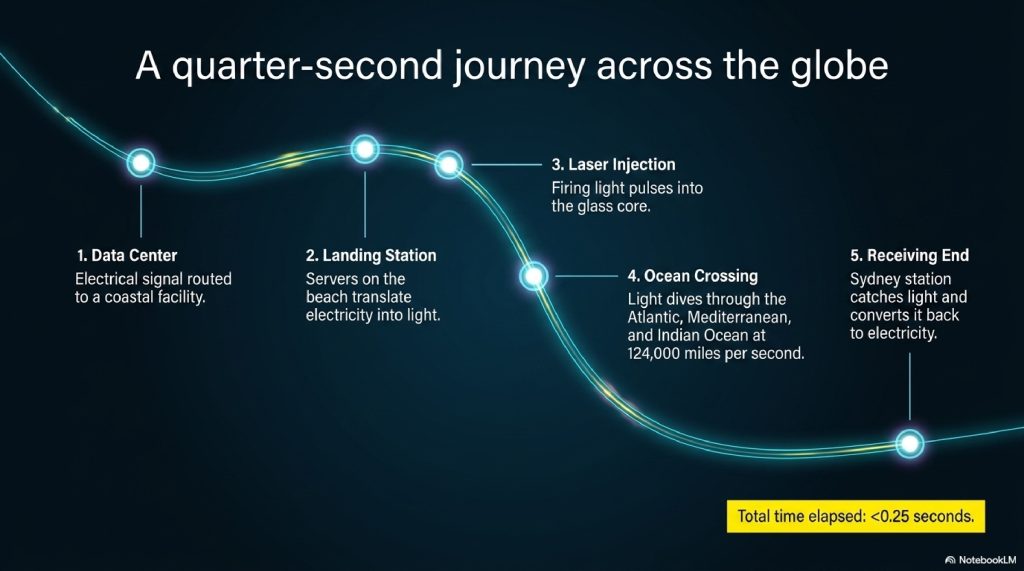
- Step 1: The Data Center Your device sends an electrical signal (data) to your local internet service provider, which routes it to a massive data center on the coast.
- Step 2: The Landing Station The data arrives at a heavily fortified building right on the beach called a Cable Landing Station. Here, massive servers take the electrical signal and translate it into light pulses.
- Step 3: The Laser Injection Industrial lasers fire these light pulses into the hair-thin glass fibers of the submarine cable.
- Step 4: The Ocean Crossing The light races through the glass under the ocean at about 124,000 miles per second (the speed of light in glass is slightly slower than in a vacuum).
- Step 5: The Receiving End The light arrives at a landing station on a different continent. Specialized photo-receptors catch the light, translate it back into electrical signals, and route it to the destination router.
5. Real-World Example: An Email from London to Sydney
Imagine you hit “Send” on an email in London, destined for a server in Sydney, Australia.
Your email is instantly broken down into tiny data packets. Those packets rush through terrestrial fiber-optic cables beneath the streets of London, arriving at a landing station on the coast of Cornwall, England.
Lasers encode your email into light and shoot it into a cable like the SEA-ME-WE 3 (South East Asia–Middle East–Western Europe 3). The light dives under the Atlantic, passes through the Mediterranean Sea, slides through the Suez Canal, crosses the Indian Ocean, and finally arrives at a landing station in Perth, Australia.
From there, it converts back to electricity and zips across the Australian outback to Sydney.
Total time elapsed? Less than a quarter of a second.
6. Advanced Technical Layer: Lasers, Repeaters, and WDM
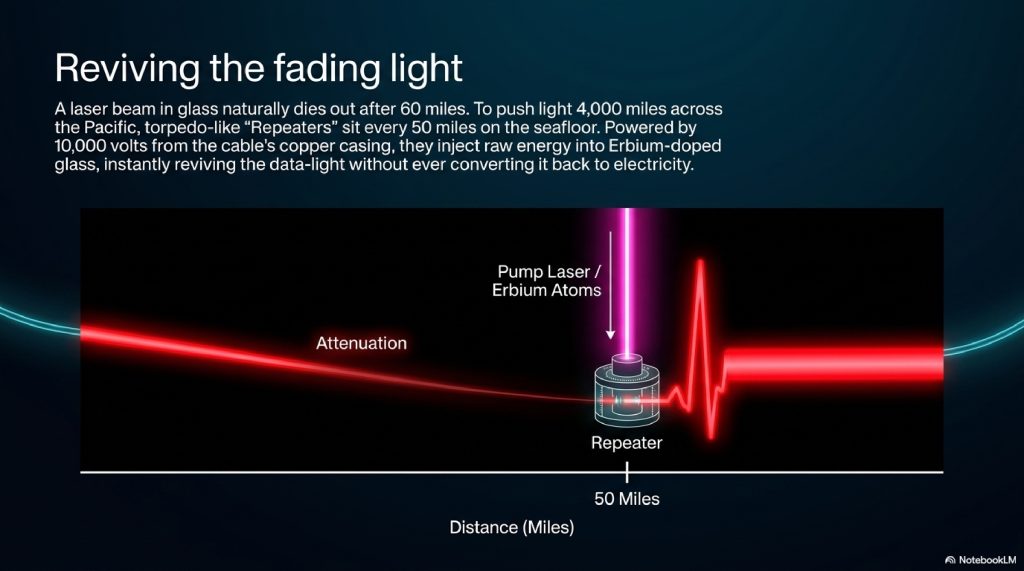
If you shine a flashlight into a long pipe, the light eventually fades. The same is true for lasers in glass. This fading is called attenuation. Without help, a laser beam would die out completely after about 60 miles (100 km).
How do we push light 4,000 miles across the Pacific? We use two incredible pieces of technology:
A. Submarine Repeaters Every 50 miles, the cable has a thick, torpedo-like bulge called a Repeater. Inside the repeater is an Erbium-Doped Fiber Amplifier (EDFA). When the fading data-light enters the repeater, it hits a section of glass doped with the rare-earth element Erbium. The repeater uses its own “pump laser” to inject raw, unstructured light energy into the Erbium. The Erbium atoms absorb this raw energy and transfer it to the fading data-light, instantly reviving it and shooting it out the other side at full strength. Note: This is why the cable contains a copper tube. It carries up to 10,000 volts of electricity from the landing stations to power these repeaters on the ocean floor.
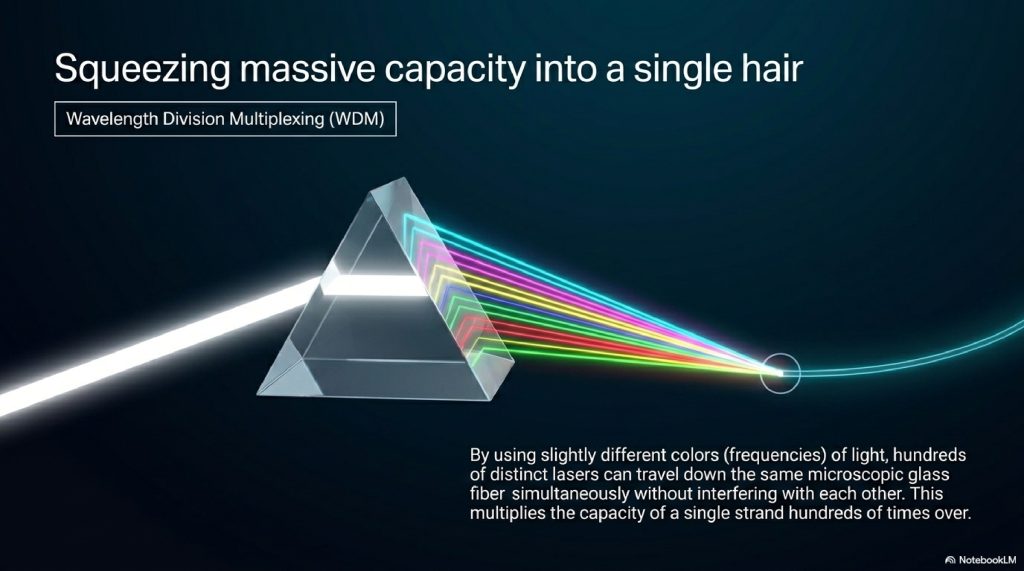
B. Wavelength Division Multiplexing (WDM) Shooting one laser down a fiber is wasteful. Scientists discovered that if you use slightly different colors (frequencies) of light, you can shoot multiple lasers down the same microscopic glass fiber at the same time without them interfering with each other. Modern cables can transmit hundreds of different colors of light simultaneously, multiplying the data capacity of a single strand of glass by hundreds of times.
7. Laying the Veins of the Earth: Cable Ships and ROVs
How do you lay a 4,000-mile wire across an ocean? Slowly, and with massive, specialized vessels called Cable Ships.
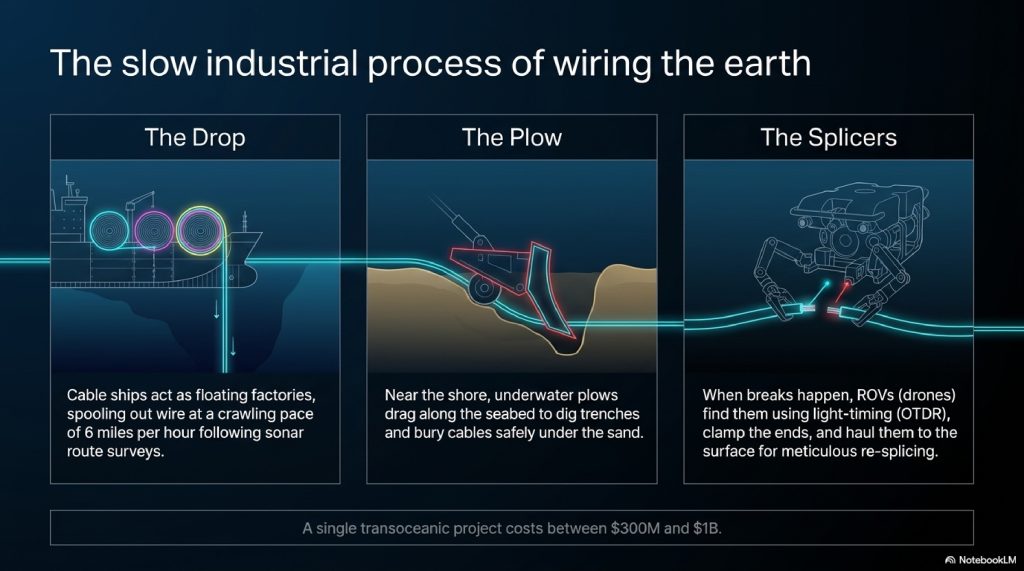
A cable ship is essentially a floating factory. The cable is spooled in giant, circular holding tanks inside the ship.
- The Route Survey: Months before laying, sonar ships map the ocean floor to find a safe path. They look for flat plains and avoid underwater volcanoes, deep trenches, and jagged coral reefs.
- The Drop: The ship sets sail from the origin point, slowly spooling the cable off the back. It moves at a crawling pace of roughly 6 miles per hour.
- The Plow: Near the shore, the cable is highly vulnerable to fishing trawlers and ship anchors. The cable ship lowers an underwater plow. The plow drags along the seabed, digging a trench, laying the cable inside, and burying it under the sand.
- The ROVs: When a cable breaks, telecom companies dispatch Remotely Operated Vehicles (ROVs) underwater drones. The ROV dives to the seabed, finds the cut, clamps onto the two ends, and brings them to the surface. Engineers on the ship meticulously splice the hair-thin glass fibers back together, wrap the cable in fresh armor, and drop it back down.
8. Common Myths About Undersea Cables
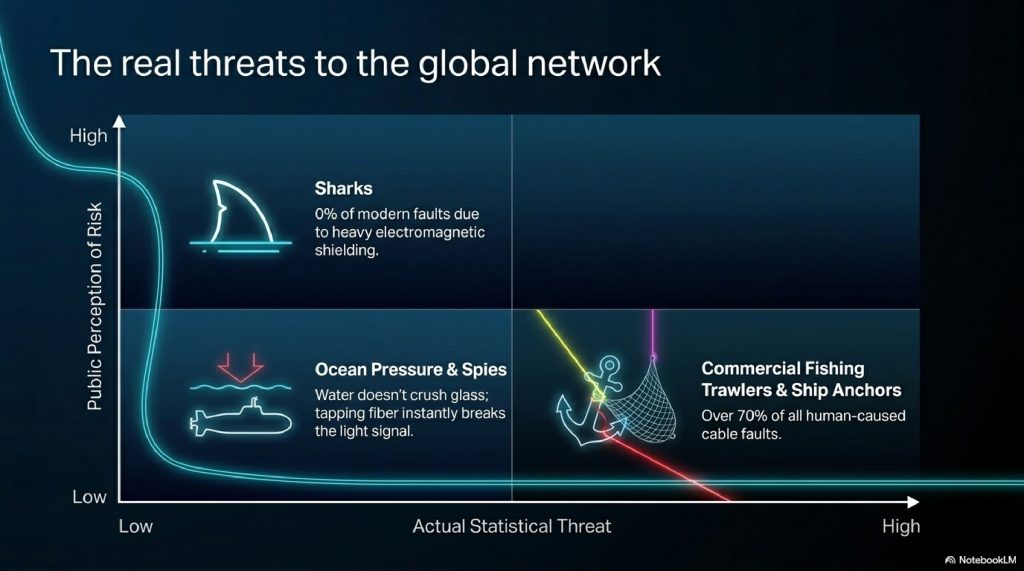
Myth: Sharks are constantly eating the internet. In the 1980s, a few early experimental cables were indeed bitten by sharks, likely because the sharks’ electro-receptors were confused by the electromagnetic fields generated by the cables. Today, cables are heavily shielded. According to the International Cable Protection Committee, shark bites account for 0% of modern cable faults.
Myth: The ocean is the biggest danger to cables. The crushing pressure and saltwater rarely damage a cable. Over 70% of all cable faults are caused by humans, specifically commercial fishing trawlers dragging heavy nets on the seafloor, and cargo ships dropping anchors in restricted zones.
Myth: It’s easy for spies to tap a submarine cable. While governments (like the US and Russia) have used modified submarines to place tapping devices on cables in the past, it is incredibly difficult. Because data is transmitted as light, cutting into the fiber to “listen” will immediately disrupt the light signal, alerting the operators that the cable has been breached.
9. The Future: Reaching the Physical Limits of Light
Humanity has an insatiable appetite for data. We are approaching a physical barrier called the Shannon Limit, the absolute maximum amount of data you can force through a single strand of optical fiber before the light signals bleed into each other and corrupt the data.
To solve this, the industry is shifting to Space-Division Multiplexing (SDM). Instead of trying to force more colors of light into one core, manufacturers are creating fibers with multiple tiny glass cores inside a single strand.
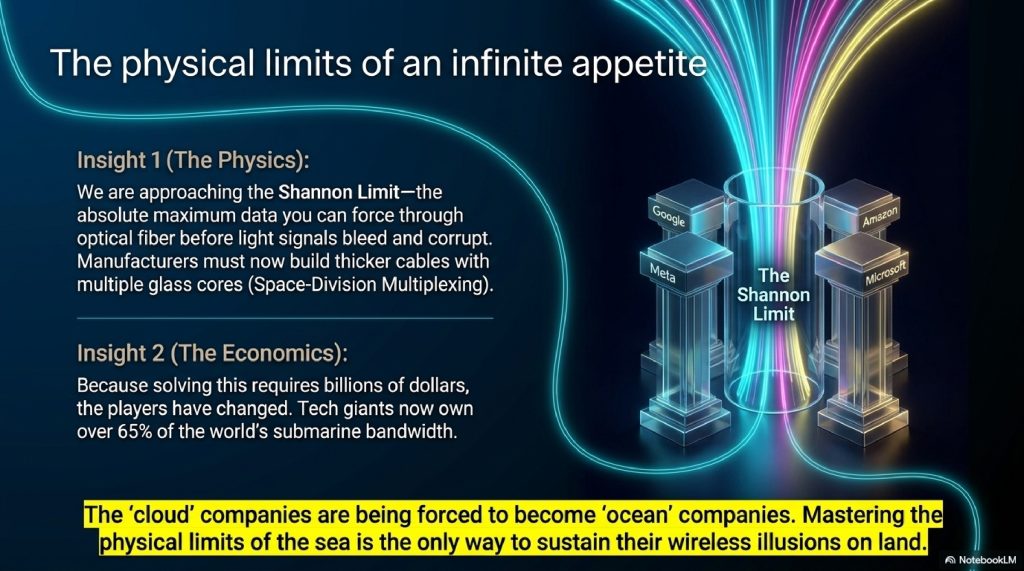
Furthermore, the players have changed. Ten years ago, telecom companies built the cables. Today, massive tech giants Google, Meta (Facebook), Microsoft, and Amazon, own or lease over 65% of the world’s submarine bandwidth. Projects like the 2Africa cable (funded heavily by Meta) are wrapping the entire continent of Africa in a massive 28,000-mile loop, connecting over 3 billion people to high-speed internet for the first time.
10. Surprising Facts You Didn’t Know
- The First Cable: The very first submarine telegraph cable was laid across the English Channel in 1850. It worked for only a few hours before a French fisherman accidentally snagged it and cut it, thinking he had discovered a new type of gold-filled seaweed.
- The Queen’s Email: In 1858, a transatlantic telegraph cable was laid. Queen Victoria sent a message of congratulations to US President James Buchanan. The 98-word message took 16 hours to transmit.
- No Ownership of the Ocean: Much of the ocean floor is international waters. Cables lie there unprotected by any single nation’s military, relying on international treaties for safety.
- The Internet is Bouncy: When an earthquake hit Taiwan in 2006, it triggered a submarine landslide that severed multiple massive cables. Millions of people in Asia lost internet access instantly, forcing data to automatically route the “long way” around the globe through Europe to reach the US.
11. FAQs
1. How long do submarine cables last? A typical submarine cable has an engineered lifespan of about 25 years. However, they are often “retired” earlier not because they break, but because newer cables offer vastly more capacity, making the old ones economically obsolete.
2. Who owns the undersea internet cables? Historically, consortiums of national telecom companies owned them. Today, tech giants like Google, Meta, Amazon, and Microsoft are the primary investors and owners of new cable routes.
3. What happens if a cable is cut? The internet is designed to route around damage. If a single cable is cut, traffic automatically redirects to other cables. You might experience slower loading times, but the internet rarely goes down entirely, unless you live in an area served by only one or two cables.
4. How deep do these cables go? Some cables rest at depths of over 26,000 feet (8,000 meters), as deep as Mount Everest is tall. At this depth, the water pressure is immense, but the cables are engineered to withstand it.
5. Do sharks really bite undersea cables? This is a popular myth. While sharks occasionally bit poorly shielded cables in the 1980s, modern cables have advanced electromagnetic shielding. Sharks are no longer a threat.
6. How much does it cost to lay a submarine cable? Depending on the length and the terrain of the ocean floor, a major transoceanic cable project can cost anywhere from $300 million to over $1 billion.
7. Can satellites like Starlink replace submarine cables? No. While Starlink is incredible for remote areas without infrastructure, satellites simply cannot carry the sheer volume of data that physical glass fibers can. Submarine cables will remain the backbone of the global internet for the foreseeable future.
8. Are undersea cables dangerous to marine life? No. Once laid, the cables are inert and quickly become part of the environment, often serving as artificial reefs where coral and sponges grow.
9. How do they find a break in a cable in the middle of the ocean? Engineers use a technique called Optical Time-Domain Reflectometry (OTDR). They shoot a pulse of light down the broken cable and measure exactly how long it takes for the light to bounce off the broken end and return. By calculating the speed of light, they can pinpoint the break down to the precise meter.
10. How thick is an undersea cable? In the deep ocean, where there are no ships or anchors, the cable is incredibly thin, about the size of a garden hose. Near the shore, layers of steel armor are added, making it roughly the size of a soda can.
12. OTHER BLOG SUGGESTIONS
To keep readers engaged and improve your site’s SEO architecture, consider linking to these related topics:
- How Does Wi-Fi Work? The Simple Science of Wireless Data
- How Do Mobile Towers Work? The Science of Cellular Networks
- How Does Satellite Internet Work? (A Complete Guide)
- How Lithium-Ion Batteries Work: The Science of Portable Energy
13. CONCLUSION
The next time you make a video call, stream a movie, or tap to pay for your coffee, take a moment to look down.
We live our lives looking up at the sky, assuming the magic of modern connectivity falls from the clouds. But the reality is far more grounded, more physical, and infinitely more fascinating. The internet is a tangible thing. It is made of glass, steel, and light. It rests in the absolute darkness of the ocean floor, braving freezing temperatures, immense pressure, and shifting tectonic plates.
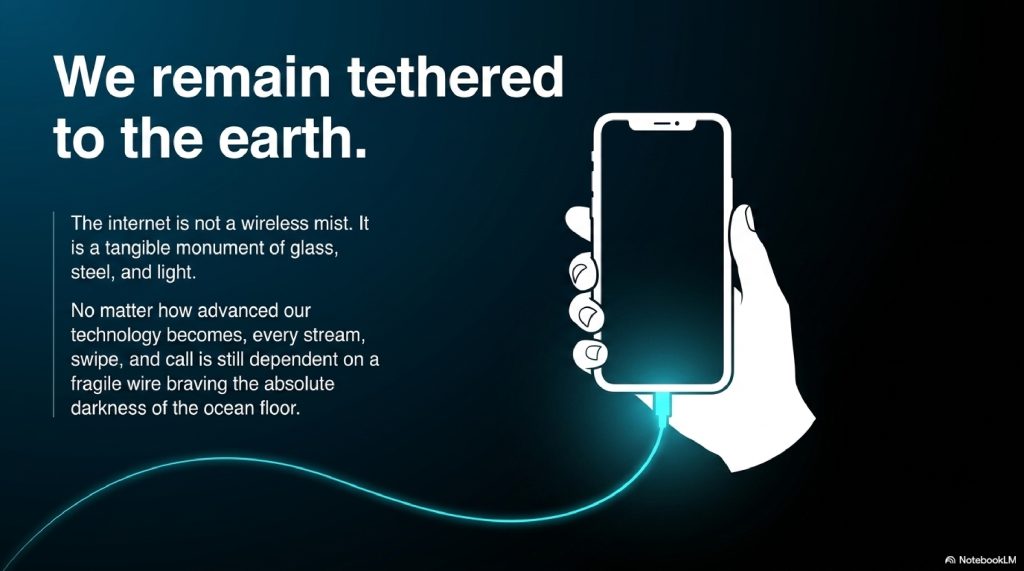
The global internet is not a wireless mist. It is a monument to human engineering, a delicate, glowing web that ties the continents together, reminding us that no matter how advanced our technology becomes, we are still completely dependent on the physical earth beneath our feet.