INTRODUCTION
Look up at a clear blue sky, and it appears endlessly vast and peacefully empty.
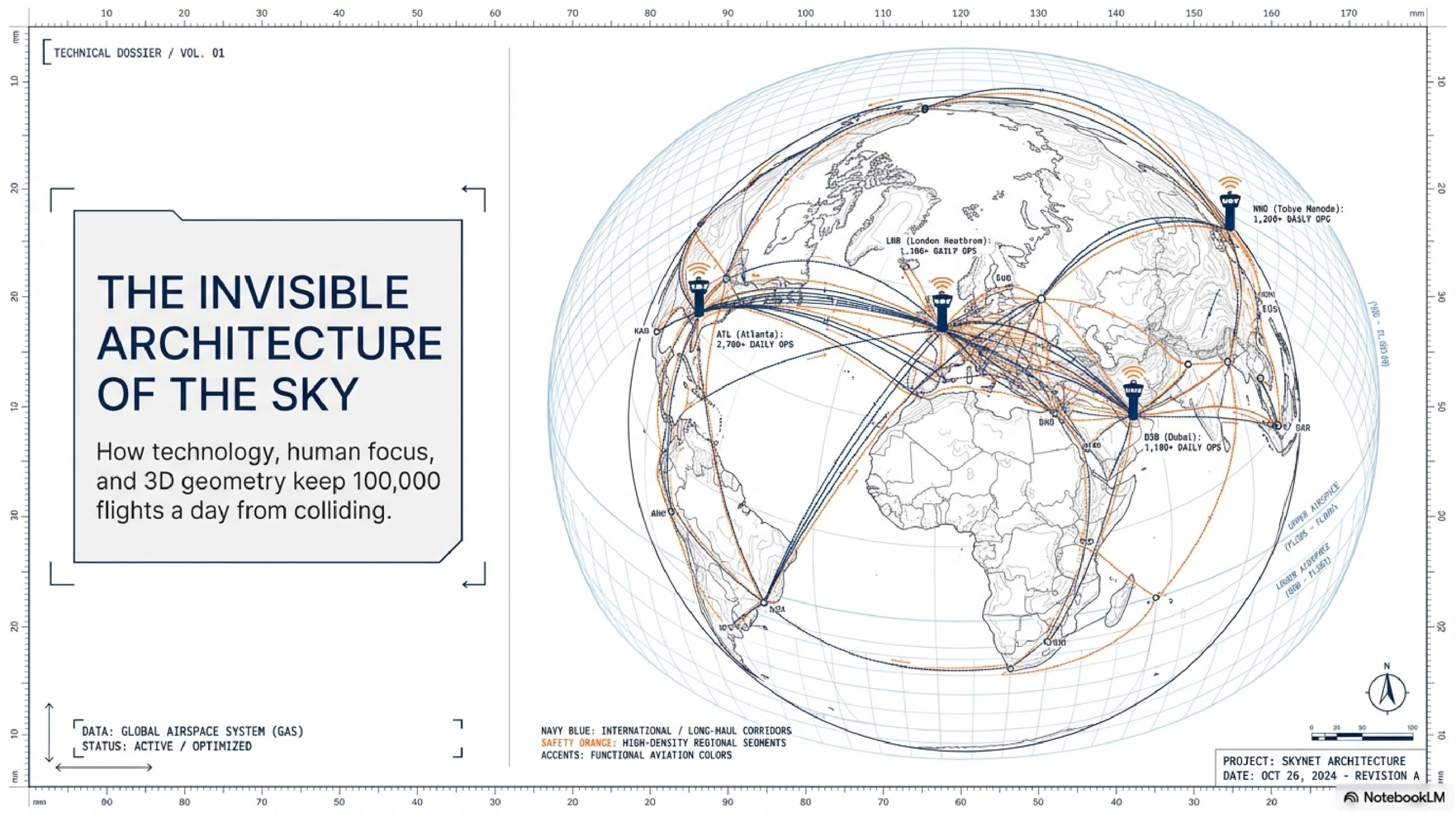
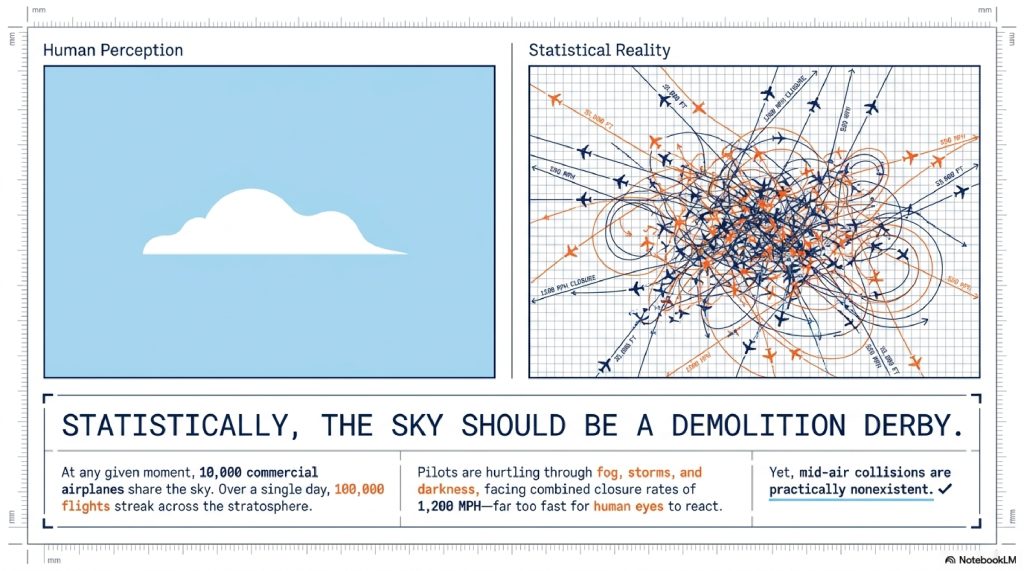
But behind the scenes, that seemingly open space is a chaotic, hyper-crowded digital warzone. At any given moment, there are roughly 10,000 commercial airplanes in the sky. Over the course of a single day, more than 100,000 flights will take off, streak across the stratosphere at 600 miles per hour, and land. Millions of tons of metal and fuel hurtle through the atmosphere, often completely blind to one another, flying into fog, storms, and darkness.
Statistically, the sky should be a demolition derby. Yet, mid-air collisions involving commercial airliners are so incredibly rare that they are practically nonexistent in modern aviation.
How is this possible?
If you ask the average passenger, they might point to the pilots looking out the cockpit windows, or perhaps to the towering glass structures at the airport. But human eyes cannot see a jet approaching at a combined closure rate of 1,200 miles per hour until it’s far too late to turn. And those glass towers? They only watch the planes for the first and last five miles of a journey.
The reality is that our skies are carved into thousands of invisible, strictly regulated 3D highways. Managing them requires a globe-spanning relay race involving radar arrays, GPS satellites, robotic collision-avoidance algorithms, and tens of thousands of human beings sitting in dark, windowless rooms staring at glowing screens.
In this deep dive, we are going to strip away the clouds and expose the invisible architecture of the sky. We will track a flight from the moment the engines start to the second the wheels touch down, revealing the brilliant, overlapping layers of technology that ensure you arrive at your destination safely, every single time.
Buckle up. We’re heading into the control room.
TABLE OF CONTENTS
- The Simple Explanation: The 3D Highway and the Invisible Bubble
- Step-by-Step: The Ultimate Relay Race
- Real-World Example: Delta Flight 123 to LAX
- The Advanced Technical Layer: How Radar Actually “Sees”
- TCAS: The Robot Bodyguard That Overrules Humans
- Common Myths About Air Traffic Control
- The Future: NextGen and Satellite Tracking
- Surprising Facts You Didn’t Know
- FAQs
- Conclusion
1. The Simple Explanation: The 3D Highway and the Invisible Bubble
To understand how Air Traffic Control (ATC) works, stop thinking about the sky as an open ocean where planes can go wherever they want.
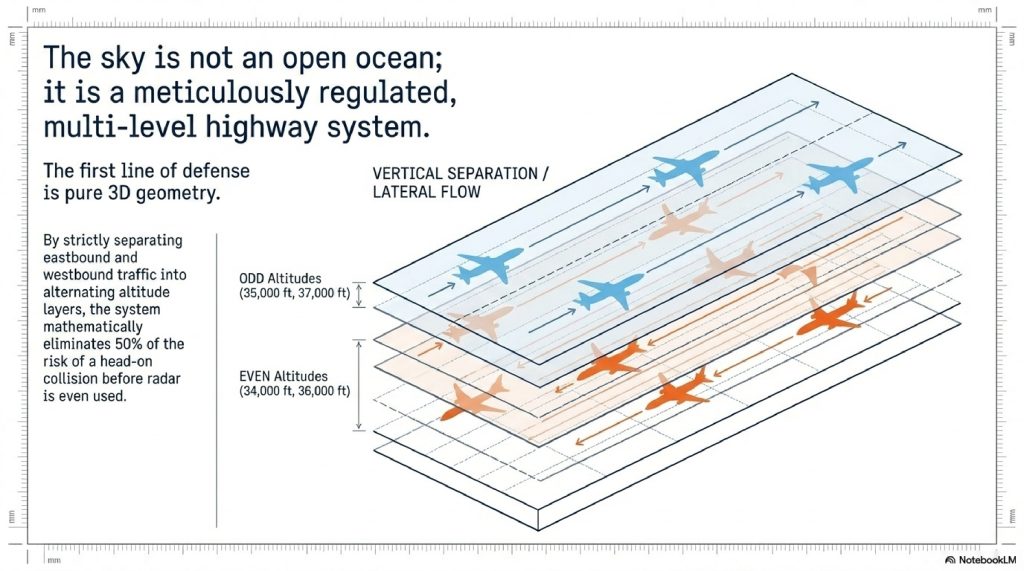
Think of the sky as a massive, multi-level highway system.
Just like roads on the ground, the sky has lanes, intersections, and speed limits. But unlike a highway on the ground, these lanes stack on top of each other. Planes traveling East fly at odd altitudes (e.g., 35,000 feet, 37,000 feet). Planes traveling West fly at even altitudes (e.g., 34,000 feet, 36,000 feet). This simple rule immediately eliminates half the risk of a head-on collision.
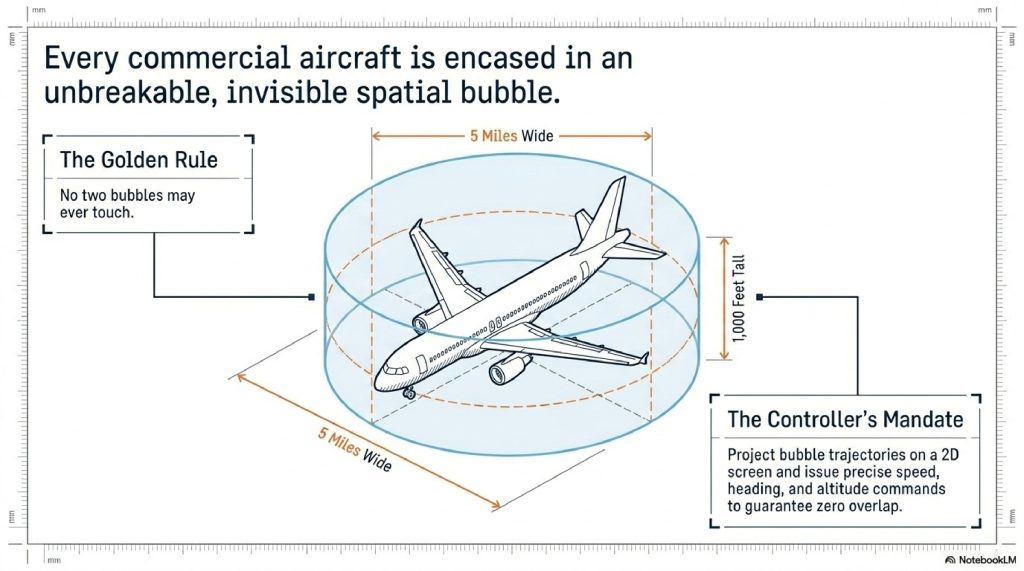
But ATC goes a step further. Every commercial airplane is wrapped in an invisible protective bubble.
In the United States, the standard bubble is 5 miles wide and 1,000 feet tall. The fundamental rule of Air Traffic Control is absolute and unbreakable: No two bubbles may ever touch.
The job of an air traffic controller is simply to look at a screen, predict where these bubbles are moving, and issue speed, heading, and altitude adjustments to ensure they never overlap.
2. Step-by-Step: The Ultimate Relay Race
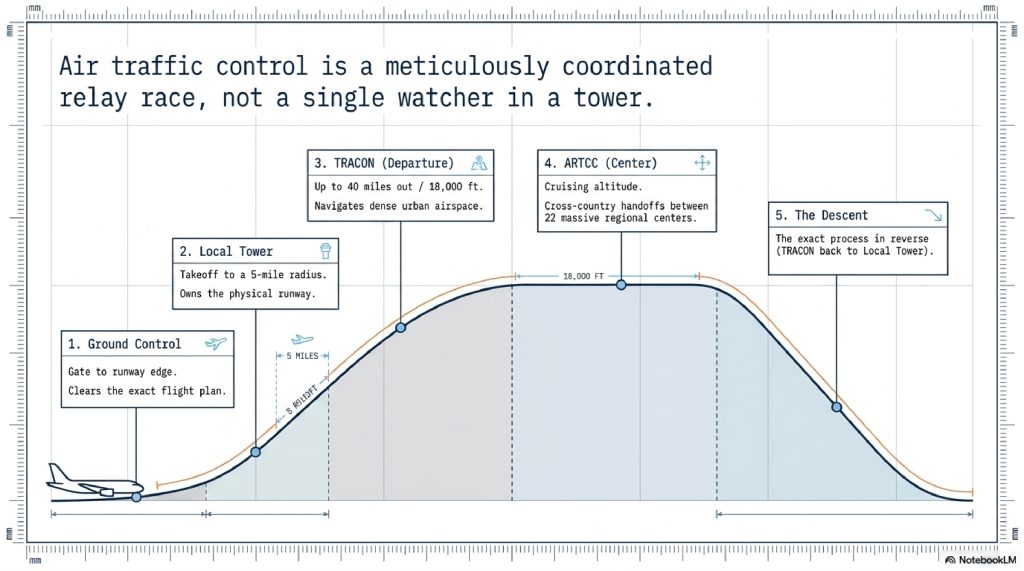
One of the biggest misconceptions about flying is that a single person in a tower watches your plane for the whole flight. In reality, ATC is a meticulously coordinated relay race. As your plane flies, your pilot’s radio frequency is handed off from one controller to the next, piece by piece.
Here is exactly what happens:
Step 1: Clearance Delivery & Ground Control
Before the engines even start, the pilot calls Clearance Delivery. This controller approves the flight plan, ensuring the computer network knows the plane’s exact intended route. Once approved, Ground Control takes over, guiding the plane through the maze of taxiways safely to the edge of the runway.
Step 2: Local Control (The Tower)
This is the person sitting in the glass tower at the airport. They own the runway. They have visual sight of the plane and give the final, magical words: “Cleared for takeoff.” The Tower only handles the airspace within about a 5-mile radius.
Step 3: TRACON (Departure)
As soon as the wheels leave the ground, the Tower hands the pilot off to a TRACON (Terminal Radar Approach Control). These controllers sit in a dark room often far away from the airport itself. They look at radar screens and guide the plane as it climbs through the busy airspace surrounding the city (up to about 40 miles out and 18,000 feet up).
Step 4: ARTCC (The En Route Center)
Once the plane hits cruising altitude, TRACON passes the baton to an ARTCC (Air Route Traffic Control Center). The US is divided into 22 massive “Centers.” If you fly from New York to California, you will be handed off from the New York Center, to the Cleveland Center, to Chicago, Kansas City, Denver, and finally Los Angeles.
Step 5: The Descent
As the plane nears its destination, the process happens in reverse: ARTCC passes the plane to the destination city’s TRACON, who lines the plane up with the runway, and finally passes it to the Local Tower for landing clearance.
3. Real-World Example: Waking Up the Blue Dot
Let’s visualize this with a flight from Atlanta (ATL) to London (LHR).
When Flight 123 pushes back from the gate in Atlanta, the Atlanta Ground Controller makes sure it doesn’t bump into a baggage cart. The Atlanta Tower clears it to take off. At 2,000 feet, the pilot switches radio frequencies to Atlanta Departure (TRACON), who guides the heavy jet through a maze of other planes arriving from Orlando and Dallas.
At 18,000 feet, Atlanta Center takes over. As the plane flies up the East Coast, it is seamlessly handed off to Washington Center, then New York Center, then Boston Center.
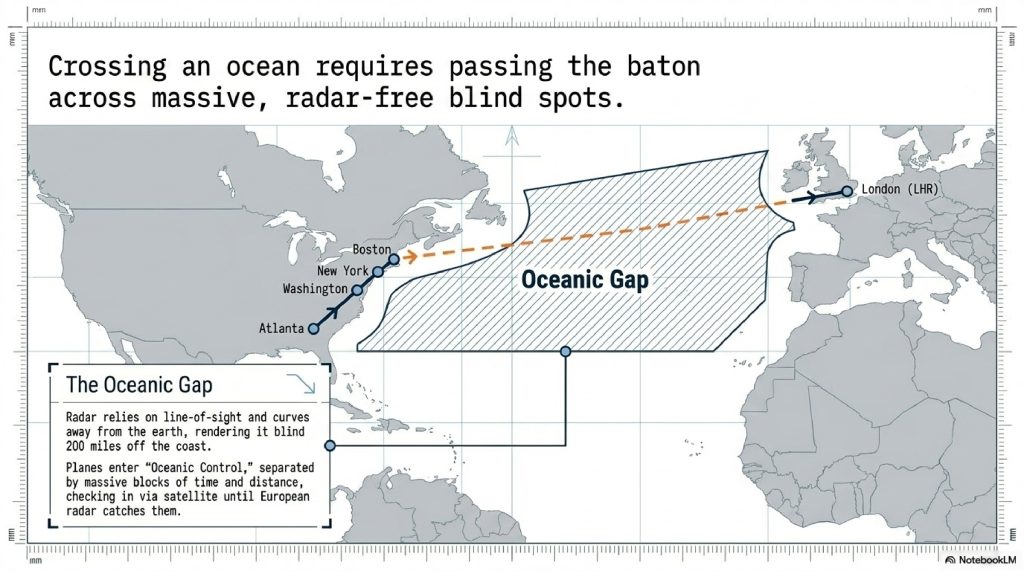
As the plane leaves the coast of North America and heads out over the dark Atlantic Ocean, it leaves radar coverage entirely. Now, it enters “Oceanic Control,” where planes are separated by massive blocks of time and distance, checking in via satellite or high-frequency radio until European radar picks them up off the coast of Ireland.
The pilots will speak to over 15 different controllers during the flight. The passengers will never notice a single transition.
4. The Advanced Technical Layer: How Radar Actually “Sees”
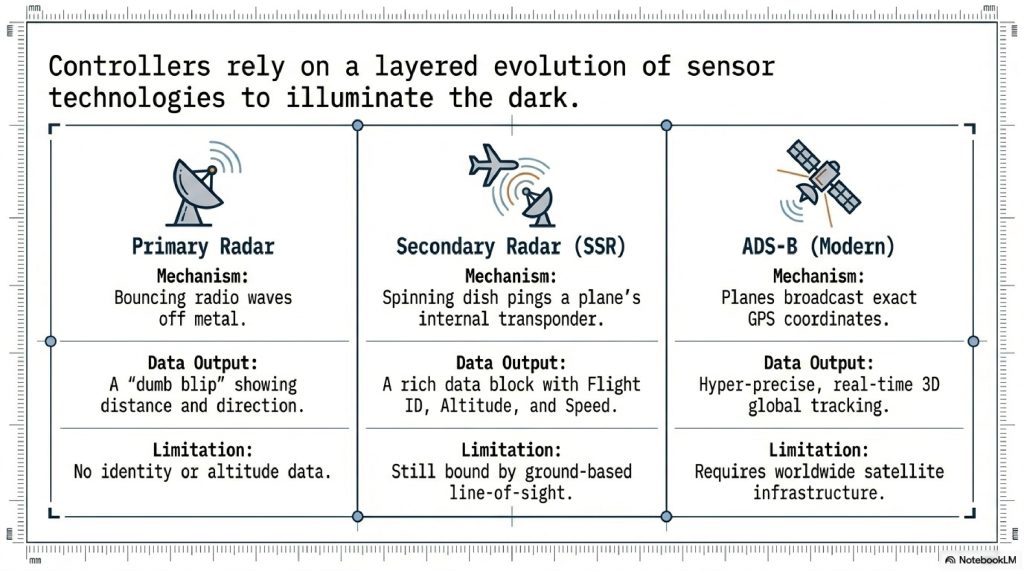
How do those controllers in dark rooms actually see the planes? They use a combination of technologies that have evolved dramatically over the last 80 years.
Primary Radar
This is the classic, WWII-era technology. A massive dish spins around, blasting radio waves into the sky. If a radio wave hits a metal object (an airplane), it bounces back to the dish. The computer calculates how long the bounce took, giving the controller a blip on the screen showing distance and direction. The flaw: Primary radar doesn’t know who the plane is, or how high it is. It’s just a dumb blip.
Secondary Surveillance Radar (SSR) & Transponders
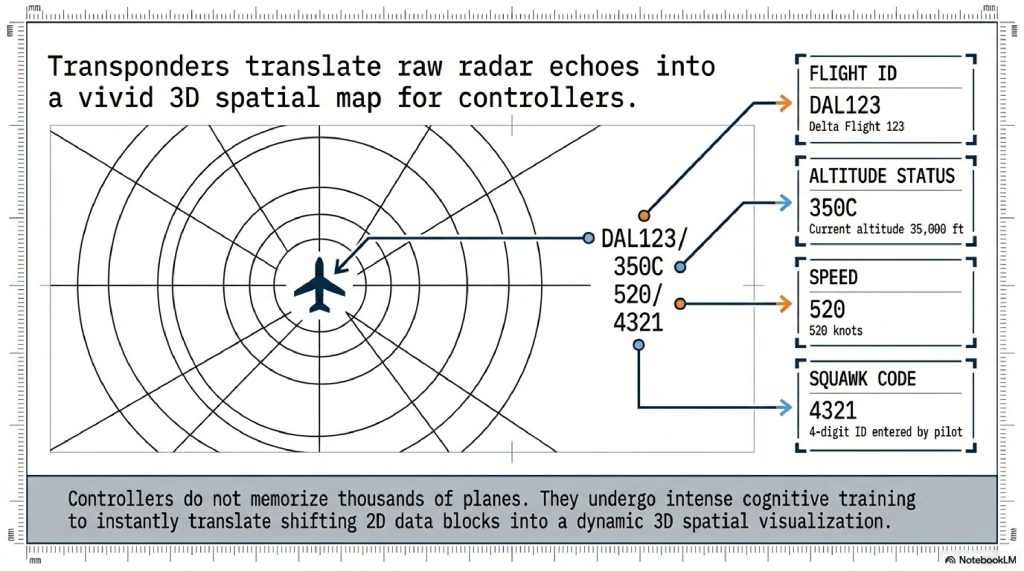
To fix the primary radar problem, every commercial plane carries a device called a Transponder. When the spinning radar dish on the ground pings the airplane, the transponder actively shouts back a digital message. It says: “I am Delta Flight 123, my unique 4-digit ID code is 4321, I am at exactly 35,000 feet, and I am traveling at 520 knots.” This turns the “dumb blip” on the controller’s screen into a rich data block filled with crucial information.
ADS-B (Automatic Dependent Surveillance-Broadcast)
This is the modern upgrade. Instead of waiting to be pinged by a spinning radar dish, planes use GPS to determine their exact location in space, and then constantly broadcast that location to the ground, to satellites, and to other airplanes. It is incredibly precise and is rapidly replacing traditional radar entirely.
5. TCAS: The Robot Bodyguard That Overrules Humans
What happens if the system fails? What if two planes are put on a collision course, the controller doesn’t notice, and the pilots are flying through a thick cloud?
Enter the ultimate safety net: TCAS (Traffic Collision Avoidance System).
TCAS is a computer system built directly into the airplane that talks to the transponders of other airplanes nearby. It completely bypasses Air Traffic Control. It forms a digital shield around the aircraft.
If TCAS detects that another plane is getting too close and a collision is imminent (usually within 40 seconds), an alarm blares in both cockpits. But TCAS doesn’t just warn the pilots; it actively negotiates a solution with the other airplane’s computer in a fraction of a millisecond.
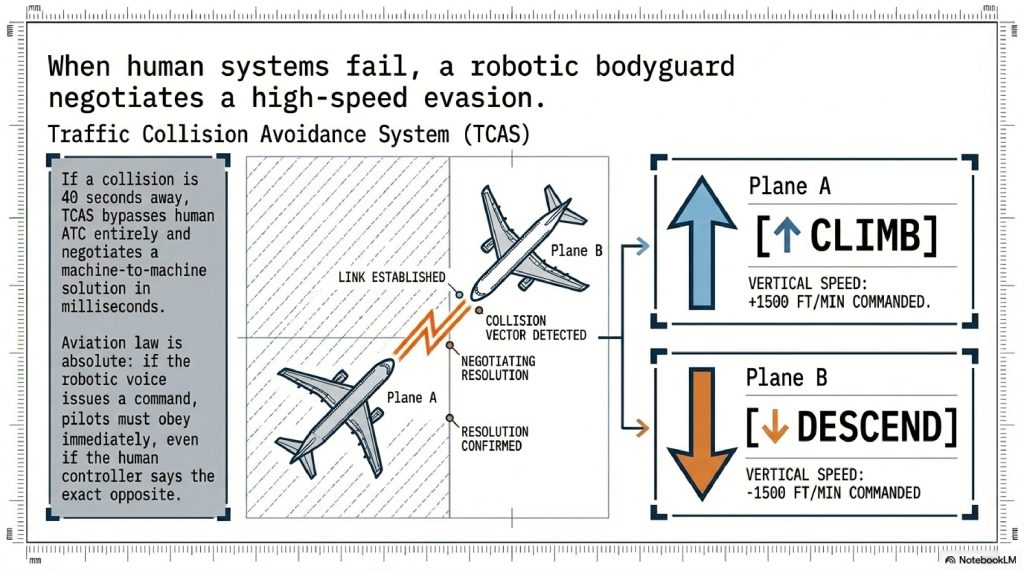
- In Plane A, a robotic voice yells: “CLIMB! CLIMB!”
- In Plane B, a robotic voice yells: “DESCEND! DESCEND!”
Aviation law dictates that if TCAS gives a command, the pilots must obey it immediately, even if the human air traffic controller on the radio tells them to do the exact opposite. TCAS is the final, infallible referee of the sky, and it has saved countless lives.
6. Common Myths About Air Traffic Control
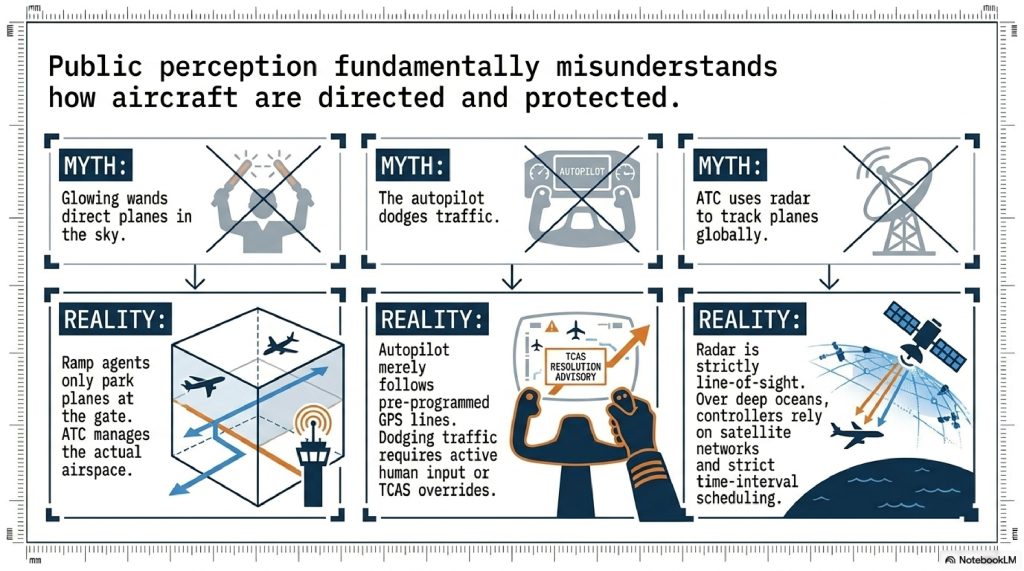
Myth 1: Controllers direct planes with glowing wands on the tarmac. Those are ramp agents, not Air Traffic Controllers. ATC is handling the airspace; ramp agents are just making sure the plane parks at the gate without clipping its wings.
Myth 2: ATC uses radar to track planes across the ocean. Radar is line-of-sight and curves away from the earth. Once a plane is about 200 miles off the coast, traditional radar cannot see it. Over oceans, planes are tracked via satellite networks and strictly scheduled time intervals.
Myth 3: The autopilot flies the plane to avoid traffic. Autopilot keeps the plane level and follows pre-programmed GPS routes, but it does not automatically dodge other planes. Avoiding traffic requires active human input from the pilots based on ATC instructions or TCAS alerts.
7. The Future: NextGen and Space-Based Tracking
The global ATC system is currently undergoing the biggest upgrade in its history. In the United States, this modernization project is called NextGen.
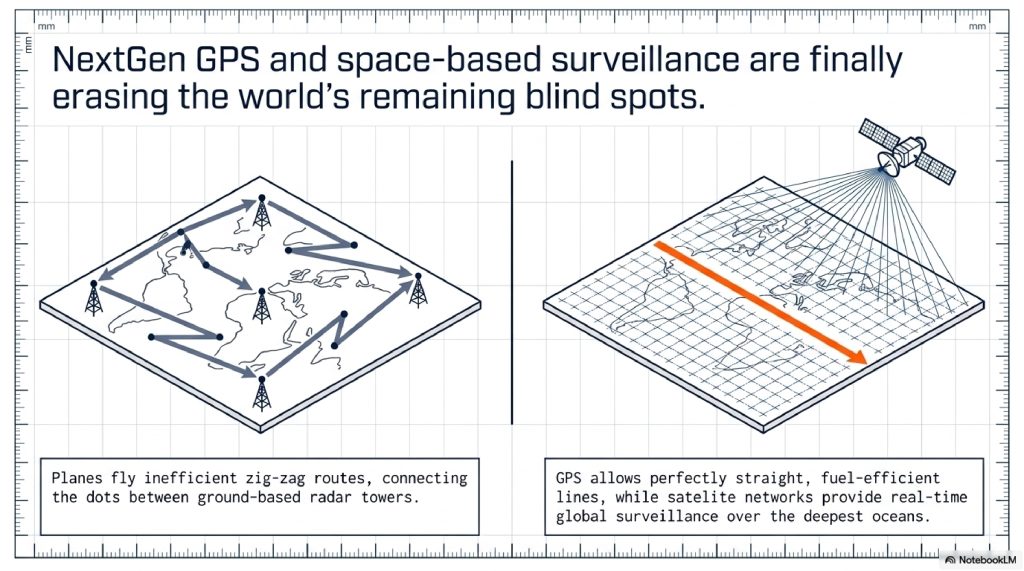
For decades, planes flew slightly curved, inefficient routes because they had to fly from one ground-based radar beacon to the next (like connecting the dots). NextGen transitions the system entirely to GPS. This allows planes to fly in perfectly straight lines, saving millions of gallons of fuel and easing congestion.
Furthermore, companies like Aireon have launched networks of satellites capable of tracking ADS-B signals from space. For the first time in human history, controllers have real-time, global surveillance of aircraft over the deepest oceans and the most remote poles. The “blind spots” of the 20th century are finally being erased.
8. Surprising Facts You Didn’t Know
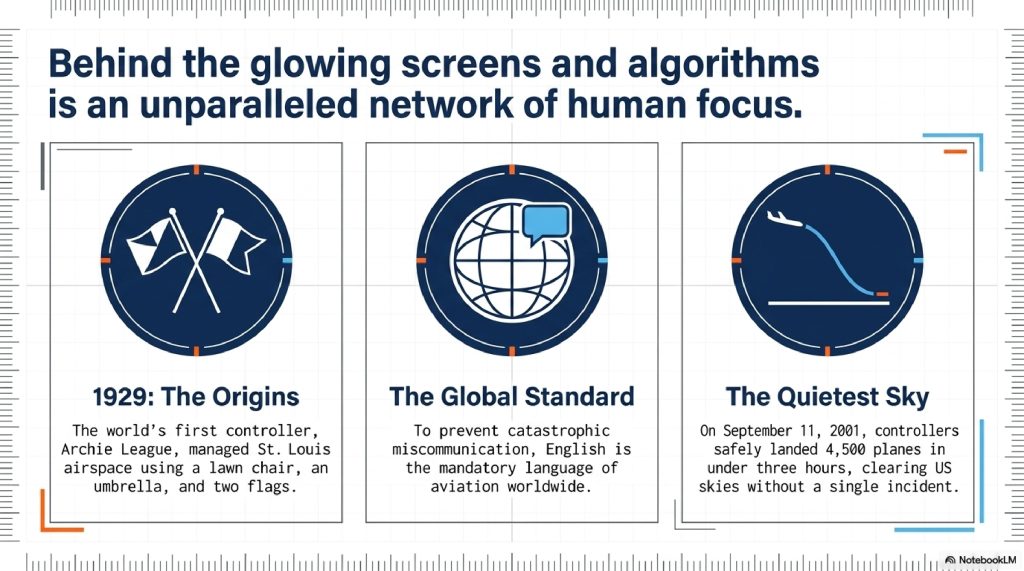
- The First Controller: In 1929, a man named Archie League became the world’s first air traffic controller. He sat on a lawn chair at the St. Louis airport with a wheelbarrow, an umbrella, and two flags, one to tell biplanes to “Go” and one for “Hold.”
- English is Mandatory: No matter where you fly in the world, whether it’s over Tokyo, Paris, or Moscow, the official language of aviation is English. Every pilot and controller must speak it to prevent miscommunication.
- The Quietest Sky: On September 11, 2001, US Air Traffic Controllers accomplished the impossible. In less than three hours, they safely landed over 4,500 planes, completely clearing the skies over the United States without a single incident.
9. FAQs
1. Does Air Traffic Control operate 24/7? Yes. While some small local towers close at night, the massive TRACON and ARTCC centers that control the high-altitude highways never close. They are staffed 24 hours a day, 365 days a year.
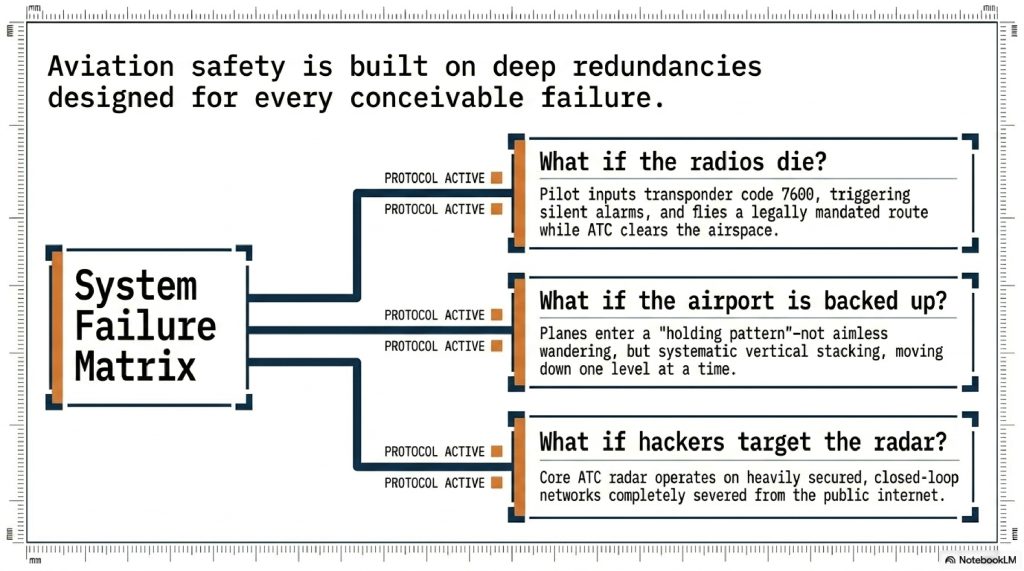
2. What happens if a plane loses communication with ATC? Pilots are trained for “Lost Comm” procedures. They change their transponder code to 7600, which instantly triggers an alarm on the controller’s screen indicating the radio is dead. The pilot then follows a highly specific, legally mandated route to land safely while ATC clears the airspace around them.
3. Do planes ever get dangerously close? Occasionally, a “loss of separation” occurs, where the protective bubbles overlap. However, this usually means they are still miles apart. Actual near-misses are extremely rare due to the redundancy of the systems.
4. How do controllers keep track of so many planes on a screen? Controllers don’t memorize them. The computer attaches a “data block” to every blip on the screen showing the flight number, altitude, and speed. Controllers are also intensely trained to develop 3D spatial visualization.
5. Is the job of an air traffic controller really that stressful? Yes. It is widely considered one of the most stressful jobs in the world. Controllers must process massive amounts of dynamic information rapidly, and mistakes can have catastrophic consequences. They are required to take frequent breaks to maintain absolute focus.
6. Can hackers take over Air Traffic Control radar? The core ATC radar systems operate on secure, closed-loop networks completely severed from the public internet, making remote hacking incredibly difficult, if not impossible.
7. How do planes avoid drones? This is a growing problem. Currently, ATC cannot easily track small drones. Safety relies heavily on “geofencing” software built into consumer drones that prevents them from taking off near airports.
8. What is a “Squawk” code? A squawk code is a 4-digit number assigned to a flight by ATC. The pilot enters this into their transponder so the ground computer can positively identify that specific plane on the radar screen.
9. Why do planes sometimes fly in circles before landing? This is called a “holding pattern.” If an airport is backed up due to weather or high traffic, ATC will stack planes in a vertical holding pattern, moving them down one altitude level at a time until they are cleared to land.
10. Do military planes talk to civilian ATC? Yes. When military aircraft fly in civilian airspace, they follow the exact same rules and talk to the same controllers as commercial airliners to ensure everyone stays safe.
10. OTHER BLOG SUGGESTIONS
To keep readers engaged and improve your site’s SEO architecture, consider linking to these related topics:
- How Does Satellite Internet Work? (A Complete Guide)
- How Weather Satellites Predict Storms: The Science of Space Forecasting
- How GPS Tracks Your Location: The Satellites Keeping You From Getting Lost
- How Does Wi-Fi Work? The Simple Science of Wireless Data
11. CONCLUSION
The next time you settle into a window seat, lean your head against the glass, and watch the ground fall away, take a moment to appreciate the invisible safety net rising up to catch you.
You are not flying blindly into the void. You are merging onto the most advanced, meticulously managed highway system ever constructed by human hands. From the spinning radar dishes on the tarmac to the satellites orbiting in the vacuum of space, thousands of unseen guardians are watching your specific metal tube.
Air traffic control is a triumph of engineering, communication, and human focus. It turns the terrifying prospect of 100,000 daily flights into a routine operation so safe, so seamless, and so utterly reliable, that the most stressful part of your journey isn’t hurtling through the sky at 600 miles per hour, it’s finding a parking spot at the airport.