INTRODUCTION
Imagine, for a moment, that you are the CEO of a major airline.
You sell tickets to passengers flying from New York to London. You load them onto a state-of-the-art, $300 million Boeing 747. The plane takes off, soars across the Atlantic, and safely drops the passengers off at Heathrow Airport.
But then, instead of refueling the airplane for a return trip, your crew sets the entire 747 on fire and pushes it into the ocean. If you want to fly back to New York tomorrow, you have to build a brand new airplane from scratch.
This sounds like absolute financial insanity. Yet, for the first sixty years of the Space Age, this is exactly how human beings went to space.
From the mighty Saturn V that took Apollo astronauts to the moon, to the Atlas and Delta rockets that launched our GPS satellites, spaceflight was a disposable industry. Governments and corporations would spend tens of millions of dollars building a towering marvel of engineering, only to let it burn up in the atmosphere or crash into the ocean ten minutes after liftoff.
Then came SpaceX.
On December 21, 2015, the aerospace industry changed forever. A Falcon 9 rocket roared into the Florida night sky, delivering a payload into orbit. But instead of discarding the massive first stage of the rocket, SpaceX did the impossible. They turned it around in the vacuum of space, plummeted back through the Earth’s atmosphere at hypersonic speeds, and landed a 15-story-tall cylinder of metal perfectly upright on a concrete pad.
It was the engineering equivalent of shooting a bullet into the sky, having it reverse direction, and catching it with tweezers.
Today, SpaceX does this almost every few days. They land rockets on concrete pads, and they land them on floating autonomous boats in the middle of the ocean. They have turned the impossible into the routine.
But how? How do you steer a falling skyscraper? How do you reignite engines in a freezing vacuum? And why does the rocket have to use a terrifying maneuver known by engineers as a “suicide burn”?
We are going to pull apart the Falcon 9. From the aerodynamics of “grid fins” to the volatile chemistry of rocket ignition, this is the hidden science of how SpaceX taught rockets to fly backward.
TABLE OF CONTENTS
- The Big Picture: The “Airplane” Analogy
- Anatomy of a Falcon: Stage 1 vs. Stage 2
- Step-by-Step: The 10-Minute Miracle
- The Hardware: How to Steer a Falling Building
- The Advanced Layer: Deep Throttling and TEA-TEB
- The Hoverslam: Why the Rocket Must “Suicide Burn”
- Common Myths About SpaceX Reusability
- Fascinating Facts You Didn’t Know
- The Future: Starship and the “Mechazilla” Catch
- Frequently Asked Questions (FAQs)
The Big Picture: The “Airplane” Analogy
To understand SpaceX’s reusability, we must first understand the fundamental problem with getting to space.
Space isn’t just about going up. It’s about going sideways fast enough that you constantly miss the Earth as you fall back down. To achieve this orbital velocity (around 17,500 mph or 28,000 km/h), you need an obscene amount of fuel.
Because fuel is heavy, rockets are essentially giant flying gas tanks. To be efficient, rockets use “staging.” Instead of carrying the heavy, empty metal tanks all the way to orbit, the rocket drops pieces of itself along the way.
SpaceX realized that if they could just save the first piece, the biggest, most expensive part holding the largest engines they could drastically slash the cost of spaceflight.
[Visual Suggestion: An infographic showing a traditional rocket dropping its stages into the ocean, contrasted with a SpaceX rocket where the first stage performs a U-turn and lands back on a drone ship.]
Anatomy of a Falcon: Stage 1 vs. Stage 2
The SpaceX Falcon 9 rocket is divided into two main sections:
- The First Stage (The Booster): This is the massive bottom section. It is 135 feet (41 meters) tall and is powered by nine Merlin engines. Its only job is to push the rocket through the thickest part of Earth’s atmosphere for the first two and a half minutes of flight. This is the part SpaceX reuses.
- The Second Stage: This is the smaller top section with a single engine. It carries the satellite or spacecraft the rest of the way into orbit. Currently, this part is not reusable; it burns up in the atmosphere.
When we talk about “SpaceX landing rockets,” we are talking specifically about that massive, 9-engine First Stage booster.
Step-by-Step: The 10-Minute Miracle
Let’s trace the exact, real-world journey of a Falcon 9 First Stage, from liftoff to touchdown.
- Step 1: Liftoff & MECO. The rocket launches. At around T+ 2 minutes and 30 seconds, the rocket is about 40 miles (65 km) high and traveling at 4,000 mph. At this exact moment, the nine first-stage engines shut down. This is called MECO (Main Engine Cut Off).
- Step 2: Stage Separation. Pneumatic pushers fire, separating the First Stage from the Second Stage. The Second Stage ignites its engine and continues to space. The First Stage is now in a ballistic freefall.
- Step 3: The Flip (Cold Gas Thrusters). The First Stage is flying engine-first away from Earth, but it needs to go back. Small nozzles near the top of the rocket blast bursts of compressed nitrogen gas. This flips the 135-foot rocket 180 degrees in the vacuum of space, pointing the engines toward Earth.
- Step 4: The Boostback Burn (Optional). If the rocket is returning to land on the coast, three of its engines reignite to reverse its forward momentum and push it back toward the launch site. (If it is landing on a drone ship in the ocean, it skips this step to save fuel).
- Step 5: The Entry Burn. As the rocket falls back into the Earth’s atmosphere, it hits a “wall” of thick air at hypersonic speeds. The friction would melt the rocket. To survive, it reignites three engines to act as a retro-brake, slowing it down and protecting it with the exhaust plume.
- Step 6: Aerodynamic Steering. As it falls through the thick atmosphere, four titanium “Grid Fins” deploy near the top of the rocket. They act like the feathers on an arrow, steering the falling cylinder with pinpoint accuracy.
- Step 7: The Landing Burn. Just seconds before crashing into the ground or drone ship, a single center engine ignites. Four carbon-fiber landing legs snap open. The engine throttles down, bringing the rocket’s speed from hundreds of miles an hour to exactly zero, right as the legs touch the deck.
The entire process, from launch to landing, takes about 8 and a half minutes.
The Hardware: How to Steer a Falling Building
If you drop a pencil from the top of a building, it will tumble chaotically. A rocket wants to do the exact same thing. Keeping it perfectly upright requires brilliant hardware.
The Grid Fins
Traditional airplanes use flat wings to steer. But flat wings don’t work well at hypersonic speeds (mach 4+), and they add too much weight.
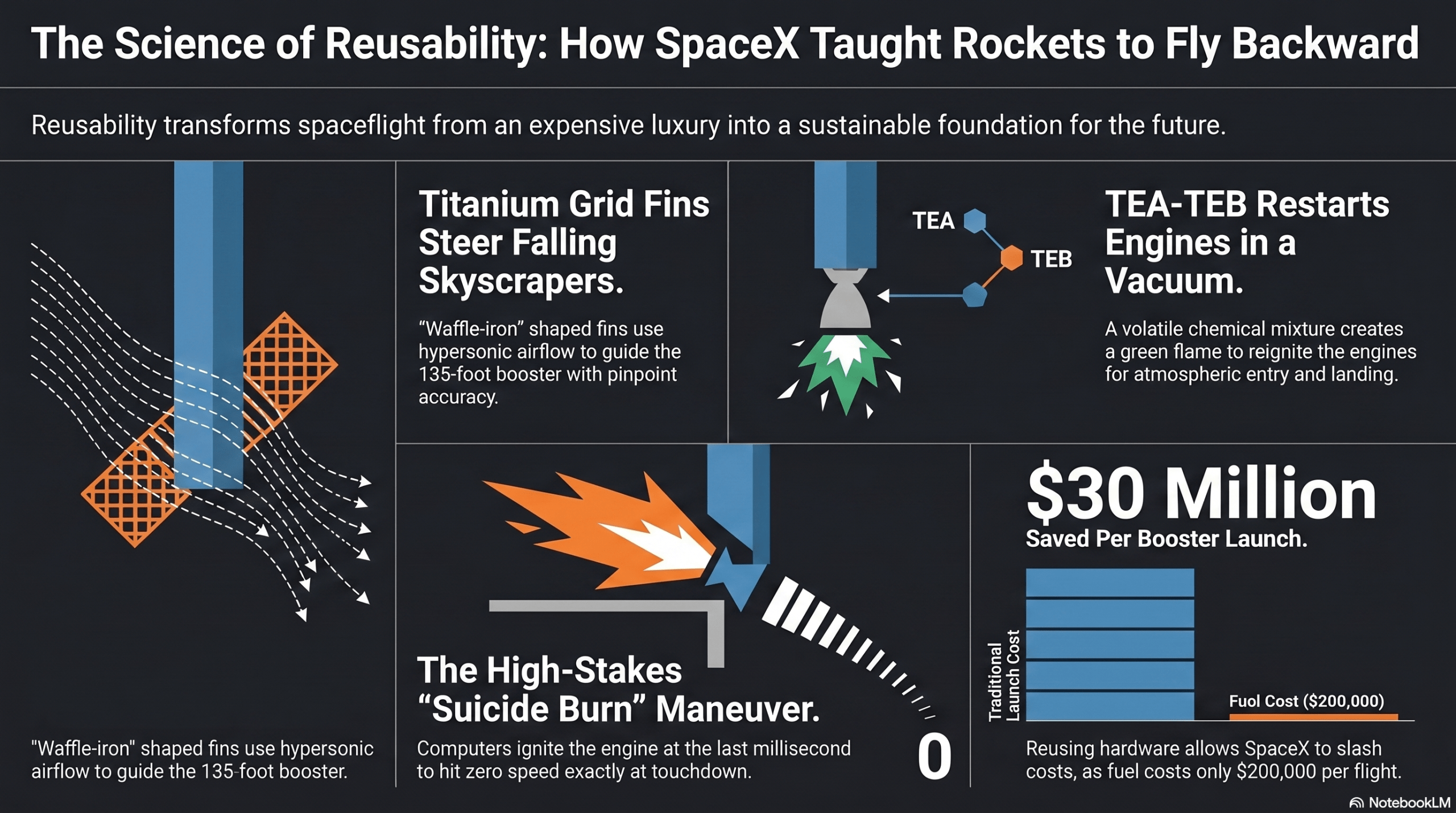
SpaceX uses Grid Fins. They look like giant metal waffle irons. When folded flat against the rocket, they create no drag. When deployed, the air flows through the holes. By tilting these waffle-iron fins slightly, the onboard computers can steer the massive rocket through the atmosphere with a margin of error of just a few meters.
Because the friction of reentry generates temperatures hot enough to melt steel, SpaceX manufactures these grid fins out of solid, forged Titanium. They are the largest single-piece titanium castings in the world.
Autonomous Spaceport Drone Ships (ASDS)
Not all rockets have enough leftover fuel to fly all the way back to land. Because they launch out over the Atlantic or Pacific Ocean, SpaceX built floating landing pads to catch them.
These drone ships (with names like Of Course I Still Love You and Just Read the Instructions, named after sci-fi novels by Iain M. Banks) do not have anchors. They use powerful underwater thrusters connected to GPS to hold their position perfectly steady, even in rough ocean swells, while the rocket lands on them.
[Visual Suggestion: An animation showing how a Grid Fin tilts to change the airflow, altering the trajectory of the falling rocket.]
The Advanced Layer: Deep Throttling and TEA-TEB
Now, let’s explore the deeper engineering. How does a rocket engine actually restart in space?
The Ignition Problem: TEA-TEB
You can’t use a spark plug to start a rocket engine in a vacuum. SpaceX uses a hypergolic chemical mixture called TEA-TEB (Triethylaluminum-Triethylborane).
This is a terrifyingly volatile fluid. The moment TEA-TEB comes into contact with liquid oxygen, it spontaneously erupts into a brilliant green flame. You will often see a flash of green light on the SpaceX broadcast right before the engines ignite. This green flash is the TEA-TEB setting the main fuel (kerosene) on fire. The rocket carries small, limited vials of TEA-TEB to allow for the multiple engine restarts required for landing.
Deep Throttling
Most rockets are like light switches: they are either 100% ON or 100% OFF. But to land smoothly, you need a dimmer switch.
The Merlin 1D engine on the Falcon 9 is an engineering marvel because it has “deep throttling” capabilities. It can throttle its power down to roughly 40%. This is incredibly difficult in rocket physics, as reducing the flow of volatile propellants usually causes the engine to stutter, choke, and explode (a phenomenon called combustion instability).
The Hoverslam: Why the Rocket Must “Suicide Burn”
Here is the most intense mathematical reality of a SpaceX landing.
Even when throttled down to its absolute minimum power (40%), one single Merlin engine produces more upward thrust than the entire empty rocket weighs.
Think about what that means. The rocket is physically incapable of hovering. If the engine is on, the rocket must go up.
Therefore, SpaceX cannot slowly lower the rocket to the ground like a helicopter. If they turn the engine on too early, the rocket will slow down to zero in mid-air, start flying back up into the sky, run out of fuel, and crash.
To land safely, the onboard computers must calculate a maneuver known in aerospace as a Suicide Burn (SpaceX prefers the friendlier term “Hoverslam”).
The computer calculates the rocket’s exact mass, its speed, and the wind resistance. It waits until the absolute last possible millisecond to ignite the engine. The engine fires at maximum power, decelerating the rocket violently. The goal is for the rocket’s speed to hit exactly zero at the precise millimeter the legs touch the drone ship.
If the engine ignites one second too early, the rocket flies back up. If it ignites one second too late, it slams into the deck and explodes. The math must be flawless.
[Visual Suggestion: A graph comparing a “Hover” landing trajectory (smooth curve leveling out) vs a “Suicide Burn” trajectory (a steep V-shape where speed hits zero precisely at altitude zero).]
Common Myths About SpaceX Reusability
Myth 1: “It costs more to refurbish the rocket than to build a new one.” False. This was true for the Space Shuttle, which required thousands of hours of inspection and tile replacement after every flight. The Falcon 9 was designed differently. Today, a Falcon 9 booster can land, be inspected, and fly again in just a few weeks with minimal refurbishment. SpaceX saves tens of millions of dollars per launch.
Myth 2: “The rocket is flown by a pilot on the ground with a joystick.” False. Human reaction times are far too slow to manage the calculations required for a hoverslam. The entire landing sequence, from the grid fin steering to the final engine burn, is 100% autonomous, controlled by the rocket’s onboard flight computers.
Myth 3: “They just put fuel in it and fly it the next day.” False (For Now). While turnaround times are fast, engineers still conduct ultrasound inspections of the fuel tanks, check the engines for soot buildup, and replace certain ablative materials that burn away during reentry. It is not quite as simple as filling up a car at a gas station yet.
Fascinating Facts You Didn’t Know
- The “Sooty” Rockets: When SpaceX first started reusing rockets, they meticulously cleaned the white paint so they looked brand new. Eventually, they realized this was a waste of time and money. Today, reused Falcon 9s launch covered in black scorch marks and soot from their previous entries. It has become a badge of honor.
- The Octagrabber: Once a rocket lands on a drone ship in the rolling ocean, it could easily tip over. Before human crews board the ship, a heavy, remote-controlled robot nicknamed the “Octagrabber” drives under the rocket and clamps onto its hold-down points, acting as a massive anchor to stabilize it.
- Radar Altimeters: To know exactly when to fire the suicide burn, the rocket bounces radar waves off the ground/ocean to measure its altitude down to the centimeter.
The Future: Starship and the “Mechazilla” Catch
The Falcon 9 is a marvel, but it only reuses the First Stage. SpaceX’s ultimate goal is full and rapid reusability.
Enter Starship.
Starship is a massive, fully reusable, two-stage rocket currently in development. It is designed to be the largest and most powerful flying object ever built by humans. But its landing method is even crazier than the Falcon 9.
Instead of landing legs, SpaceX built a launch tower dubbed “Mechazilla.”
When the massive Super Heavy booster returns to the launch site, it doesn’t land on a pad. It hovers next to the tower. Two massive mechanical arms (the “chopsticks”) quickly close around the hovering rocket and catch it in mid-air.
Why? Because landing legs add weight. By putting the “landing gear” on the tower instead of the rocket, the rocket can carry more cargo to space. Furthermore, the tower can immediately place the caught rocket right back onto the launch mount, allowing it to be refueled and launched again within hours, truly achieving airline-like operations.
FREQUENTLY ASKED QUESTIONS (FAQs)
1. How much money does SpaceX save by reusing rockets? While exact internal margins are proprietary, a new Falcon 9 booster is estimated to cost around $30 million to build. The fuel only costs about $200,000. By reusing the hardware, SpaceX drastically lowers the cost of access to space, allowing them to underbid competitors significantly.
2. How many times can a Falcon 9 be reused? SpaceX initially designed the Falcon 9 Block 5 to fly 10 times. However, through engineering updates, they have far surpassed that. Some individual “fleet leader” boosters have now flown and landed over 20 times.
3. What happens to the Second Stage of the Falcon 9? Currently, the Second Stage is expendable. After it delivers the payload to orbit, it uses its remaining fuel to push itself into Earth’s atmosphere, where it safely burns up upon reentry.
4. Why doesn’t NASA reuse the SLS rocket? NASA’s Space Launch System (SLS) is built using legacy technology from the Space Shuttle era. It was designed primarily as a heavy-lift expendable vehicle. Re-engineering it for landing would require starting from scratch.
5. How fast is the rocket falling before the landing burn? During reentry, the rocket is falling at hypersonic speeds (Mach 4+). By the time it reaches the final landing burn near the ground, atmospheric drag has slowed it down to terminal velocity roughly 500 mph (800 km/h) before the engine fires to bring it to zero.
6. Do the drone ships have crews on them during landing? No. A rocket landing is a highly explosive event. The drone ships are completely unmanned during the landing. Support ships wait miles away and only approach the drone ship after the rocket has successfully landed and secured itself.
7. Why do rockets launch near the ocean? Safety. Rockets launch over the ocean so that if they explode or if stages detach normally, the debris falls into empty water rather than populated cities.
8. What fuel does the Falcon 9 use? It uses RP-1 (a highly refined form of kerosene) and LOX (Liquid Oxygen). To pack more fuel into the rocket, SpaceX chills the propellants to incredibly low temperatures, which shrinks them and makes them denser.
9. Can weather prevent a landing? Yes. High winds or heavy seas can force a launch delay. If the drone ship is pitching up and down too aggressively in the ocean waves, the rocket’s computer may deem it unsafe to attempt a landing.
10. What is a “Fairing” and does SpaceX reuse those? The fairing is the nose cone at the top of the rocket that protects the satellite. It splits in half and falls back to Earth. Yes! SpaceX installs parachutes on these halves and scoops them out of the ocean. Reusing the fairing saves about $6 million per flight.
OTHER USEFUL BLOG SUGGESTIONS
To keep exploring the cutting edge of aerospace technology, check out these related guides:
- How Neural Networks Learn: The Hidden Science of AI
- How AI Image Generators Work: The Science of Digital Dreams
- How Recommendation Algorithms Work: The Science of Your Feed
CONCLUSION
Every time you watch a Falcon 9 pierce the atmosphere and gently touch down on a floating platform in the Atlantic, you are watching the culmination of thousands of failed simulations, mathematical breakthroughs, and a stubborn refusal to accept the status quo.
SpaceX didn’t just build a better rocket; they fundamentally broke the economic barrier to the cosmos. By solving the supersonic puzzle of grid fins, the volatile chemistry of TEA-TEB, and the terrifying calculus of the suicide burn, they transformed spaceflight from an exclusive, disposable luxury into a sustainable foundation for the future.
We are no longer throwing away the airplanes. The era of the reusable rocket is here. And as we look toward the massive steel towers preparing to catch the Starships of tomorrow, one thing is certain: the journey to the stars has only just begun.
Comments (2)