INTRODUCTION
It starts with a single click.
Maybe you were looking for a recipe for sourdough bread. Or perhaps you stumbled upon a ten-second clip of a cat wearing a tiny hat. You tell yourself you’ll only watch one. But then, something strange happens. The next video is perfectly aligned with your sense of humor. The one after that addresses a hobby you haven’t thought about in years.
Three hours later, you are still staring at the screen. You’ve fallen down a “rabbit hole” so deep you can’t remember how you got there.
We often talk about “The Algorithm” as if it’s a living, breathing entity, a digital ghost haunting our smartphones. We treat it with a mix of awe and suspicion. Does it listen to our conversations? Is it reading our minds? How does a piece of software on a server in California or Singapore know that you are currently interested in 14th-century blacksmithing techniques, even though you’ve never told a soul?
The truth is far more clinical, yet infinitely more fascinating than any “spy” theory.
Recommendation algorithms are the most powerful curators in human history. They have replaced the radio DJ, the librarian, and the film critic. They decide what news you see, what music you discover, and even who you date. They are the invisible architects of our digital reality, processing trillions of data points every second to solve a single, high-stakes problem: What can I show you right now to make sure you don’t leave?
This isn’t just about “likes” and “shares.” This is a story about high-dimensional geometry, hidden mathematical patterns, and a technology that understands the patterns of human behavior better than we understand them ourselves. In this deep dive, we are going to peel back the screen and look at the gears of the machine. We’ll explore the math that turns your personality into a coordinate in space and the psychological loops that keep us all hooked.
Welcome to the science of the “Invisible Mirror.” Let’s find out how it really works.
TABLE OF CONTENTS
- The Digital Matchmaker: A Simple Explanation
- The Two Pillars: Content-Based vs. Collaborative Filtering
- The Math of You: Matrix Factorization and Latent Features
- Step-by-Step: The Journey of a Recommendation
- The Deep Learning Era: Neural Networks and Embeddings
- The TikTok Secret: Real-Time Feedback Loops
- Common Myths About Algorithms
- The Dark Side: Echo Chambers and Ethics
- The Future: From Prediction to Prescription
- FAQs
The Digital Matchmaker: A Simple Explanation
Imagine you walk into a library that contains every book ever written. You have no idea where to start.
Standing at the door is a librarian who has never met you, but they have a superpower: they have watched every single person who has ever entered this library. They know exactly which books everyone picked up, which ones they read to the end, and which ones they threw in the trash after two pages.
As you walk in, the librarian hands you a book. You love it. When you finish, they hand you another. It’s even better.
How did they do it?
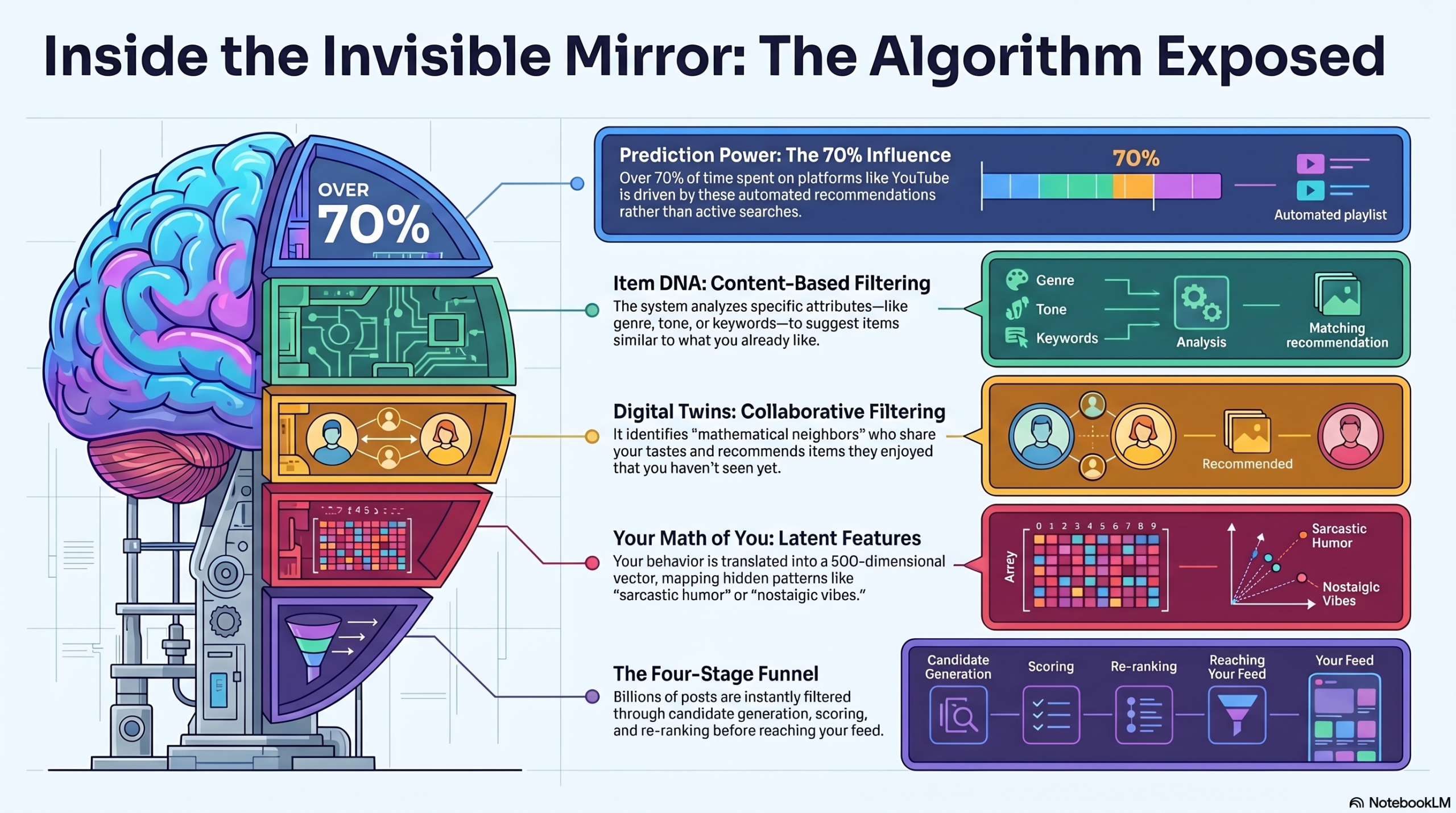
- They looked at the “Book’s DNA”: They noticed you liked a book about a detective in London. So, they found another book about a detective in London. (This is Content-Based Filtering).
- They looked for your “Digital Twin”: They remembered a person last week who liked the exact same three books you just read. That person also loved a specific cookbook. The librarian assumes you’ll like that cookbook, too. (This is Collaborative Filtering).
An algorithm is simply this librarian, running at the speed of light, serving billions of people at once.
The Two Pillars: Content-Based vs. Collaborative Filtering
To build a recommendation engine, engineers generally start with two classic strategies. Understanding the difference is the key to knowing why your Spotify “Discovery Weekly” is so different from your Amazon “Frequently Bought Together.”
1. Content-Based Filtering: The Item Specialist
This method focuses on the properties of the items themselves. If you are a chess enthusiast who spends hours analyzing the Italian Opening or the Sicilian Defense, the algorithm looks for other videos tagged with “Chess Openings,” “Grandmaster Analysis,” or “Tactical Traps.”
- How it works: It creates a profile for each item. A movie isn’t just a movie; it’s a list of attributes: Genre: Sci-Fi, Director: Christopher Nolan, Tone: Mind-bending.
- The Strength: It’s great at recommending niche interests.
- The Weakness: It can’t “surprise” you. If you only watch chess, it will only ever show you chess. You’ll never discover your secret love for competitive gardening.
2. Collaborative Filtering: The Wisdom of the Crowd
This is the “people who liked this also liked…” approach. It ignores the “DNA” of the item and focuses entirely on the behavior of the users.
Imagine User A and User B.
- User A likes: Inception, The Matrix, Interstellar.
- User B likes: Inception, The Matrix.
The algorithm concludes that A and B are “neighbors” in a mathematical sense. Since User A liked Interstellar, it recommends Interstellar to User B, even if it has no idea what the movie is about.
The Math of You: Matrix Factorization and Latent Features
Now, let’s go a level deeper. How does an algorithm handle millions of users and millions of items at once? It uses a mathematical trick called Matrix Factorization.
Imagine a giant spreadsheet (a Matrix).
- The rows are every user on Netflix.
- The columns are every movie on Netflix.
- The cells are the ratings (1 to 5 stars).
Because most people haven’t watched most movies, 99% of this spreadsheet is empty. The goal of the algorithm is to predict the missing numbers.
To do this, the computer breaks the giant matrix into two smaller, hidden matrices: one for Users and one for Items. It looks for “Latent Factors” hidden themes that aren’t explicitly labeled.
For example, a latent factor might be “Sarcastic Humor” or “Nostalgic 80s Vibe.” The algorithm might discover that you have a high “score” for 80s Nostalgia and Stranger Things also has a high score for 80s Nostalgia. When the math multiplies these scores together, it gets a high prediction.
$$Prediction = User\_Preferences \times Item\_Features$$
Step-by-Step: The Journey of a Recommendation
What actually happens the millisecond you pull to refresh your Instagram or TikTok feed? It’s a four-stage relay race:
- Candidate Generation (The Funnel): The system has billions of posts. It quickly narrows them down to a few thousand that you might like based on your history and your “neighbors.”
- Scoring (The Calculation): A more complex machine learning model takes those thousand candidates and calculates a score for each one. It asks: “What is the probability this user will like, comment, or watch this to the end?”
- Re-Ranking (The Filter): The system adjusts the scores. It ensures you don’t see five videos from the same creator in a row (Diversity) and filters out clickbait or banned content.
- The Delivery: The top 10–20 items are sent to your phone.
The Deep Learning Era: Neural Networks and Embeddings
Modern algorithms have evolved past simple spreadsheets. Giants like YouTube and TikTok use Deep Neural Networks.
The “magic” here is a concept called Embeddings. In a simple system, a computer sees a user as a single ID number. In a Deep Learning system, it sees a user as a Vector, a point in a 500-dimensional space.
Imagine a 3D map.
- One axis is “Age.”
- One axis is “Interest in Tech.”
- One axis is “Love of Horror Movies.”
Your “coordinate” on that map tells the AI exactly who you are relative to everyone else. Deep Learning allows the AI to find patterns that are too complex for humans to describe like the fact that people who enjoy “Lo-fi hip hop” also happen to buy “ergonomic keyboards” on Tuesday nights.
The TikTok Secret: Real-Time Feedback Loops
Why is TikTok’s algorithm considered the “gold standard” of engagement? It’s because of the Speed of the Feedback Loop.
On Netflix, you might watch a two-hour movie. The algorithm only gets one “data point” every two hours. On TikTok, you might watch 20 videos in five minutes.
- Did you skip after one second? (Negative)
- Did you watch it twice? (Strong Positive)
- Did you check the comments? (Engagement)
- Did you hover over the “Share” button but didn’t click? (Curiosity)
TikTok’s AI processes this in real-time. It updates your “coordinate” in the vector space every few seconds. It’s like a conversation where the AI is constantly asking, “How about this? No? Okay, how about THIS?” until it finds your current mood.
Common Myths About Algorithms
Myth 1: “The Algorithm is listening to my microphone.”
The Reality: There is almost no evidence for this. The truth is scarier: the algorithm is so good at predicting you based on your “neighbors” that it doesn’t need to listen. If your friend (whose phone is near yours) searches for “blue sneakers,” the algorithm knows you are likely to see those sneakers soon, so it shows them to you too. It’s a correlation, not a wiretap.
Myth 2: “If I ‘Dislike’ a video, I’ll never see it again.”
The Reality: Sometimes, “negative engagement” is still engagement. If you watch a video you hate all the way to the end to leave an angry comment, the algorithm sees “100% watch time” and “high engagement.” It might actually show you more of that content because it knows it triggers a reaction.
Myth 3: “The Algorithm wants to show me the truth.”
The Reality: The algorithm has no concept of “truth” or “quality.” It only has a concept of “Retained Attention.” If a lie keeps you watching longer than the truth, the algorithm will choose the lie every time unless engineers manually intervene.
The Dark Side: Echo Chambers and Ethics
While recommendation systems are convenient, they come with a significant cost to society.
- The Filter Bubble: If the algorithm only shows you what you already like, you never see opposing viewpoints. You begin to believe that everyone thinks like you do. This leads to massive social polarization.
- The Rabbit Hole of Extremism: To keep you engaged, algorithms often show you more “intense” versions of what you like. If you watch a video on healthy eating, you might be led to extreme diets; if you watch a video on politics, you might be led to conspiracy theories.
- The Cold Start Problem: How does a new creator get seen? If the algorithm only recommends what’s already popular, new ideas struggle to break through. This is why platforms have to “force-feed” a small amount of random new content to users to see how they react.
Interesting Facts Section
- The Netflix Prize: In 2006, Netflix offered $1 million to anyone who could improve their recommendation algorithm by just 10%. It took three years for a team to win.
- YouTube’s Massive Reach: Over 70% of the time people spend on YouTube is driven by the recommendation algorithm, not by what they searched for.
- The “Amazon Effect”: Recommendations are responsible for an estimated 35% of all purchases on Amazon.
- Digital Immortality: Because these algorithms store your “coordinate,” they can technically predict what a person who has passed away would have liked if they were still alive today.
The Future of the Technology
We are moving away from Reactive algorithms and toward Proactive ones.
- Generative Recommendations: Instead of picking an existing video, the AI might create a custom video or song specifically for you, in real-time, based on your current biometric data (heart rate, stress levels from your smartwatch).
- Multimodal AI: Future algorithms won’t just look at what you watch. They will “see” your facial expression through your camera (with permission) to see if you are actually smiling or bored, adjusting the feed instantly.
- The “Sovereign Algorithm”: There is a growing movement for “User-Owned Algorithms,” where you carry your “Digital DNA” from one app to another, rather than being locked into one platform’s silo.
FAQ SECTION
1. Can I “reset” my algorithm?
Yes. Most platforms allow you to clear your “Search and Watch History.” This effectively moves your “coordinate” back to the center of the map, though the AI will begin re-profiling you almost immediately.
2. Why do I see the same three ads everywhere?
This is called “Retargeting.” When you visit a website, a “cookie” is placed in your browser. Other algorithms see that cookie and “bid” to show you that specific product across different platforms to wear down your resistance.
3. Does the algorithm know my age and gender?
Even if you don’t tell it, it can infer it with over 95% accuracy based on the speed of your scrolling and the types of content you engage with.
4. Why does the algorithm show me things I just talked about?
Usually, it’s because you were already in the “context” of that thing. If you talked about a vacation, you probably also searched for a flight or looked at a photo of a beach. The algorithm connects those dots.
5. What is the “Cold Start” problem?
It’s the difficulty an algorithm faces when a new user joins or a new item is uploaded. With no history, the math can’t make a prediction. Platforms solve this by using “Content-based” analysis until they get enough “Collaborative” data.
6. Is 5G making algorithms faster?
Not exactly. 5G allows for more data to be sent to your phone, but the speed of the algorithm is determined by the processing power of the servers in the data center.
7. Can algorithms be biased?
Absolutely. If the training data contains human biases (e.g., historical hiring biases), the algorithm will learn and amplify those biases, often with devastating real-world consequences.
8. How do “dislike” buttons work?
They act as a “strong negative signal.” In the math, they drastically lower the score of similar items in your candidate pool.
9. What is “Exploration vs. Exploitation”?
“Exploitation” is showing you more of what you already like. “Exploration” is showing you something totally new to see if you like it. A good algorithm balances both to keep you from getting bored.
10. Do all apps use the same algorithm?
No. Each company (Google, Meta, ByteDance) has its own proprietary “Neural Architecture,” which is their most valuable trade secret.
OTHER USEFUL BLOG SUGGESTIONS
- How ChatGPT Works: The transition from prediction to conversation.
- How do mobile tower works? The science of cellular networks.
CONCLUSION
Recommendation algorithms are perhaps the most successful “magic trick” of the 21st century. They give us the illusion of a world tailored specifically to our desires, a digital universe where every song is a hit and every video is a masterpiece.
But as we have seen, there is no magic only math. Behind every “Recommended for You” section is a complex web of matrix factorization, high-dimensional vectors, and deep neural networks working tirelessly to map the labyrinth of the human psyche.
These systems are a double-edged sword. They are incredible tools for discovery, helping us find the Italian Opening tutorials or the obscure indie bands that change our lives. Yet, they also threaten to trap us in “bubbles” of our own making, showing us a mirror that only reflects what we want to see, rather than what we need to know.
The next time you find yourself three hours deep into a YouTube marathon, take a second to pause. Look at that blue dot, that “Up Next” video, and realize that you are participating in a massive, global experiment in human behavior. The machine knows where you’ve been, and it thinks it knows where you’re going.
The question is: are you following the algorithm, or is the algorithm following you?
The answer, as always, is somewhere in the math.