You are driving down the highway at 70 miles per hour. You are listening to a high-definition podcast streaming from a server in Sweden, your GPS is downloading real-time traffic data from space, and you are having a crystal-clear phone conversation with your mother who is sitting in her living room three states away.
You take all of this entirely for granted.
But as you drive, you occasionally pass them. Towering monoliths of steel, sometimes awkwardly disguised as giant pine trees, sometimes bolted to the sides of brick buildings, or jutting out of open farmland. They stand silently, adorned with strange rectangular panels and circular drums, looking like sentinels from a sci-fi movie.
These are mobile towers (or cell towers). And without them, modern human civilization would instantly grind to a halt.
We casually use the term “wireless,” but the truth is a beautifully hidden paradox: your wireless connection is actually supported by the largest, most complex physical wire network ever built by humans.
Think about it. How does your voice, a physical soundwave pushing air out of your lungs, turn into a mathematical code, fly through the air at the speed of light, hit a piece of steel on the side of a highway, travel thousands of miles across the country, and reconstruct itself perfectly in your mother’s ear all in less than a fraction of a second, while you are moving in a metal car?
If you had eyes that could see radio waves, the sky wouldn’t be empty. It would look like a breathtaking, chaotic laser light show. Every tower is a lighthouse, perfectly coordinating millions of invisible beams of data, ensuring they never cross, crash, or drop.
Today, we are going to climb the tower. We are going to peel back the steel, follow the invisible signals, and trace the hidden underground cables to answer one of the modern world’s greatest mysteries: How does a mobile tower actually work?
TABLE OF CONTENTS
- The Big Picture: Why is it Called “Cellular”?
- The Anatomy of a Steel Giant: What Are Those Shapes?
- Step-by-Step: The Epic Journey of a Single “Hello”
- The Magic of the “Handoff”: Why Calls Don’t Drop in a Car
- The Hidden Underworld: The Secret of the Backhaul
- The Advanced Layer: Sectoring and Frequency Reuse
- Common Myths About Cell Towers Debunked
- Fascinating Facts You Didn’t Know About Mobile Towers
- The Future: 6G, Small Cells, and Towers in Space
- Frequently Asked Questions (FAQs)
The Big Picture: Why is it Called “Cellular”?
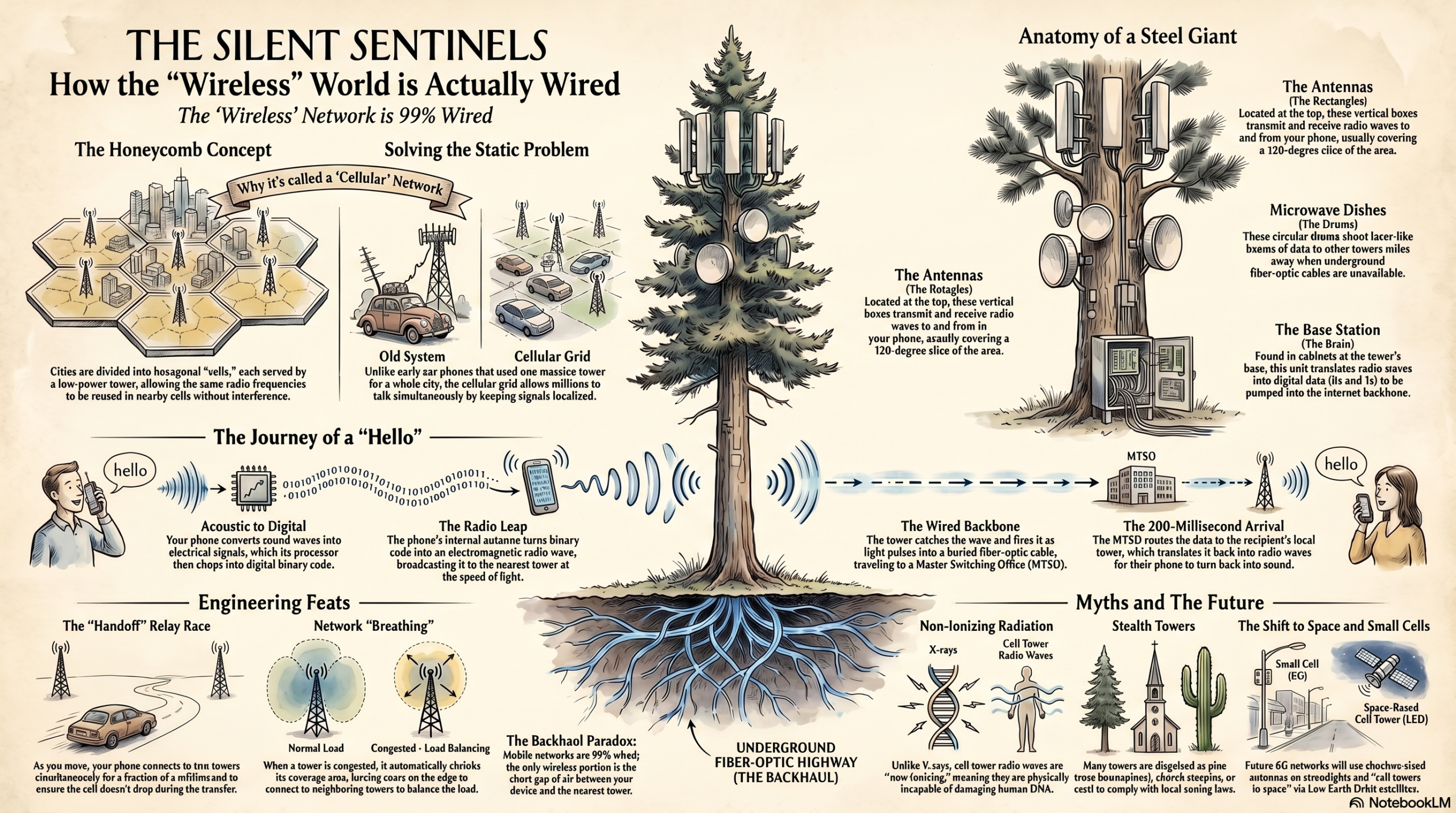
To understand how a mobile tower works, we first have to answer a more basic question: Why do we call them “cell” phones?
Imagine you have a walkie-talkie. It has a powerful antenna, and you can talk to your friend across town. But there is a massive problem: if everyone in town bought the exact same walkie-talkie, and you all tried to talk at once, the radio channel would just be a wall of static. There are only so many radio frequencies available.
In the early days of car phones (the 1950s and 60s), cities solved this by putting one massive radio tower in the center of town. But because there were limited channels, only about 20 people in an entire city could make a phone call at the same time. If 21 people tried, the system gave them a busy signal.
Then, engineers came up with a genius geometric solution: The Honeycomb.
Instead of one giant tower covering the whole city, what if we divided the city into hundreds of smaller puzzle pieces? We could put a small, low-power tower in the middle of each piece.
Because the towers are low-power, their signals don’t travel far enough to interfere with a tower a few miles away. This means two towers can use the exact same radio frequencies at the exact same time without crossing wires.
These interlocking puzzle pieces usually shaped like hexagons on engineering maps are called Cells. When you move through a city, you are constantly hopping from one invisible cell to the next. That is why it is a cellular network.
The Anatomy of a Steel Giant: What Are Those Shapes?
If you look closely at a mobile tower, it isn’t just one big stick. It is a highly organized piece of infrastructure with three main visible components, plus a hidden brain at the bottom.
1. The Antennas (The Rectangles)
At the very top, you will see tall, vertical, rectangular boxes pointing in different directions. These are the actual antennas. They are responsible for transmitting and receiving radio waves to and from your phone. Usually, they are arranged in a triangle, with each side covering a 120-degree slice of the surrounding area (totaling 360 degrees).
2. The Microwave Dishes (The Drums)
Sometimes you will see large, circular items that look like snare drums attached to the tower. These do not talk to your phone. These are microwave backhaul dishes. They shoot a highly focused, laser-like beam of data to another cell tower miles away. They are used when it’s too expensive or difficult to dig up the ground to lay fiber-optic cables.
3. The Tower Structure (The Skeleton)
The steel lattice or the single heavy pole (monopole) exists for one reason only: elevation. Radio waves for mobile phones require “line of sight.” If a mountain, a building, or the curvature of the Earth blocks the signal, the call drops. The tower just lifts the antennas high enough to “see” your phone.
4. The Base Transceiver Station (The Brain)
At the very bottom of the tower, usually surrounded by a chain-link fence, is a small shed or a series of metal cabinets. This is the Base Transceiver Station (BTS). If the antennas are the tower’s ears and mouth, the BTS is the brain. It takes the radio waves caught by the antennas, translates them into digital data (0s and 1s), and pumps them into the underground internet cables.
Step-by-Step: The Epic Journey of a Single “Hello”
Let’s trace the exact, real-world journey of what happens when you call your friend in another state and say the word “Hello.”
- Step 1: The Acoustic Translation. You speak. Your phone’s microphone captures the soundwaves of your voice and converts them into an electrical signal. The phone’s processor chops this signal up into digital binary code (zeros and ones).
- Step 2: The Radio Broadcast. Your phone’s internal antenna takes this digital code and turns it into an invisible electromagnetic radio wave. It broadcasts this wave out into the air in all directions at the speed of light.
- Step 3: The Tower Catch. The nearest cell tower catches this faint radio wave. The rectangular antenna on the tower funnels the signal down a thick cable to the Base Station at the bottom of the tower.
- Step 4: The Wired Leap. The Base Station translates the radio wave back into digital light pulses. It fires these light pulses into a Fiber Optic Cable buried deep underground.
- Step 5: The Switching Office. The fiber optic cable carries your “Hello” at light speed to a massive, windowless building in your city called the MTSO (Mobile Telephone Switching Office). This building is the master traffic cop. It looks at the phone number you dialed, figures out where your friend is in the world, and routes the call into the global internet/telephone backbone.
- Step 6: The Reverse Journey. The data travels thousands of miles via underground wires to your friend’s local MTSO, which sends it via fiber optic cable to the cell tower closest to them. That tower translates the data back into a radio wave, shoots it through the air, and their phone turns it back into the sound of your voice.
All of this happens in less than 200 milliseconds.
The Magic of the “Handoff”: Why Calls Don’t Drop in a Car
If you are walking around your house, you stay connected to one tower. But what happens when you are driving 70 miles per hour down the highway? You are crossing through multiple “cells” every few minutes. Why doesn’t the call drop?
This requires a microscopic, high-speed negotiation called The Handoff (or Handover).
As you drive away from Tower A, your phone’s signal gets weaker. But your phone is smart; it is constantly scanning the horizon for other towers. It notices that Tower B is getting closer and the signal is getting stronger.
Your phone silently sends a message to Tower A: “Hey, I’m losing you, but Tower B looks great.”
Tower A talks to the main switching office (MTSO) and says, “Get ready to transfer this user to Tower B.”
For a fraction of a millisecond, your phone is actually connected to both towers at the exact same time. Then, Tower A drops the connection, Tower B takes over completely, and you keep talking without ever noticing a hiccup. It is a perfect, invisible relay race happening in your pocket.
The Hidden Underworld: The Secret of the Backhaul
Here is the biggest “Wait… what?” moment of mobile technology.
Mobile networks are 99% wired.
The only “wireless” part of your mobile phone call is the short gap of air between your phone and the nearest tower. Once your signal hits that tower, it almost immediately goes into the ground.
This hidden wired network is called the Backhaul. Beneath the streets of your city, running along highways, and stretching across the bottoms of the oceans are millions of miles of fiber-optic glass cables. They are as thick as a garden hose and carry data via flashing lasers.
When your phone shows “5G,” it means the wireless connection from your phone to the tower is incredibly fast. But if that tower isn’t connected to a massive, high-speed fiber-optic cable in the ground, your internet will still be slow. The tower is just the on-ramp; the buried fiber-optic cables are the actual highway.
The Advanced Layer: Sectoring and Frequency Reuse
Let’s get slightly more technical for a moment. How can a single tower handle 10,000 people at a crowded music festival without crashing?
Engineers use a trick called Sectoring. Look at the top of a tower. The antennas aren’t just one big cylinder; they are usually arranged in a triangle. Each side of the triangle covers 120 degrees of the map. By doing this, the tower splits the cell into three separate sub-cells.
Furthermore, they use Frequency Division and Time Division. Imagine a tower as a high-speed auctioneer. It doesn’t actually let everyone talk at the exact same time. It slices a single second into thousands of tiny fractions. It gives you fraction #1, the person next to you fraction #2, and someone else fraction #3. It rotates through thousands of users so fast that it feels like a continuous connection, even though you are technically taking turns.
Common Myths About Cell Towers Debunked
Myth 1: Cell towers cause cancer and emit dangerous radiation. False. The word “radiation” scares people, but there are two types. Ionizing radiation (like X-rays or nuclear material) has enough energy to rip electrons off atoms and damage human DNA. Cell towers emit Non-Ionizing radiation (radio waves), which are physically incapable of damaging DNA. The lightbulb in your lamp emits higher frequency radiation than a 5G cell tower.
Myth 2: “More bars” means your internet will be faster. False. The bars on your phone only measure the strength of the radio signal between your phone and the tower. They do not measure internet speed. You could have 5 full bars, but if the tower you are connected to has a million people trying to use it at once (like at a sports stadium), your internet will be agonizingly slow due to congestion.
Myth 3: 5G towers are killing birds. False. This was a rampant internet hoax. Radio frequencies used by 4G and 5G do not harm wildlife. Ironically, the physical structure of the towers often serves as safe nesting grounds for large birds like ospreys and hawks!
Fascinating Facts You Didn’t Know About Mobile Towers
- The “Stealth” Towers: Zoning laws often prevent ugly steel towers from being built in residential areas. Telecommunication companies hire artists to build “stealth towers.” They disguise them as giant pine trees (Monopines), palm trees (Monopalms), church steeples, flagpoles, and even fake cacti in the desert!
- The “Breathing” Network: Cell sizes are not fixed; they “breathe.” If a tower gets too congested with traffic, it will actually lower its power output, shrinking its coverage area. This forces users on the outer edges to seamlessly connect to neighboring towers, automatically balancing the load.
- The First Cell Call: The first public cell phone call was made in 1973 by Motorola engineer Martin Cooper. He stood on a street in New York and called his rival at Bell Labs. The “tower” he used was a massive, custom-built receiver placed on top of a nearby skyscraper.
The Future: 6G, Small Cells, and Towers in Space
The giant steel monoliths on the side of the highway are slowly becoming a thing of the past. As we demand more speed for things like Augmented Reality (AR) and self-driving cars, the frequencies we use are getting higher.
Higher frequencies (like the millimeter waves used in ultra-fast 5G) carry massive amounts of data, but they can barely travel a few city blocks, and they get blocked by rain, leaves, and glass.
Therefore, the future is Small Cells. Instead of one giant tower covering 5 miles, we are installing thousands of tiny antennas the size of shoeboxes on top of streetlights, bus stops, and the sides of buildings.
But the biggest revolution is looking upward. Companies like Starlink and AST SpaceMobile are building “cell towers in space.” They are launching Low Earth Orbit (LEO) satellites with massive, unfolded antennas that act exactly like cell towers, but from 300 miles above the Earth. In the near future, you will have cell service in the middle of the ocean, at the top of Mount Everest, and deep in the Amazon rainforest with zero steel towers in sight.
FREQUENTLY ASKED QUESTIONS (FAQs)
1. How far can a cell tower reach? It depends on the terrain and the frequency. A 4G tower in flat, rural farm country can reach up to 20-30 miles (32-48 km). However, a high-frequency 5G node in a dense city might only reach 1,000 feet (300 meters) before the signal gets blocked by buildings.
2. Why do calls drop in elevators? Radio waves struggle to pass through thick metal and concrete. An elevator is essentially a metal box surrounded by a concrete shaft, creating a “Faraday cage” that completely blocks the tower’s radio waves.
3. Who owns mobile towers? Usually, it’s not your cell phone provider (like AT&T, Verizon, or Vodafone). Most towers are owned by third-party real estate companies (like American Tower or Crown Castle). They build the tower and then rent space on the pole to multiple different phone companies at the same time.
4. Can a cell tower work during a power outage? Yes. Almost all major cell towers have backup battery banks at the base station that can keep them running for a few hours. For longer outages, they have diesel generators on-site to keep the network active during natural disasters.
5. What is the difference between 4G and 5G towers? Visually, 4G towers use long rectangular antennas to broadcast broad signals. 5G towers use smaller, square-shaped panels that utilize “Massive MIMO” and “Beamforming” meaning instead of broadcasting everywhere, they shoot a targeted, laser-like beam of data directly to your specific phone.
6. Why does my phone battery drain faster when I have bad signal? When you are far away from a tower, the tower’s signal is faint. To ensure your “Hello” makes it back to the tower, your phone’s internal amplifier turns up its broadcast power to maximum volume, which drains your battery incredibly fast.
7. Do cell towers track my location? Yes. Because your phone is constantly “pinging” the three nearest towers to prepare for handoffs, the network knows roughly where you are based on the time it takes your signal to reach those towers (trilateration). This is how emergency services find you when you call 911.
8. What happens if a tower breaks? Mobile networks are designed with redundancy. If a tower is struck by lightning and destroyed, neighboring towers will temporarily boost their power output to cover the dead zone, and the network will route traffic around the broken node.
9. Why is the internet so slow at sports games or concerts? Cell towers have a bandwidth limit. If a tower is designed to handle 5,000 active connections, and suddenly 50,000 people cram into a stadium and try to post a video to social media at the same time, the tower’s “highway” jams up.
10. What is a femtocell? It is a micro-cell tower for your living room. If you live in a dead zone, you can buy a small box that plugs into your home internet router. It broadcasts a tiny, localized 5G signal just for your house, routing your cell phone calls through your home broadband connection.
To keep exploring the invisible technology that runs our world, check out these related guides:
- How Does Satellite Internet Work? (A Complete Guide)
- How Does Wi-Fi Work? The Simple Science of Wireless Data
- How Do VPNs Work? The Complete Guide to Virtual Private Networks
CONCLUSION
The next time you are stuck in traffic or walking down a busy city street, look up. Find that towering steel monolith, or the fake pine tree, or the rectangular panels bolted to the side of a brick building.
Take a moment to appreciate the sheer mechanical beauty of what it is doing. Right there, in plain sight, physical air is being translated into digital math. Light pulses from the bottom of the ocean are being converted into radio waves, dodging skyscrapers and trees, to deliver a meme, a text, or an “I love you” straight into the palm of your hand.
We live in a world where we believe the internet lives in the air. But the truth is much more grounded. The mobile tower is the great translator, the bridge between the invisible waves of the sky and the glowing glass cables buried beneath our feet. It is the silent, unsung hero of the modern age, standing watch 24/7, keeping humanity talking.
Comment