INTRODUCTION
Imagine standing three miles away from a concrete pad in the Florida marshlands. The air is humid, thick with the sound of cicadas, but suddenly, the world goes silent. Then comes the light, a flash brighter than a thousand suns followed by a sound so physical it doesn’t just hit your ears; it vibrates your internal organs. A 20-story skyscraper made of steel and high-grade aluminum begins to lift, agonizingly slow at first, as a pillar of white-hot fire screams out of its base.
This is the miracle of the rocket engine.
For most of us, “rocket science” is the universal shorthand for something incomprehensibly difficult. We treat it as a black box of fire and noise. But if you peel back the metal skin of a SpaceX Merlin engine or a NASA RS-25, you find something far more elegant than a mere bomb. You find a machine that has mastered the art of the controlled explosion.
Every second a rocket engine is firing, it is performing a feat of engineering that defies common sense. It is a furnace that burns at temperatures hotter than the melting point of the metal it is made of. It is a pump that can empty a swimming pool’s worth of fuel in seconds. And most importantly, it is a device that proves one of the most misunderstood laws of the universe.
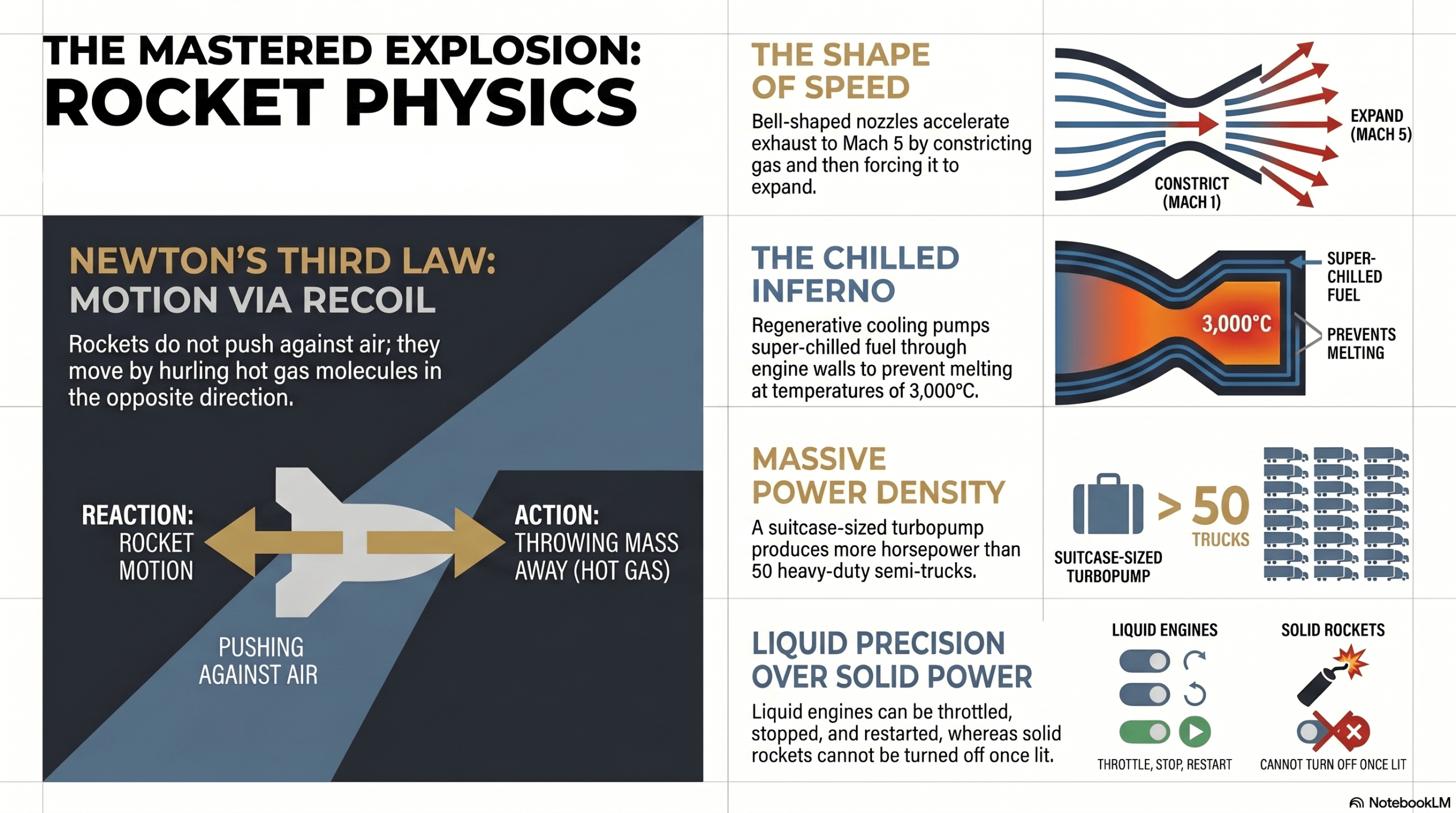
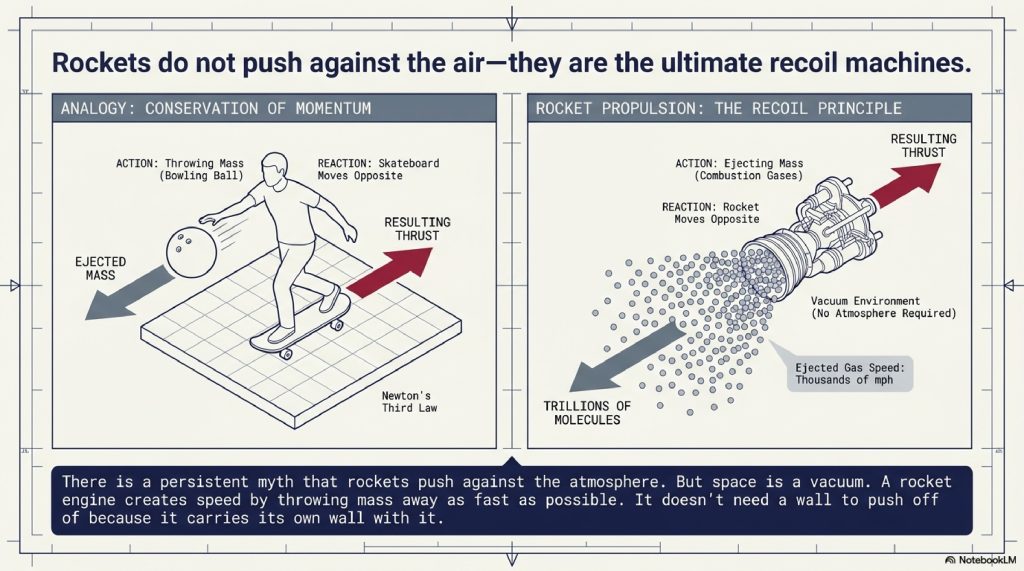
There is a persistent myth that rockets work by pushing against the air, like a swimmer pushing off a wall. But space is a vacuum. There is no air to push against. If a rocket worked by “pushing,” it would simply stop moving the moment it hit the edge of the atmosphere.
Instead, a rocket engine is the ultimate expression of Newton’s Third Law of Motion. It is a machine that creates speed by throwing mass away as fast as possible. It doesn’t need a wall to push off of because it carries its own wall with it.
In this deep-dive exploration, we are going to dissect the anatomy of these mechanical beasts. We will explore how we teach fire to flow in one direction, why the shape of a nozzle is the difference between a firework and a moon-shot, and how engineers keep these engines from melting into a puddle of slag while they are operating.
Buckle up. We are going to explore the physics of how we leave the Earth behind.
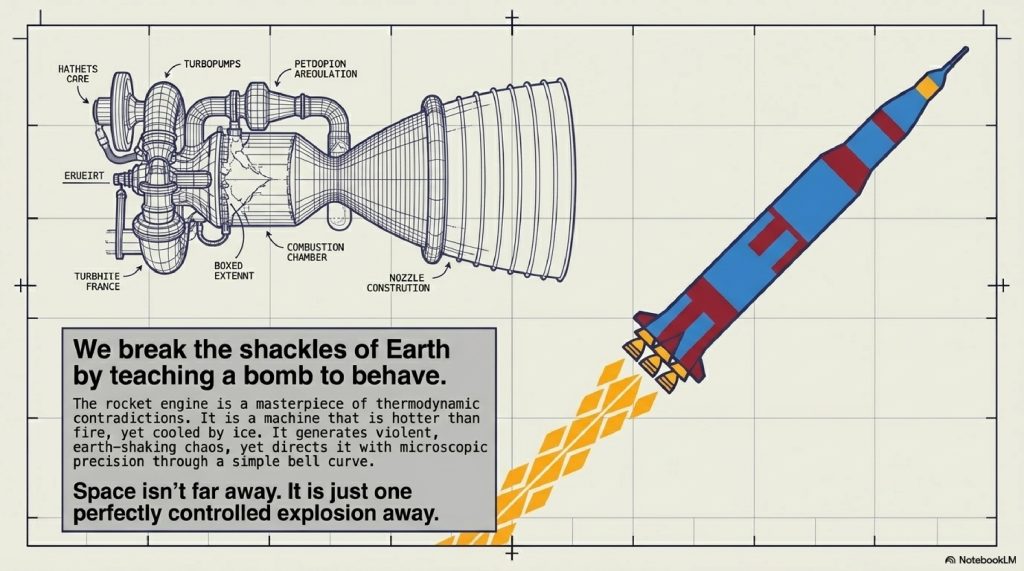
TABLE OF CONTENTS
- The Fundamental Truth: Newton’s Third Law
- The Simple Explanation: The Skateboard and the Bowling Ball
- The Anatomy of the Beast: Step-by-Step Mechanics
- The Chemistry of Fire: Fuel vs. Oxidizer
- The Nozzle: The Shape of Speed (de Laval)
- Advanced Engineering: How to Cool a Metal Inferno
- The Turbopump: The Jet Engine Inside the Rocket
- Liquid vs. Solid: Choosing Your Fire
- Common Myths About Rocket Engines
- The Future: Methane, Ion Drives, and Nuclear Rockets
- Interesting Facts & FAQs
The Fundamental Truth: Newton’s Third Law
To understand a rocket, you have to forget about the ground, the air, and the wind. You have to think about Recoil.
If you have ever fired a shotgun or a high-powered rifle, you know that the gun kicks back into your shoulder. That “kick” is the fundamental principle of rocket science. When the gunpowder explodes, it pushes the bullet forward. Because of Newton’s Third Law, For every action, there is an equal and opposite reaction, the bullet pushes the gun backward with the exact same amount of force.
A rocket engine is essentially a Recoil Machine. It isn’t pushing against the atmosphere; it is pushing against its own exhaust. By throwing hot, pressurized gas out of its back at supersonic speeds, the gas pushes the rocket forward.
The Simple Explanation: The Skateboard and the Bowling Ball
Think of it like this: You are standing on a skateboard on a perfectly flat, frictionless floor. You are holding a heavy bowling ball.
- If you drop the ball, nothing happens.
- If you place the ball gently on the ground, you might move a fraction of an inch.
- But if you hurl that bowling ball away from you as hard as you can, you will go zooming in the opposite direction.
A rocket engine does this trillions of times per second. Instead of bowling balls, it uses gas molecules. Because there are so many of them and they are moving so fast, they provide enough “push” to lift a three-million-pound rocket into the stars.
The Anatomy of the Beast: Step-by-Step Mechanics
A liquid-fueled rocket engine (like those used by SpaceX or Blue Origin) follows a logical, violent progression of events.
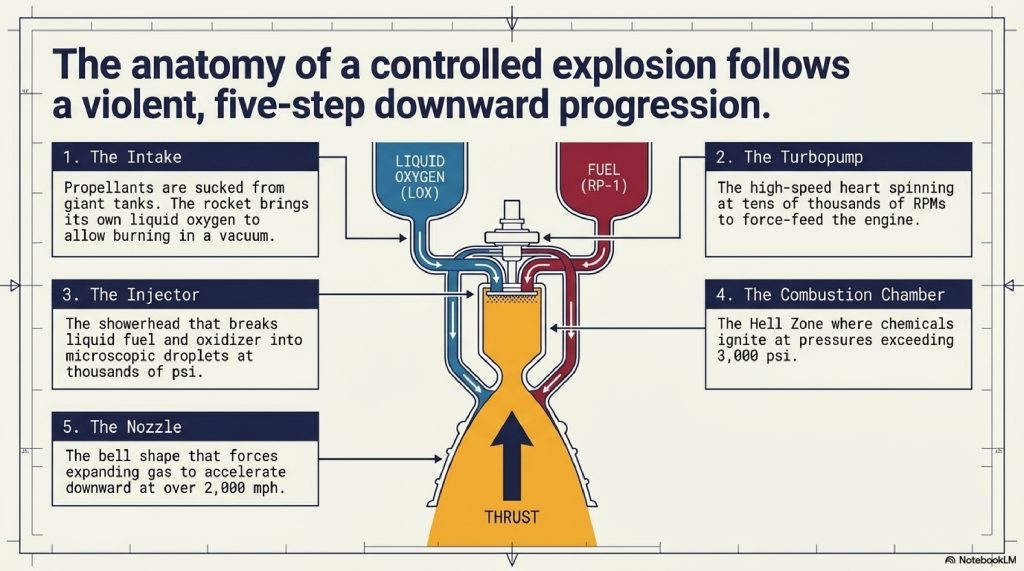
Step 1: The Intake
Propellants are sucked out of giant tanks. You have two main ingredients: a Fuel (like kerosene or liquid methane) and an Oxidizer (like liquid oxygen). In space, there is no oxygen to help things burn, so you have to bring your own “air” in liquid form.
Step 2: The Turbopump
This is the unsung hero. The propellants need to be shoved into the engine at incredible pressures. A turbopump is a high-speed heart that spins at tens of thousands of RPMs to force-feed the engine. Without this, the engine would just “burp” and go out.
Step 3: The Injector
Think of a showerhead, but one that is mixing volatile chemicals at thousands of pounds per square inch. The injector breaks the liquid fuel and oxidizer into tiny droplets so they can mix and explode efficiently.
Step 4: The Combustion Chamber
This is the “Hell Zone.” This is where the fuel and oxidizer meet and ignite. The pressure here is astronomical, sometimes over 3,000 psi. The chemicals turn from liquid to a massive volume of expanding, white-hot gas.
Step 5: The Nozzle
The gas wants to go everywhere, but the bell-shaped nozzle forces it to go in one direction: Down. By constricting the gas and then letting it expand, the nozzle accelerates the exhaust to speeds exceeding 2,000 miles per hour.
The Chemistry of Fire: Fuel vs. Oxidizer
In a car, you have gasoline and you have the air outside. In a rocket, the “air” (Oxidizer) takes up more space than the fuel.
Most modern rockets use Cryogenic Propellants. These are gases like Oxygen and Hydrogen that have been cooled to hundreds of degrees below zero until they turn into liquids. This allows you to pack more “energy” into a smaller tank.
- RP-1: A highly refined kerosene. Great for the first stage because it’s stable and powerful.
- Liquid Hydrogen: The most efficient chemical fuel, but it’s “fluffy” (takes up a lot of space) and incredibly hard to keep cold.
- Methane (Starship): The new frontier. It’s cleaner than kerosene and easier to handle than hydrogen.
The Nozzle: The Shape of Speed (de Laval)
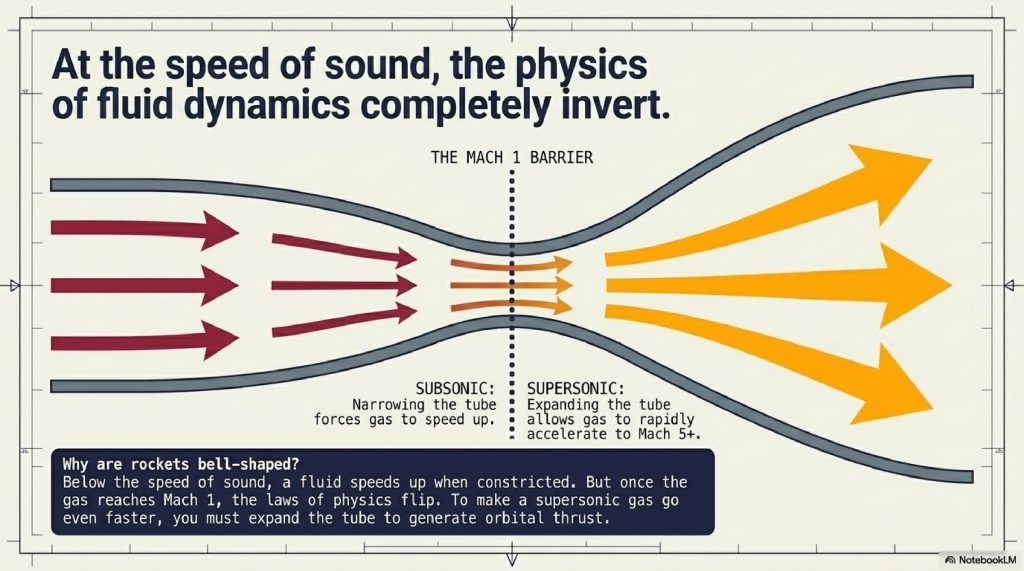
Why are rocket engines shaped like bells? Why aren’t they just straight tubes?
The answer lies in the de Laval Nozzle. If you have a subsonic gas and you narrow the tube, the gas speeds up (like putting your thumb over a garden hose). But once the gas reaches the speed of sound (Mach 1), the physics flips. To make a supersonic gas go faster, you actually have to expand the tube.
A rocket nozzle has a “throat” where the gas hits Mach 1. Then, the bell flares out, allowing the gas to expand and accelerate to Mach 3, 4, or 5. This expansion is what generates the massive thrust needed for orbit.
Advanced Engineering: How to Cool a Metal Inferno
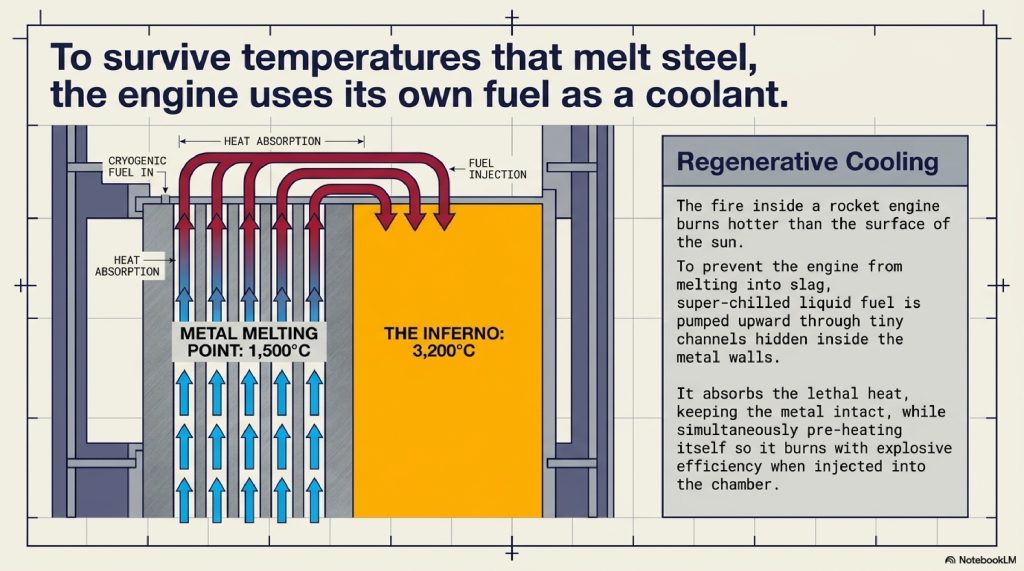
The fire inside a rocket engine is often 3,000°C (5,400°F). The melting point of the copper or steel used to build the engine is around 1,000°C to 1,500°C.
The engine should melt in seconds. Why doesn’t it?
The secret is Regenerative Cooling. Before the liquid fuel is sent into the combustion chamber to be burned, it is first pumped through thousands of tiny, microscopic channels inside the walls of the engine.
The super-chilled fuel absorbs the heat of the engine, cooling the metal down, while simultaneously getting “pre-heated” so it burns better. The fuel acts as the engine’s own coolant system before it becomes its own fire.
The Turbopump: The Jet Engine Inside the Rocket
To get enough fuel into the chamber, you need a pump that produces tens of thousands of horsepower. But you can’t just plug it into a wall.
Engineers build a “mini” rocket engine called a Pre-burner to spin a turbine, which then spins the pumps.
- In a Gas Generator Cycle (like the Merlin), the “exhaust” from this mini-engine is just dumped out a side pipe (that’s the little black smoke you see next to a rocket).
- In a Staged Combustion Cycle (like the Raptor), that exhaust is shoved back into the main engine so no fuel is wasted. This is much harder to build but far more powerful.
Liquid vs. Solid: Choosing Your Fire
Solid Rockets (The Fireworks): Think of the Space Shuttle Boosters. It’s basically a giant tube of rubbery gunpowder. Once you light it, you cannot turn it off. It’s great for raw “oomph” to get off the pad.
Liquid Rockets (The Ferraris): These are complex, but you can throttle them, turn them off, and restart them. This is how SpaceX lands its rockets. You need precision, and liquid engines provide it.
Common Myths About Rocket Engines
- “Rockets push against the ground at liftoff.”False. If you launched a rocket in deep space with nothing around it, it would move just as well. The ground is actually a nuisance, it reflects acoustic waves that can vibrate the rocket to pieces.
- “The smoke is just pollution.”Partially False. In Hydrogen engines (like the Space Shuttle Main Engines), the “smoke” is actually pure water vapor (steam).
- “Rocket engines use gasoline.”False. Gasoline isn’t energy-dense enough and doesn’t play well with liquid oxygen. We use RP-1, Hydrogen, or Methane.
The Future of the Technology
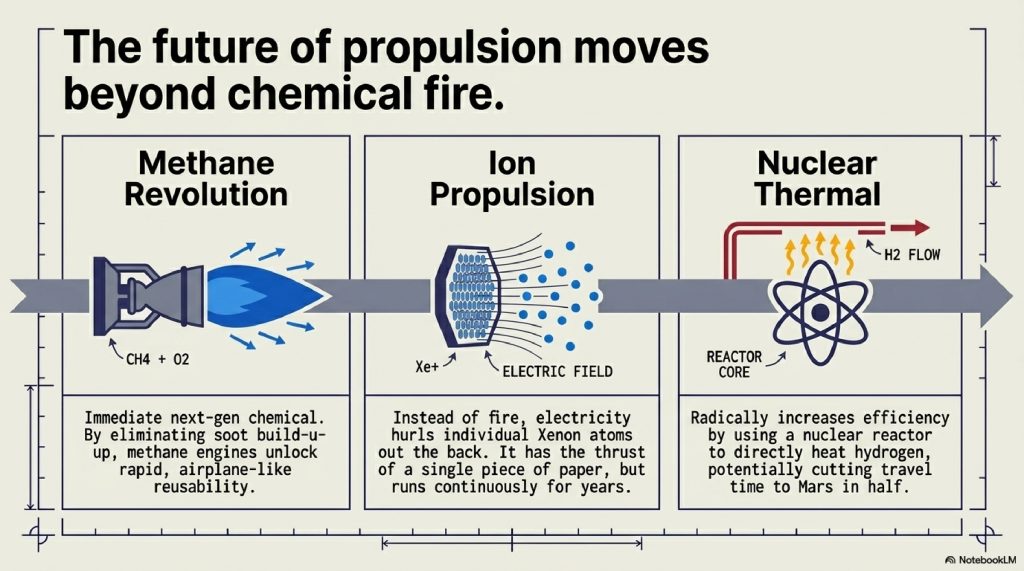
- Methane Revolution: SpaceX’s Raptor engine uses Methane because it doesn’t leave “soot” in the engine, making it easier to reuse the rocket 100 times.
- Ion Propulsion: Instead of fire, these engines use electricity to hurl individual atoms (Xenon) out the back. They have the “push” of a piece of paper, but they can run for years, eventually reaching incredible speeds for deep space travel.
- Nuclear Thermal: Using a nuclear reactor to heat hydrogen. This could cut the trip to Mars in half.
Interesting Facts Section
- Mach Diamonds: Have you ever seen the “diamonds” in a rocket flame? Those are standing shockwaves caused by the exhaust gas expanding and contracting as it fights against the outside air pressure.
- Power Density: A single turbopump for a large rocket engine is small enough to fit in a suitcase but produces more horsepower than a line of 50 heavy-duty semi-trucks.
- The Sound: At close range, the sound of a rocket engine is so loud it can literally set grass on fire through acoustic energy alone.
FAQ SECTION
1. Can a rocket engine work under water?
Yes. Since a rocket carries its own oxidizer, it doesn’t need external air. As long as the pressure inside the engine is higher than the water pressure outside, it will fire.
2. Why does the engine flame change color?
It depends on the fuel. Kerosene (RP-1) is bright orange/yellow (soot). Hydrogen is almost invisible (pale blue). Methane is a distinct “lightsaber” blue.
3. What happens if a rocket engine “stalls”?
In a car, it’s a nuisance. In a rocket, it’s usually an Uncontained Engine Breakup (an explosion). If the flow of fuel and oxygen isn’t perfectly steady, the pressure can backfire, destroying the machine.
4. How do you steer a rocket?
Most rocket engines are mounted on a Gimbal (a swivel). By tilting the engine slightly, the thrust pushes the bottom of the rocket to the side, changing its direction.
5. What is “Specific Impulse” ?
It’s the “Miles Per Gallon” of rocket science. It measures how much “push” you get for every pound of fuel. Hydrogen has a high ; Solid fuel has a low .
6. Why don’t we use electric motors to launch?
Batteries are too heavy. Chemical fuel is a way to store a massive amount of energy in a very light liquid. Currently, no battery can provide the “burst” energy needed to fight Earth’s gravity.
7. How hot is the flame?
Around . For comparison, the surface of the sun is about .
8. Can you restart a rocket engine in space?
Only if it’s designed for it. You need a way to settle the fuel at the bottom of the tank (using “ullage” motors) and a way to re-ignite the spark (like TEA-TEB fluid).
9. Why do some rockets have multiple engines?
It’s more reliable. If one engine fails on a Falcon 9 (which has nine), the others can burn longer to compensate. It’s also easier to mass-produce small engines than one giant one.
10. What is a “Vacuum Engine”?
Engines used in space have much larger “bells” (nozzles). In a vacuum, the gas wants to expand forever, so a bigger bell helps catch all that expansion and turn it into thrust.
OTHER USEFUL BLOG SUGGESTIONS
- How SpaceX Reuses Rockets: The miracle of the landing burn.
- How Recommendation Algorithms Work: The Science of Your Feed
CONCLUSION
The rocket engine is the only machine we have ever built that allows us to break the “shackles” of our planet. It is a masterpiece of contradictions: it is violent yet precise; it is hotter than fire yet cooled by ice; it is a bomb that we have successfully taught to behave.
When we look at a rocket, we shouldn’t just see a vehicle. We should see the culmination of our understanding of the universe. Every launch is a tribute to Newton’s math, the chemistry of the elements, and the sheer human will to see what is over the next horizon.
We are no longer a species confined to the dirt. Because we learned how to hurl fire at the ground, we have earned the right to touch the stars. And as we move toward Methane-powered Starships and nuclear-driven Mars missions, the fundamental principle remains the same: throw something away, and you will move forward.
Space isn’t far away. It’s just a controlled explosion away.
Comment