Imagine you are standing on the deck of a boat, hundreds of miles off the coast of Alaska. The nearest cell phone tower is a continent away. The nearest fiber-optic cable is buried miles beneath the crushing weight of the Pacific Ocean. By all logic, you are entirely disconnected from human civilization.
Yet, you pull out your phone, tap a button, and instantly begin streaming a high-definition movie.
How is this possible?
We live in an age where we treat the internet like magic. We assume it’s an invisible cloud that simply exists around us. But the internet is deeply, heavily physical. It is a planetary machine made of copper, glass, and steel. For decades, if you wanted to be part of the internet, you had to be physically tethered to it by a wire stretching all the way back to a data center.
Satellite internet shatters that rule. It rips the wires out of the ground and throws them into the vacuum of space.
Every time you load a webpage via satellite, your device initiates a staggering chain reaction. Your request is translated into a radio wave, blasted straight up through the Earth’s atmosphere at the speed of light, caught by a metal box flying at 17,000 miles per hour, and shot back down to a ground station, before traversing the globe. And all of this happens in the time it takes you to blink.
But how does a tiny dish on your roof perfectly track a satellite moving faster than a bullet? How do millions of users share this invisible highway without crashing into each other? And why did older satellite internet feel unbearably slow, while modern systems are fast enough to handle competitive gaming?
To understand how satellite internet works is to understand a triumph of modern physics. It’s a story of orbital mechanics, cold-war radar technology, and microscopic lasers dancing in the dark.
Let’s demystify the magic.
TABLE OF CONTENTS
- The Big Picture: The Internet is Physical
- The Simple Explanation: A Game of Intergalactic Catch
- The Step-by-Step Journey of a Single Click
- The Geometry of Space: LEO vs. GEO (The Latency Problem)
- Advanced Wizardry: How the “Pizza Box” Dish Actually Works
- The Backbone: Ground Stations and Space Lasers
- Common Myths About Satellite Internet
- The Future: Direct-to-Cell and The Kessler Syndrome
- Surprising Facts You Didn’t Know
- Frequently Asked Questions (FAQs)
The Big Picture: The Internet is Physical
Before we go to space, we have to look at the ground.
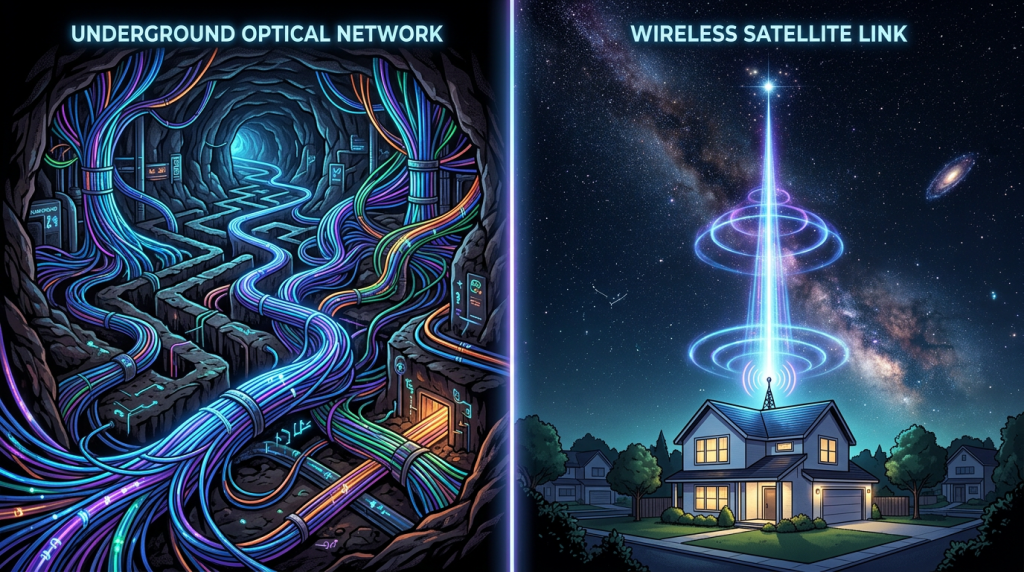
Most people think of the internet as “Wi-Fi.” But Wi-Fi only carries your data for the last 50 feet. Once your data hits your home router, it travels through physical cables buried under your street, eventually merging onto massive underwater fiber-optic cables that connect continents.
But what if you live on a mountain? Or a remote farm? Digging hundreds of miles of trench to lay down a fiber-optic cable for a single house costs millions of dollars. It’s economically impossible.
This is the exact problem satellite internet was invented to solve. Instead of burying a cable through the dirt, it uses the empty sky as the ultimate, unobstructed wire.
The Simple Explanation: A Game of Intergalactic Catch
Think of satellite internet like an impossibly fast game of catch.
Imagine you are standing in your backyard with a flashlight. You want to ask a librarian a question, but the library is 1,000 miles away. Fortunately, you have a friend in a helicopter hovering high above your house.
You flash a question in Morse code to the helicopter. Your friend in the helicopter sees it, turns their flashlight toward the distant library, and flashes the message down to a librarian standing on the roof. The librarian finds the answer, flashes it back to the helicopter, and the helicopter flashes it back to you.
In the world of satellite internet:
- You are the user.
- Your flashlight is the satellite dish on your roof.
- The helicopter is the satellite in space.
- The librarian is a “Ground Station” connected to the rest of the world’s internet.
The Step-by-Step Journey of a Single Click
Let’s slow down time. What EXACTLY happens behind the scenes when you send a WhatsApp message using a system like Starlink?
Step 1: The Translation Your phone connects to your home Wi-Fi router. The router translates your text message into binary code (1s and 0s) and sends it through a wire to the satellite dish mounted on your roof.
Step 2: The Uplink Your dish translates those 1s and 0s into radio frequency (RF) waves. It concentrates these waves into a tight, invisible beam and fires it straight up into the sky.
Step 3: The Space Catch A satellite passing overhead catches this radio wave using its own antennas. It amplifies the signal to ensure it hasn’t lost any data.
Step 4: The Downlink The satellite instantly looks for the nearest Ground Station, a massive facility on Earth filled with giant antennas connected to fiber-optic cables. The satellite fires your data down to this station.
Step 5: The Terrestrial Sprint The Ground Station receives your message, converts it back into light, and sends it through traditional fiber-optic cables to WhatsApp’s data centers.
Step 6: The Return Journey The WhatsApp server registers the message, sends a “Delivered” receipt back to the Ground Station, up to the satellite, and down to your roof dish.
This entire 2,000+ mile round trip happens in about 40 milliseconds.
The Geometry of Space: LEO vs. GEO (The Latency Problem)
If you used satellite internet 10 years ago, you probably hated it. It was slow, clunky, and had a massive delay. If you clicked a link, you had to wait two full seconds before anything happened.
Why? Because of Latency, the time it takes for data to travel from point A to point B. And latency is determined entirely by altitude.
Historically, satellite internet companies (like Viasat or HughesNet) used Geostationary Orbit (GEO). Modern companies (like SpaceX’s Starlink or Amazon’s Project Kuiper) use Low Earth Orbit (LEO).
Understanding the difference is the master key to understanding modern space tech.
The Old Way: Geostationary Orbit (GEO)
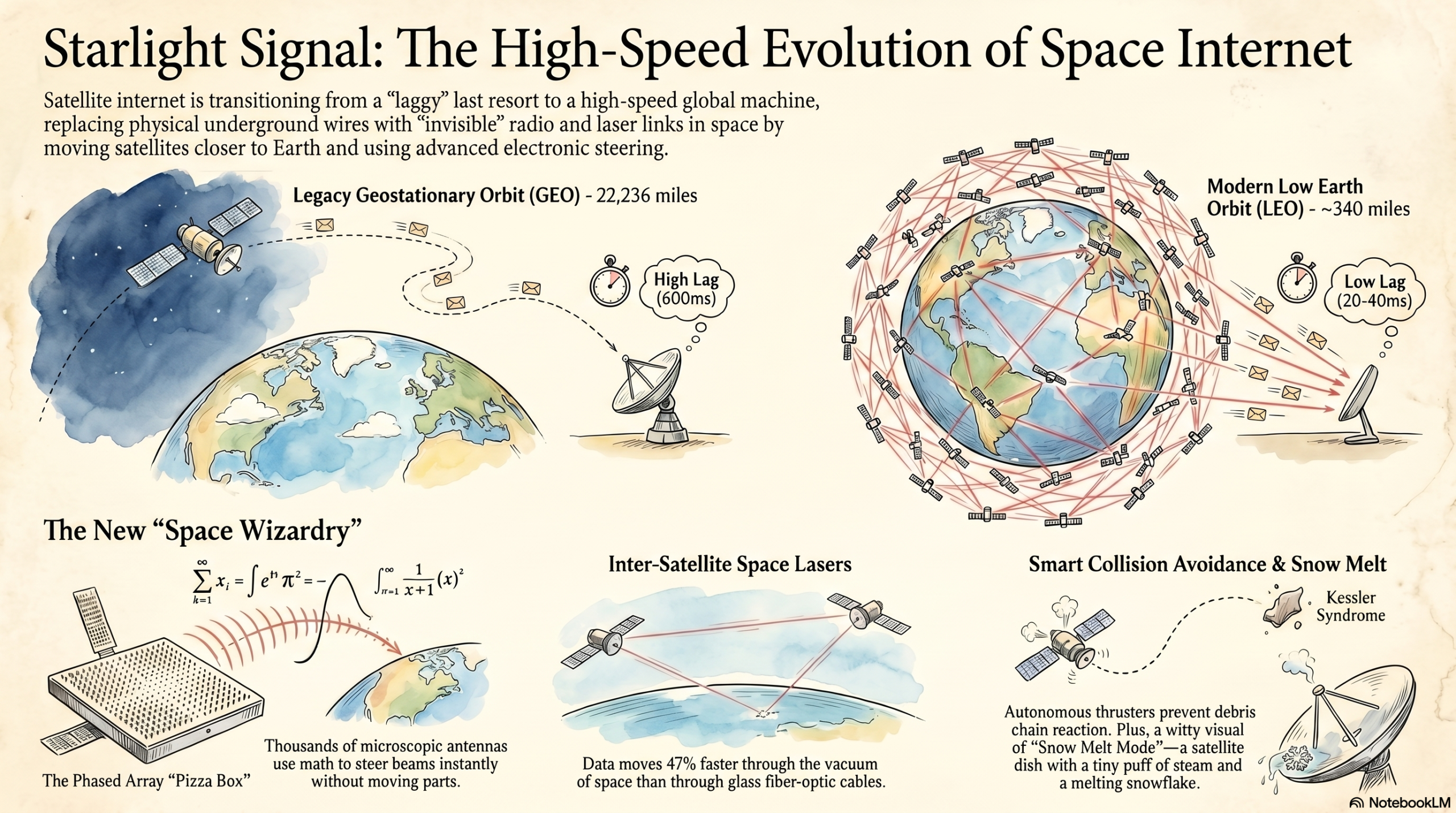
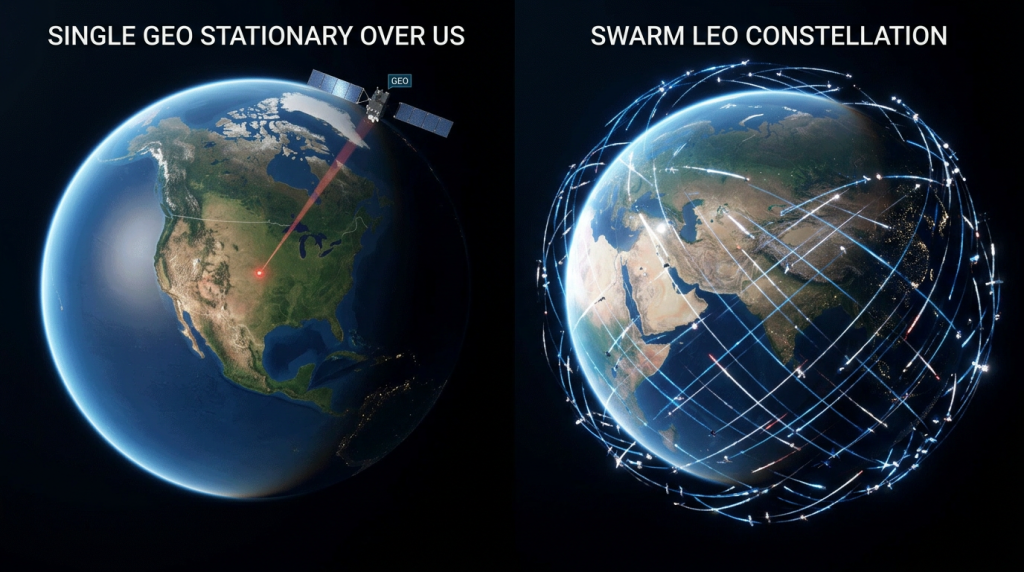
A GEO satellite sits 22,236 miles (35,786 km) above the Earth. At this specific altitude, the satellite orbits at the exact same speed that the Earth rotates. This means the satellite appears to hover completely motionless in the sky.
- The Pro: Because it’s so high up, a single GEO satellite can “see” a massive portion of the Earth. You only need two or three to cover an entire continent. Your dish on the roof just points at one fixed spot in the sky forever.
- The Con: The distance is immense. Even at the speed of light, a signal traveling 22,000 miles up and 22,000 miles down takes almost 600 milliseconds. That lag makes voice calls awkward and online gaming impossible.
The New Way: Low Earth Orbit (LEO)
LEO satellites sit just 340 miles (550 km) above the Earth.
- The Pro: Because they are so close, the data trip is incredibly short. Latency drops from 600 milliseconds to 20-40 milliseconds rivaling traditional ground-based broadband.
- The Con: Because they are so close to the Earth, their field of view is tiny. Furthermore, they don’t hover; they whip around the globe at 17,000 mph, crossing the sky in just a few minutes.
To provide continuous internet with LEO, you can’t just launch one satellite. You have to launch thousands of them to create a continuous “mesh” or Constellation over the planet, passing the connection off like a relay race.
Advanced Wizardry: How the “Pizza Box” Dish Actually Works
Wait… if LEO satellites are flying overhead at 17,000 mph, how does the dish on my roof track them? Does it physically spin around like a radar dish?
If you watch a modern satellite internet dish (like a Starlink terminal), you’ll notice it tilts once to find the best angle, and then… it just sits there. It doesn’t move. Yet, it flawlessly tracks dozens of supersonic satellites flying across the sky.
How? Through a breathtaking piece of engineering called a Phased Array Antenna.
This isn’t a traditional dish. It’s a flat surface hiding a grid of thousands of microscopic, individual antennas.
Instead of physically moving a chunk of metal to aim the signal, the computer chip inside the dish manipulates the timing of the radio waves coming out of those tiny antennas. By delaying the signal from one side of the board by a fraction of a nanosecond compared to the other side, the individual radio waves crash into each other, creating constructive interference.
This interference forms a focused “beam” of energy that can be steered electronically in any direction, instantly, without moving a single mechanical part. The dish is essentially bending the radio waves with pure math.
The Backbone: Ground Stations and Space Lasers
So far, we’ve established that your dish talks to a satellite, and the satellite talks to a Ground Station.
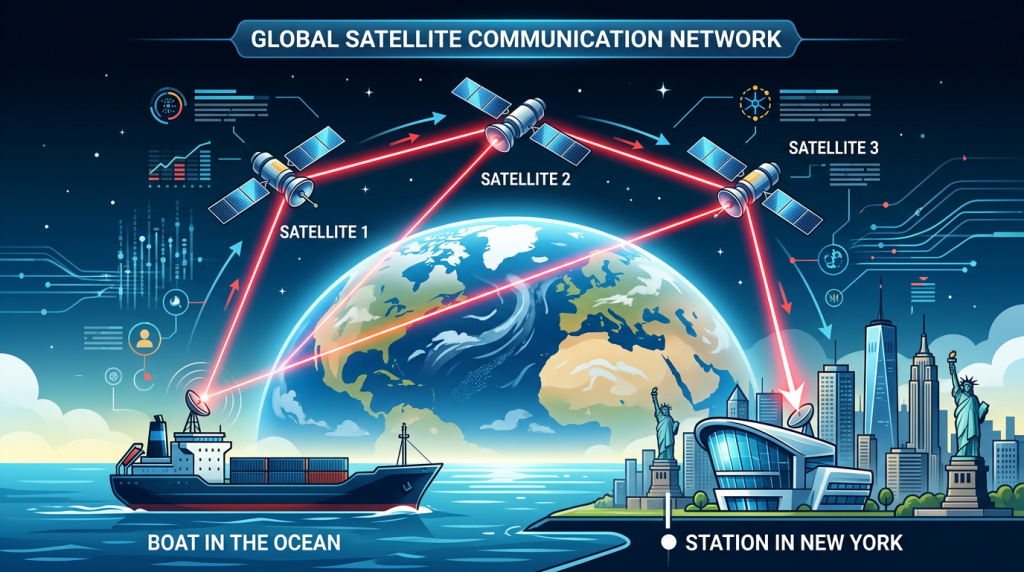
But what if you are in the middle of the Atlantic Ocean? There are no Ground Stations in the ocean. If the satellite above you can’t see a Ground Station, how does it connect to the internet?
Welcome to the cutting edge: Inter-Satellite Optical Links (Space Lasers).
Modern LEO satellites are equipped with highly advanced laser transmitters. If a satellite is over the ocean and catches your data, it doesn’t try to send it down. Instead, it fires a microscopic laser beam through the vacuum of space to the next nearest satellite, which fires it to the next one, until the data reaches a satellite that is currently over a land-based Ground Station.
Because light travels approximately 47% faster through the vacuum of space than it does through the solid glass of fiber-optic cables, data routed through these space lasers can actually travel across the globe faster than terrestrial internet.
Financial traders are currently experimenting with space lasers to shave milliseconds off international stock trades, a testament to how fast this technology truly is.
Common Myths About Satellite Internet
Myth 1: “A cloudy day will ruin my connection.” Reality: Rain fade used to be a massive problem for older GEO satellites because the signal had to push through 22,000 miles of atmosphere. Modern LEO satellites punch through clouds easily. While severe, torrential thunderstorms can cause temporary drops, standard clouds and rain barely register.
Myth 2: “It’s only for rural areas; it replaces 5G.” Reality: Satellite internet is a lifeline for rural areas, but it doesn’t replace 5G in cities. In a densely populated city, a satellite would be overwhelmed by millions of users trying to access it at once. Ground-based towers and fiber will always be the backbone of urban environments.
Myth 3: “It’s dangerous radiation.” Reality: The radio waves used by satellite dishes are non-ionizing radiation. This means they do not carry enough energy to damage DNA or cells. It is the exact same type of energy used by your local FM radio station or your TV antenna.
The Future: Direct-to-Cell and The Kessler Syndrome
Where does the technology go from here? We are entering the era of ubiquitous connectivity.
Direct-to-Cell
The next massive leap is eliminating the roof dish entirely. Companies are launching larger satellites equipped with advanced modems that can talk directly to the standard 4G/5G smartphone already in your pocket. Soon, “No Service” dead zones will simply cease to exist on the surface of the Earth.
The Looming Risk: Kessler Syndrome
With thousands of new satellites launching every year, orbit is getting crowded. The biggest fear in the aerospace industry is the Kessler Syndrome, a theoretical scenario where a collision between two satellites creates a cloud of debris. That debris destroys other satellites, creating more debris, triggering a runaway chain reaction that could render Earth’s orbit unusable for generations. To prevent this, modern satellites are designed with autonomous collision-avoidance thrusters and are built to burn up harmlessly in the atmosphere at the end of their lifespan.
Surprising Facts You Didn’t Know
- Faster Than Glass: Light travels at roughly 300,000 km/second in the vacuum of space, but only about 200,000 km/second in a fiber-optic cable. This means space internet is fundamentally, physically faster over long distances.
- The First Satellite Internet: The very first satellite to relay a voice signal was NASA’s Project Echo in 1960. It wasn’t a complex machine; it was literally a giant, shiny balloon. They bounced radio waves off it like a mirror.
- Hot Dishes: In the winter, Starlink dishes have a built-in “Snow Melt Mode.” The phased array antenna intentionally runs less efficiently, generating heat to melt snow and ice off its surface so the signal remains clear.
FREQUENTLY ASKED QUESTIONS (FAQs)
1. Does satellite internet require a phone line? No. Unlike old dial-up or DSL, satellite internet operates entirely independently of terrestrial phone lines or cable infrastructure. All you need is the dish and a clear view of the sky.
2. Is satellite internet good for gaming? Older GEO satellite internet (like Viasat) was terrible for fast-paced gaming due to high latency. Modern LEO internet (like Starlink) has latency between 20-40ms, making it perfectly viable for competitive multiplayer games like Call of Duty or Fortnite.
3. Why do I need a clear view of the sky? Radio frequencies used by satellites cannot penetrate thick solid objects like brick, metal, or dense tree canopies. If a tree branch is blocking the dish’s line of sight to the satellite, the signal will drop.
4. Can I put my satellite dish on an RV or a moving boat? Yes. Modern phased array antennas can dynamically track satellites even while you are driving down a highway or bobbing in the ocean, adjusting their electronic beams in milliseconds.
5. How fast is satellite internet? Speeds vary, but modern LEO connections typically offer between 50 Mbps and 250 Mbps for standard users, with higher tiers available for enterprise and maritime use.
6. Does the internet work at night? Yes, absolutely. Satellites run on solar panels and store energy in massive onboard batteries, allowing them to function seamlessly while orbiting on the dark side of the Earth.
7. Who owns the satellites? Currently, private companies own the majority of internet constellations. SpaceX owns Starlink, Amazon owns Project Kuiper, and Eutelsat owns OneWeb.
8. Can hackers intercept my data from space? While signals travel openly through the air, all modern satellite internet data is heavily encrypted using end-to-end security protocols. Intercepting the raw radio wave would only yield unrecognizable digital noise.
9. What happens to broken satellites? LEO satellites sit low enough that they experience slight atmospheric drag. When they reach the end of their life (usually 5 to 7 years), they run out of fuel and fall back to Earth, burning up entirely in the upper atmosphere.
10. Will satellite internet ever be free? Unlikely. The cost to manufacture rockets, launch satellites, and maintain global ground stations runs into the tens of billions of dollars. However, prices are expected to drop as competition between companies increases.
Comment