INTRODUCTION
Look at a famous photograph from NASA like the Pillars of Creation, or a deep field glittering with thousands of galaxies. The colors are vibrant, the details are razor-sharp, and the scale is almost impossible to comprehend.
It looks like magic. But it is not a point-and-shoot camera.
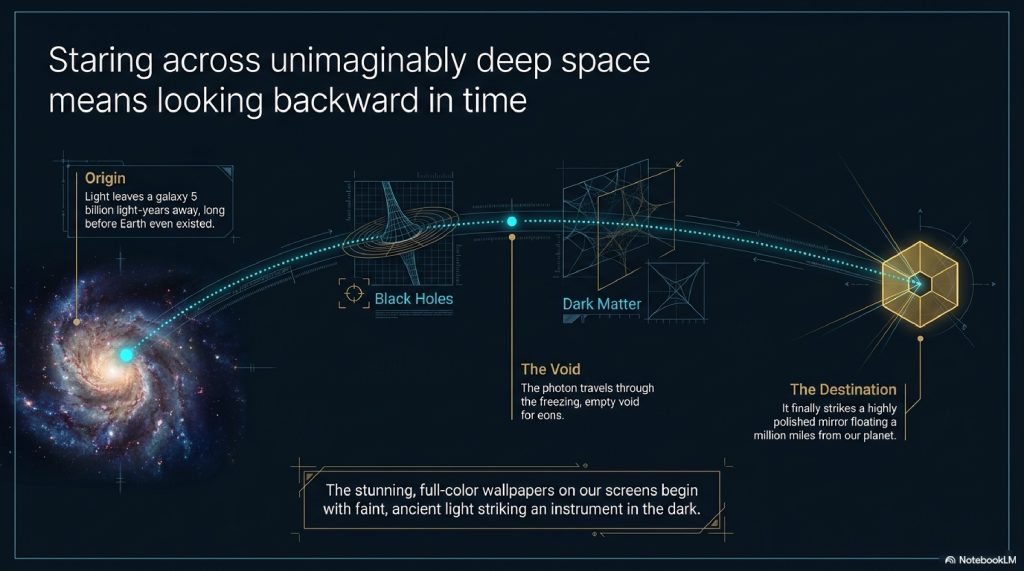
When you look at an image of a galaxy located 5 billion light-years away, you are not just looking across unimaginable distances. You are looking back in time. The light in that photograph left its home long before the Earth even existed. It traveled through the freezing, empty void of space for eons, dodging black holes and dark matter, until it finally struck a highly polished mirror floating a million miles from our planet.
But how does that faint, ancient light become the stunning, full-color wallpaper on your computer screen?
Most people assume space telescopes are simply massive cameras that zoom in really close to take a picture. The truth is far more fascinating. Capturing an image of the cosmos involves catching invisible light, counting individual electrons, and using digital artistry to translate the unseen universe into something the human eye can comprehend.
Let’s strip away the mystery and step behind the lens. Here is exactly how humanity photographs the edges of the universe.
The “Light Bucket” Concept
To understand how a space telescope works, you have to stop thinking of it as a camera and start thinking of it as a bucket.
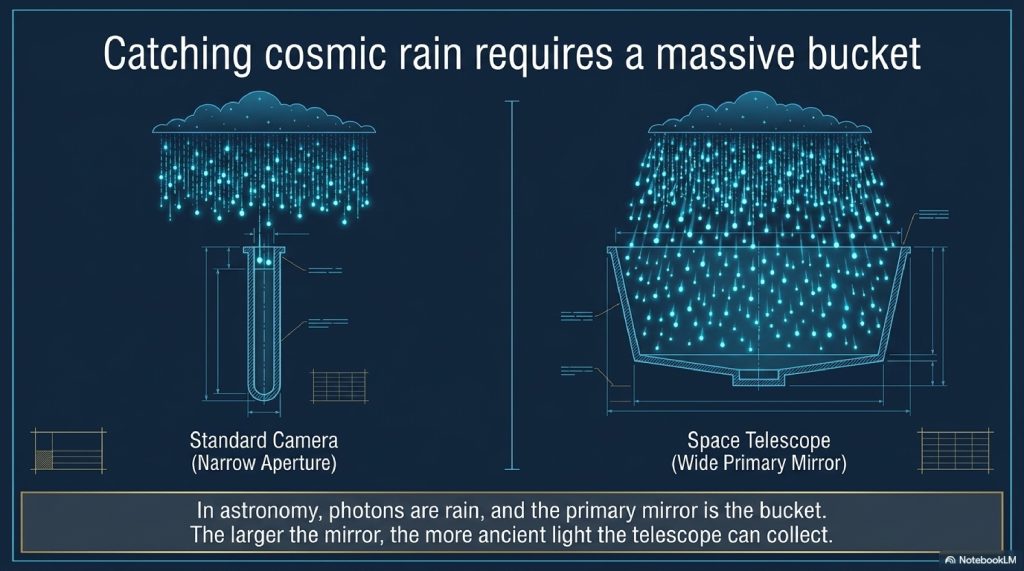
If you want to catch a lot of rain in a storm, you don’t use a narrow test tube; you use a wide bucket. In astronomy, rain is light (photons), and the bucket is a mirror.
The bigger the primary mirror, the more light the telescope can collect. This is why the Hubble Space Telescope has a mirror roughly the size of a large truck tire (2.4 meters), while the James Webb Space Telescope (JWST) uses a massive, gold-coated honeycomb of mirrors over 6.5 meters across.
But why put these mirrors in space at all?
If you’ve ever looked at a coin resting at the bottom of a swimming pool, you’ve noticed how the water makes it ripple and distort. Looking at the stars from Earth is exactly the same. Our atmosphere is a thick, turbulent ocean of gas. By placing telescopes in the vacuum of space, we completely bypass this atmospheric “swimming pool,” resulting in crystal-clear, distortion-free images.
Behind the Scenes: The Step-by-Step Journey of a Cosmic Photograph
So, what actually happens when a telescope stares into the dark?
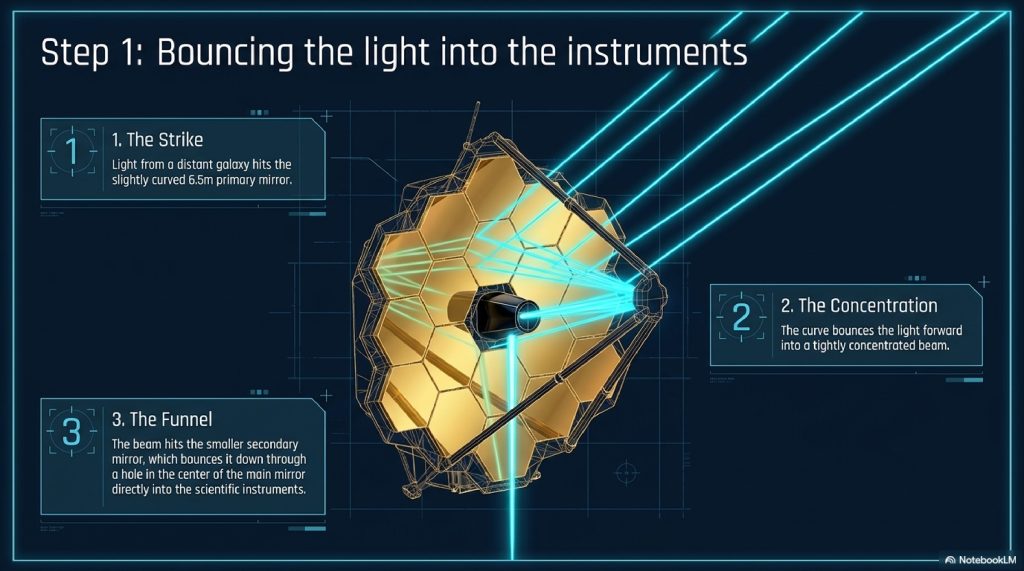
Step 1: The Photon Catch
Light from a distant galaxy hits the giant primary mirror. Because the mirror is slightly curved, it bounces that light forward into a concentrated beam, hitting a smaller secondary mirror. This secondary mirror bounces the light down through a hole in the center of the main mirror, directing it into the scientific instruments.
Step 2: The Digital Conversion
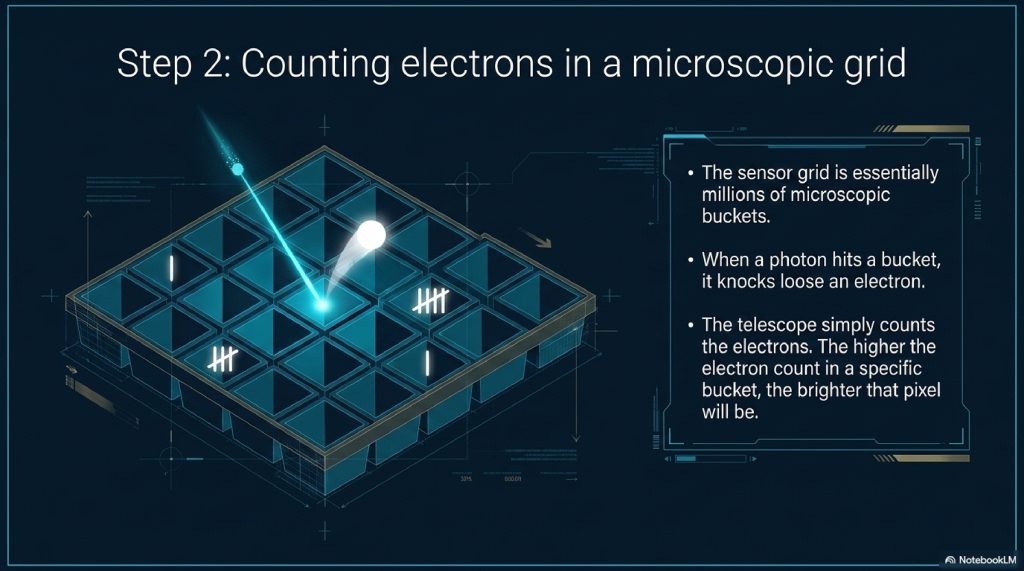
The light hits a sensor called a CCD (Charge-Coupled Device) or a near-infrared detector. Think of this sensor as a grid of millions of microscopic buckets. When a photon hits one of these buckets, it knocks loose an electron. The telescope simply counts the electrons. The more electrons in a bucket, the brighter that specific pixel will be.
Step 3: The Filter Wheel
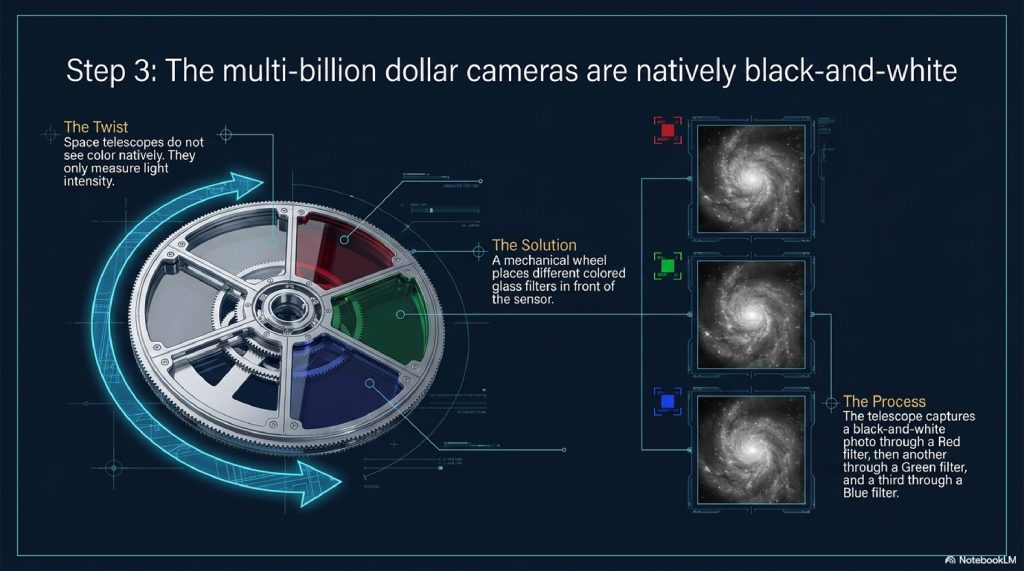
Here is the ultimate twist: Space telescopes are black-and-white cameras. They do not see color natively. Instead, they have a mechanical wheel filled with different colored pieces of glass (filters). The telescope takes a black-and-white photo looking only through a Red filter. Then, it takes another looking only through a Green filter, and a third through a Blue filter.
Step 4: Translating the Invisible
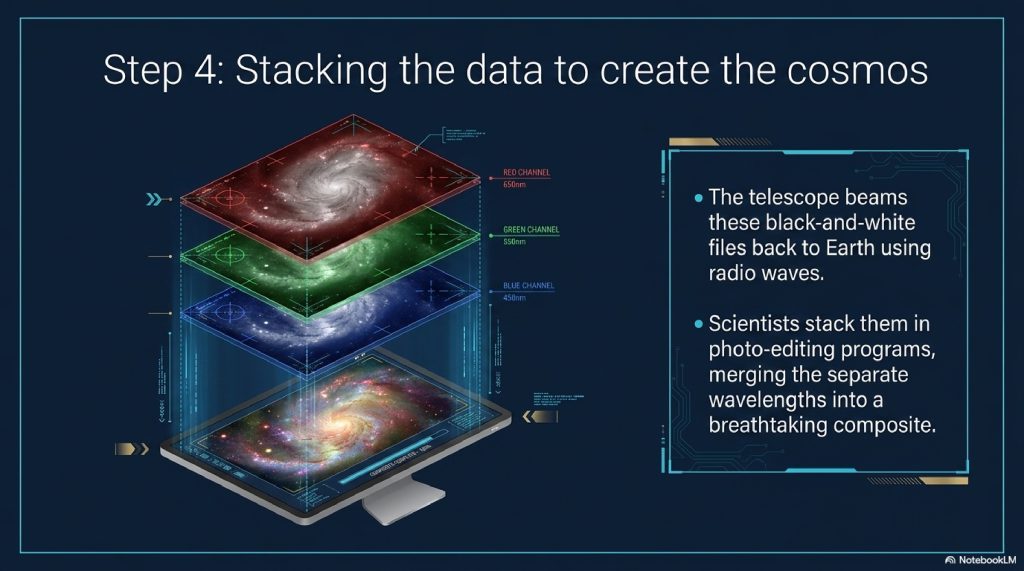
The telescope beams these black-and-white data files back to Earth using radio waves. Scientists at agencies like NASA take the black-and-white “Red” image, the “Green” image, and the “Blue” image, and stack them on top of each other in a photo-editing program. When combined, these layers produce the breathtaking, full-color images we see on the news.
Understanding “False Color” Image Compositing
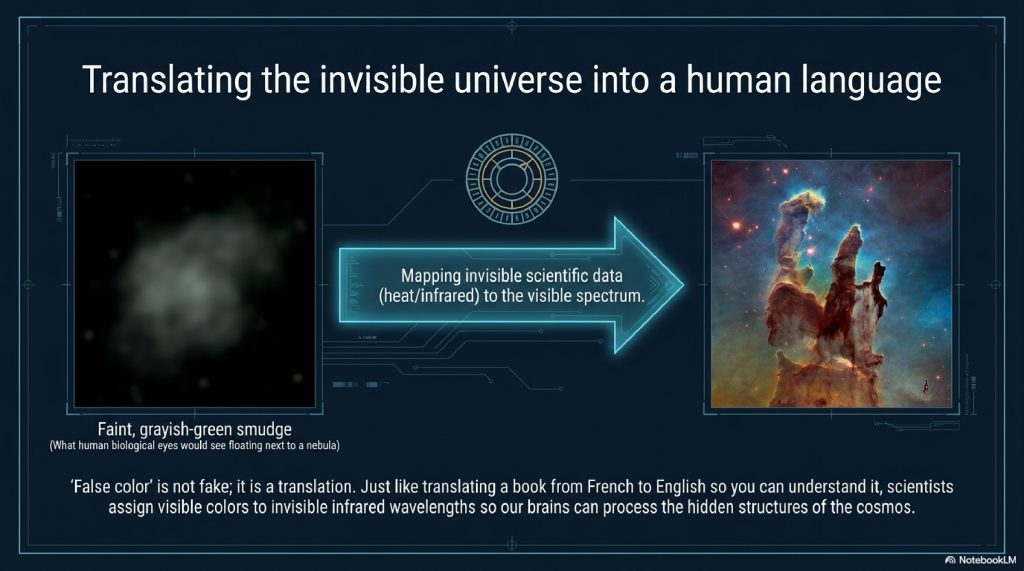
Sometimes, telescopes like James Webb capture light that is entirely invisible to the human eye, such as Infrared. Because we can’t see infrared, scientists have to “translate” it. They assign visible colors (like red, green, and blue) to different invisible wavelengths.
This is called a false-color image. It isn’t fake; it’s a translation. Just like translating a book from French to English so you can understand it, scientists translate infrared light into visible light so your eyes can see the hidden structures of the universe.
Explore how this process works below by adjusting the filters to combine different wavelengths of a galaxy.
The Advanced Layer: Redshift and the Power of Infrared
Why did we spend $10 billion to make the James Webb Space Telescope see in infrared instead of normal, visible light?
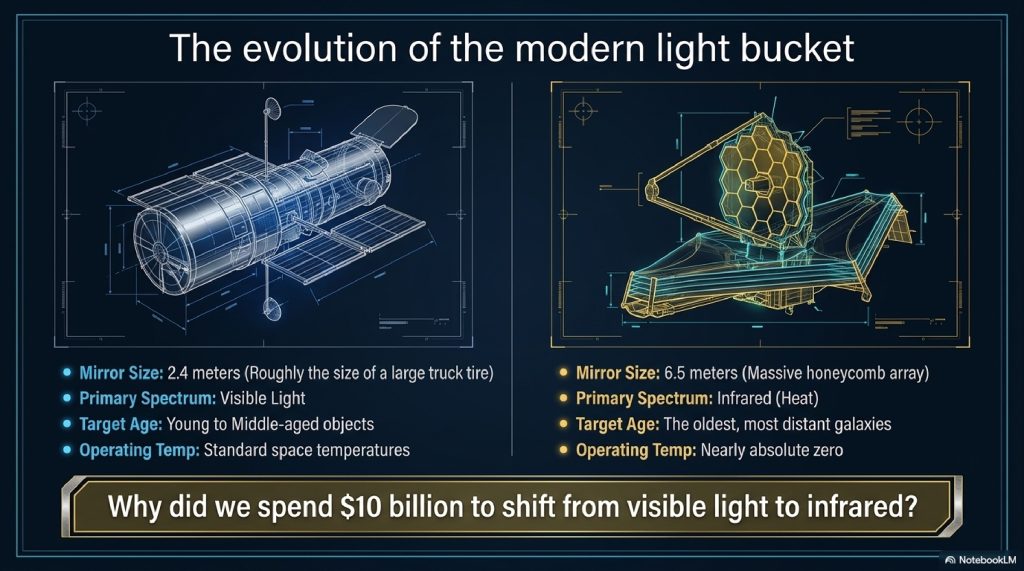
The answer lies in the expansion of the universe. As the universe expands, it stretches the very fabric of space. When light from the first galaxies travels through this expanding space for 13 billion years, the light waves themselves get stretched out.
Imagine a tightly coiled slinky being pulled apart. The light stretches from tight, visible wavelengths (like blue and green) into long, invisible wavelengths (infrared). This phenomenon is called Cosmological Redshift.
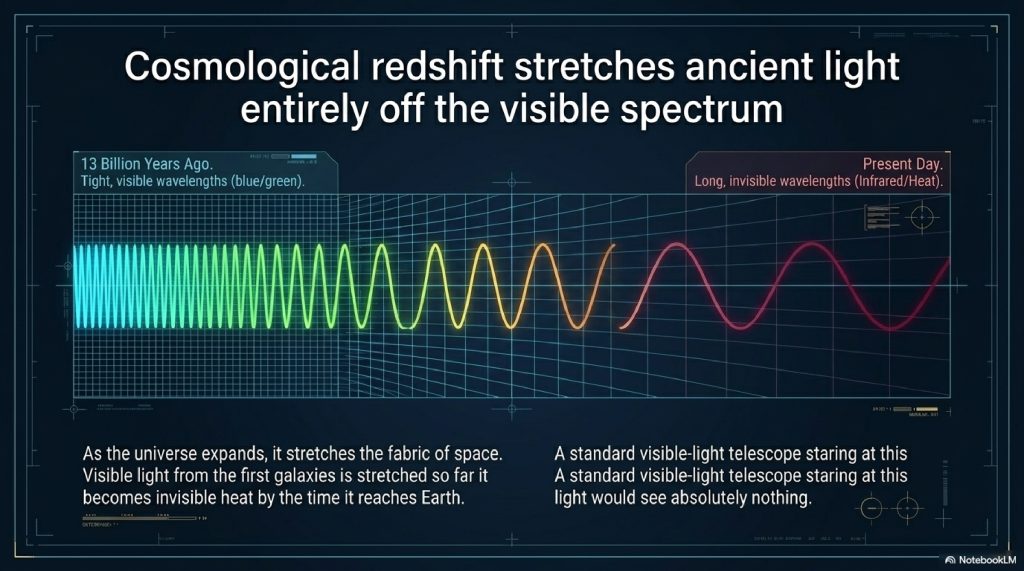
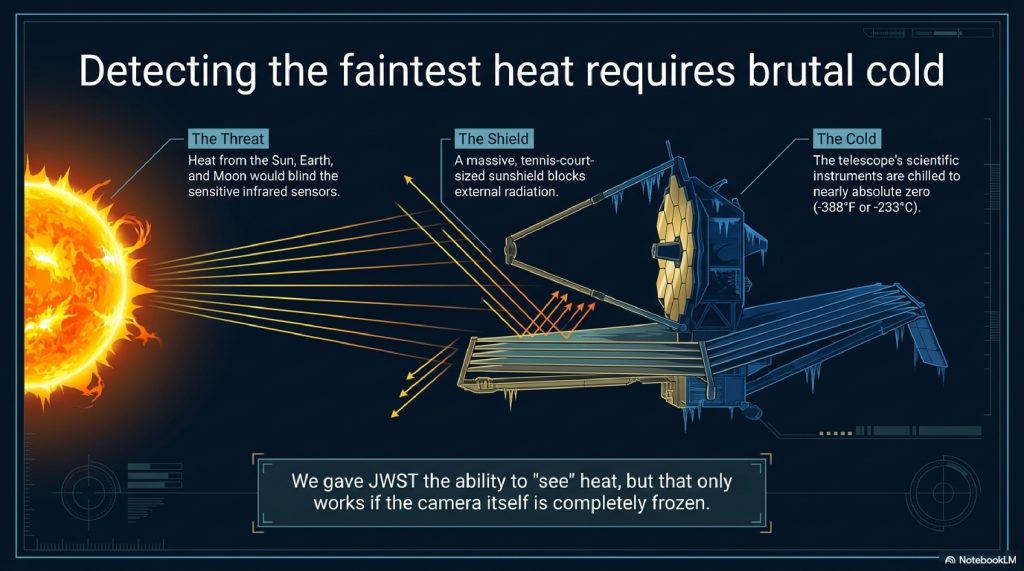
If you look at the oldest galaxies in the universe with a normal visible-light telescope like Hubble, you will see absolutely nothing. The light has stretched completely off the visible spectrum. By equipping JWST with infrared sensors, we gave it the ability to “see” heat.
However, to see the incredibly faint heat of a distant galaxy, the telescope itself must be kept brutally cold. This is why JWST features a massive, tennis-court-sized sunshield. It blocks the heat of the Sun, Earth, and Moon, chilling the telescope’s sensors to nearly absolute zero (-388°F or -233°C).
Common Myths About Space Photography
- Myth 1: The colors are “fake.” Truth: The colors are representative. They map real scientific data to colors our eyes can process. Without this translation, the images would either be completely black or just grayscale.
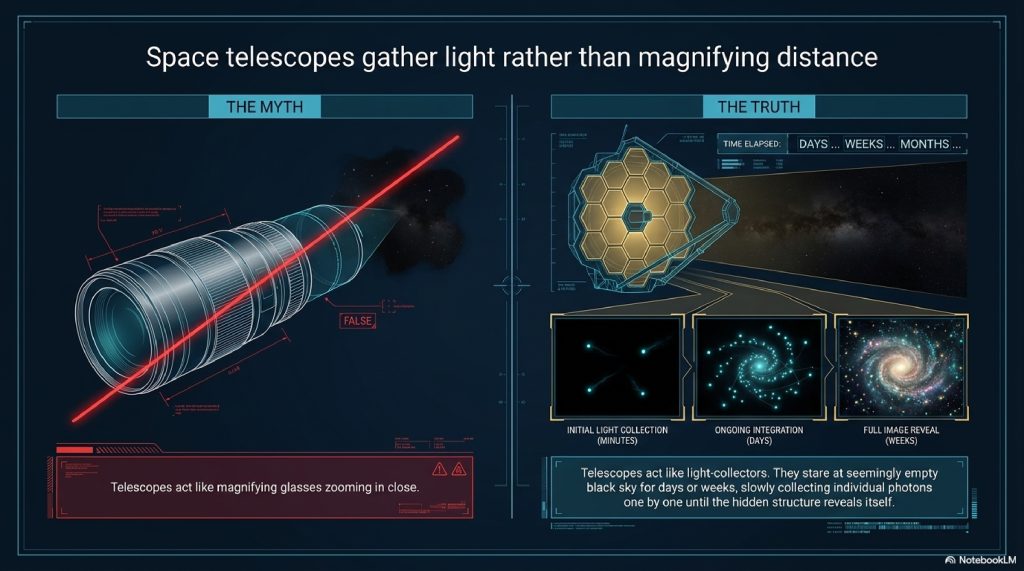
- Myth 2: Telescopes just “zoom in” really close. Truth: Telescopes don’t just magnify; they gather light. To photograph a distant galaxy, a telescope might stare at a single, seemingly empty patch of black sky for days or even weeks. It slowly collects individual photons one by one until the faint galaxy finally reveals itself.
- Myth 3: You could see these colors if you flew there in a spaceship. Truth: Human eyes are terrible at seeing faint light. If you floated right next to a nebula, it would likely look like a faint, grayish-green smudge. Telescopes collect light over long periods, revealing vibrant hues that our biological eyes could never perceive.
The Future of the Technology
The next generation of space telescopes will make today’s marvels look like toys.
Astronomers are currently designing concepts like the Habitable Worlds Observatory (HWO). This telescope will feature a mirror significantly larger than Webb’s, but designed specifically to hunt for signs of life (biosignatures) in the atmospheres of Earth-like planets orbiting other stars.
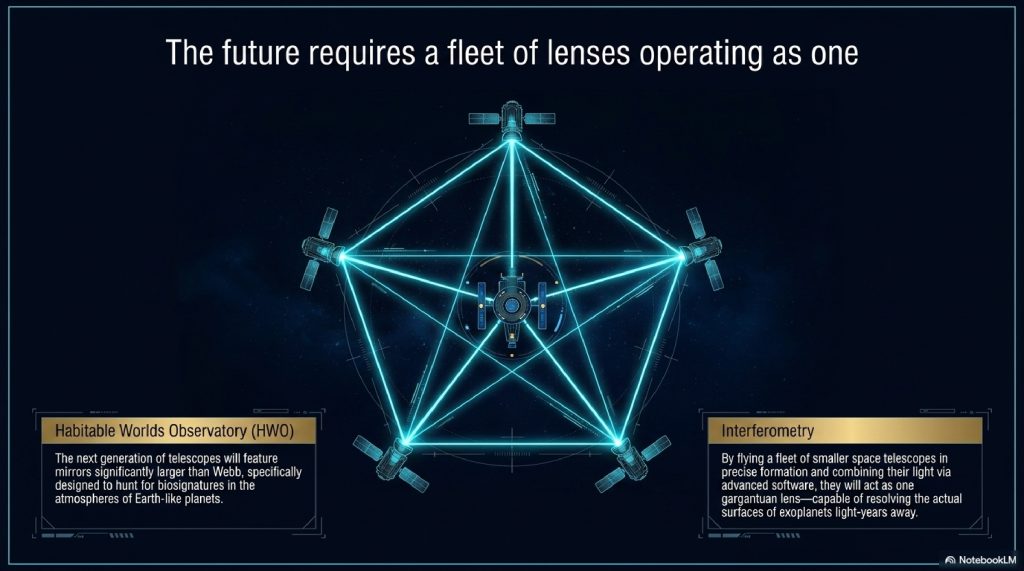
Furthermore, the future involves Interferometry flying a fleet of smaller space telescopes in a precise formation. By combining their light using advanced software, multiple small telescopes can act as one gargantuan lens, theoretically capable of resolving the actual surfaces of exoplanets light-years away.
FAQS
Do space telescopes take video?
No. They take long-exposure photographs. The cosmos moves so slowly from our perspective that a video would just look like a still image anyway.
Why do stars in Webb’s pictures have six spikes?
Those are called “diffraction spikes.” They are caused by light bending around the physical edges of the telescope’s hexagonal mirrors and the struts holding the secondary mirror in place. They are essentially optical artifacts.
How does the image data get back to Earth?
The telescope uses a high-gain radio antenna to beam the digital data across millions of miles to NASA’s Deep Space Network a collection of massive satellite dishes located in California, Spain, and Australia.
Can space telescopes see planets in other galaxies?
Not yet. We can barely see planets in our own galaxy! The distance between galaxies is too vast to resolve something as tiny and dim as an exoplanet.
How long does it take to capture one image?
It depends on how faint the object is. A bright planet like Jupiter might take minutes, while capturing a “Deep Field” of distant galaxies can require the telescope to stare at the exact same spot for hundreds of hours over several weeks.
INTERNAL LINK SUGGESTIONS
- How AI Detects Diseases in Medical Scans Explained
- How Water Treatment Plants Make Dirty Water Safe to Drink
- How Biometric Authentication Protects Your Phone & Bank
- How Spacecraft Communicate Across Millions of Kilometers
- How DNS Works: Translating Website Names into IP Addresses
CONCLUSION
When you look at a photograph of a distant galaxy, you aren’t just looking at a pretty picture. You are looking at a triumph of human ingenuity.
To create that image, humanity had to build a flawless, gold-plated mirror, strap it to a controlled explosion, shoot it a million miles into the freezing void, and use supercomputers to catch ancient light that has been traveling since the dawn of time.
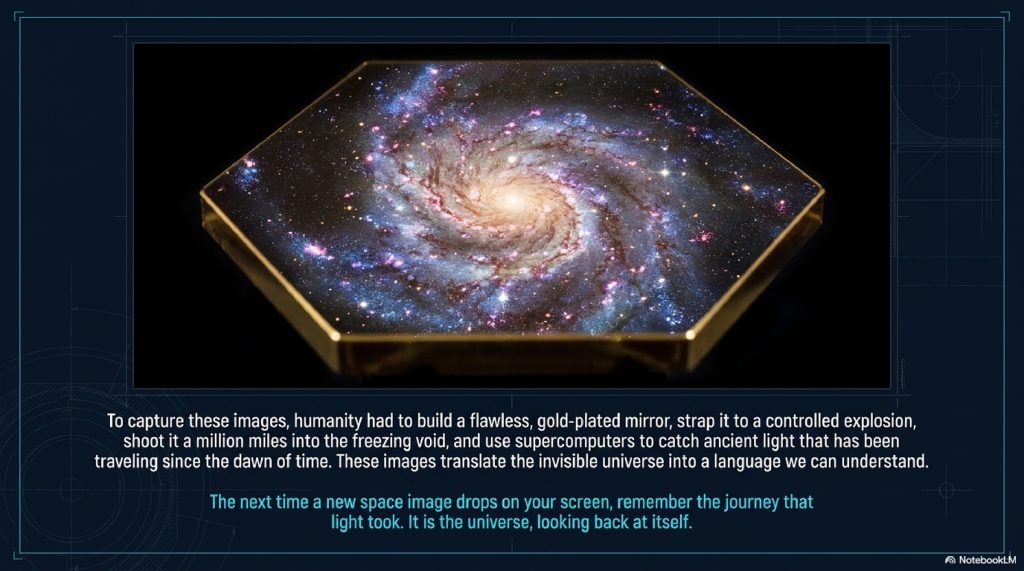
Space telescopes translate the invisible universe into a language we can understand. They remind us that the cosmos is vibrant, dynamic, and breathtakingly beautiful. The next time a new space image drops on your feed, remember the journey that light took to get to your screen, it is the universe, looking back at itself.